Exploring spring edible foam garden play using chickpea liquid and cream of tartar (6 months+)
Sensory Play
The adult places a wide tray on a non-slip mat and slides it to the centre of the floor. Two children sit close; one watches for a moment, then taps the foam with a fingertip and turns their hand to look at the smear. The adult says, “Soft,” and sets a folded cloth on the mat beside the tray. The second child presses a whole palm down, lifts it slowly, and drags a silicone spoon through the foam to make a long line while the adult stays nearby and quietly names, “Press… line… more on this side.”
Children explore a soft, edible foam that can be offered as a spring “garden” invitation. The experience focuses on touch, smell, and early cause-and-effect as children pat, smear, scoop, and watch the foam change. It can be a calm, shared sensory moment or a longer, child-led investigation depending on how children approach the materials.
Step-by-Step Guidance
1. Choose a wipe-clean floor space or a low table where the tray can stay stable. Place a non-slip mat or damp towel underneath.
2. Prepare the edible foam out of children’s reach using aquafaba and a small amount of cream of tartar, whisking until it holds soft peaks. Stop while it is still soft and spoonable rather than stiff.
3. Spoon the foam into a large shallow tray, leaving clear edges so children can rest hands without immediately touching the foam.
4. Bring the tray to the children and pause. Let them decide whether to look, reach, or wait.
5. If a child hesitates, model one simple action beside them (one slow fingertip press or a gentle pat), then move your hand away and give space.
6. Offer one or two small silicone spoons only if children begin to seek tools or if it helps reduce grabbing. Keep the tray as the main focus.
7. Stay close and narrate what you see in short phrases (e.g., “You’re pressing”, “It’s on your fingers”, “You made a line”). Avoid directing what to make.
8. If children start tasting, treat it as part of the edible invitation while watching closely for comfort and any signs of allergy or gagging. Offer a cloth for wiping when a child signals they want it.
9. End when interest drops or the foam becomes watery. Move the tray away, wipe hands and surfaces, and offer water to drink if appropriate.
Learning Objectives
This activity offers repeated chances to explore texture, temperature, and resistance through hands and fingers, linking to Physical Development. It also creates natural moments for Communication and Language as adults name what children notice and do. Children may begin to show preferences, persistence, and turn-taking around a shared tray, linking to Personal, Social and Emotional Development (PSED).
Adult Role
Stay emotionally attuned, especially for children who are unsure of messy textures. Offer closeness, a lap, or a clear “watching spot” without pushing contact. Model simple language that matches the child’s actions: “pat”, “squash”, “sticky”, “more”, “all done”, and reflect feelings neutrally: “You’re not sure yet.” Step in to scaffold only when a child is stuck (e.g., can’t access the tray, is overwhelmed, or is grabbing others’ hands), then step back again so the child leads. Observe how children approach new textures, how they manage residue on skin, and how they communicate needs. Hold responsibility for safe use of the whisked foam, supervise tasting closely, and manage hygiene and allergies.
Observation Cues
Does the child approach with fingertips first, then move to whole-hand contact?
Do they repeat a movement (patting, rubbing, scooping) and watch the foam change shape?
Do they pause to look at their hands or the tray after making a mark?
What sounds or words do they use (e.g., “more”, “yuck”, “soft”, “mine”), and do they copy adult words?
Do they tolerate residue on hands, or seek wiping quickly?
Do they watch others and then try the same action, or protect their space?
Time & Space
10–25 minutes, plus preparation and clean-up time.
Wipe-clean floor area or low table space for a large tray, with room for the adult to sit close and for easy clean-up.
Materials
Safety
Age adaptations
Budding Adventurers
Add a second empty tray or a shallow bowl beside the main tray so children can move foam between spaces without needing adult-led rules. Offer a small number of “garden” loose parts that are safe if mouthed (e.g., large cucumber chunks or big strawberry halves) only if you can supervise closely and manage choking risk; otherwise keep it foam-only. Support turn-taking by naming what you see (“You’re waiting”, “Now it’s your scoop”) and by keeping tools limited so sharing becomes visible.
Curious Investigators
Introduce a simple spring “garden” prompt through language rather than extra materials (e.g., “This looks like clouds over a garden”). Offer a small set of tools (spoon, spatula, small whisk) and invite children to notice changes as the foam warms and collapses. Add vocabulary that matches what they are doing (“smooth”, “fluffy”, “melting”, “mixing”) and follow their ideas if they begin role play or storytelling.
Confident Discoverers
Offer two batches with slightly different textures (one softer, one firmer) so children can compare by touch and talk about differences. Provide a simple way to record ideas nearby (paper and chunky pencils for drawing what they notice, kept away from the tray edge). Use open questions only when they are already investigating (“What do you notice about this one?”) and let children lead any “garden” narratives or sorting ideas they invent.
EYFS Links
Physical Development: children use hands and fingers to press, smear, scoop, and control force, which gives practice in fine motor movements and sensory feedback. Communication and Language: adults model simple, relevant words and children may respond with sounds, gestures, or words to request, refuse, or describe what they notice. Personal, Social and Emotional Development (PSED): children may practise approaching a new sensory experience at their own pace, signalling “all done”, and negotiating space and tools with others during shared tray play. Understanding the World: children notice change over time as the foam warms, collapses, or spreads, linking to early cause-and-effect.
Ethos adaptations
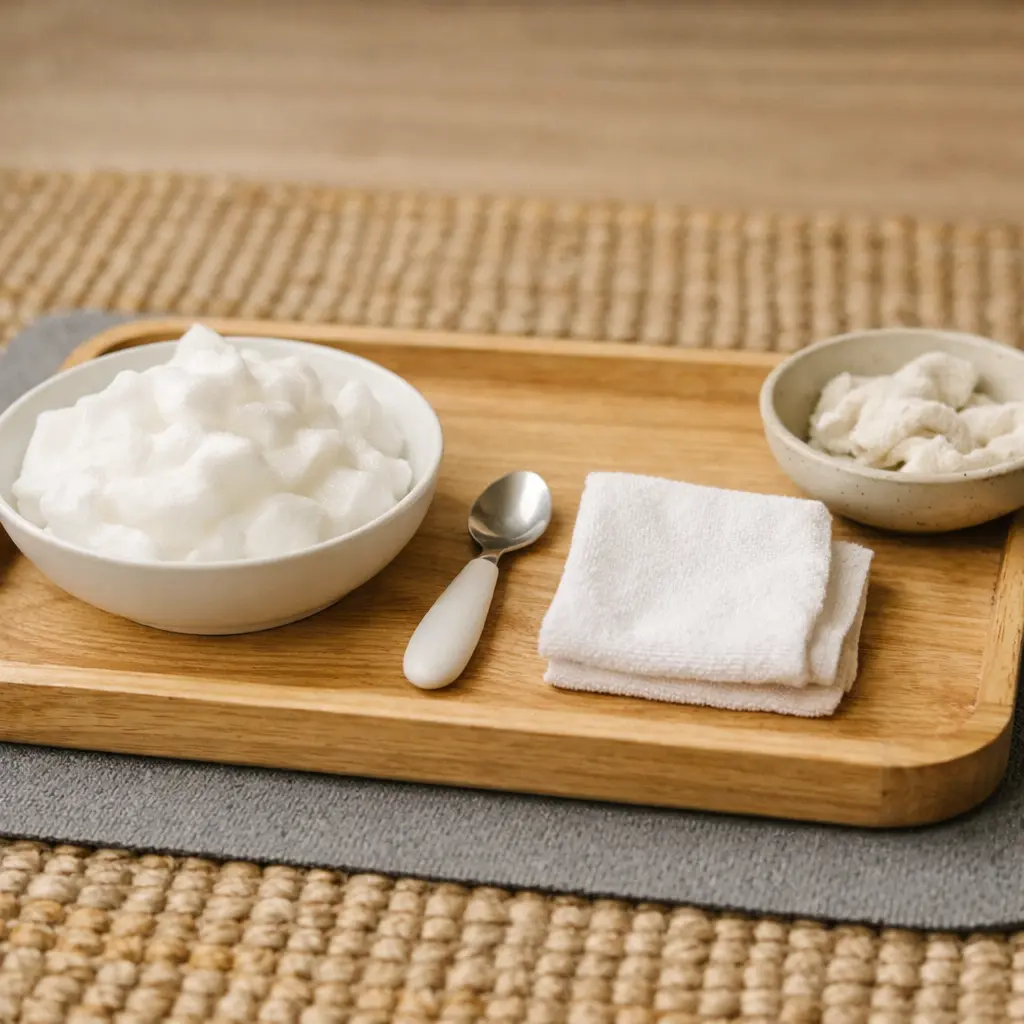
Present the foam on a small tray placed on a defined floor mat, with a clear left-to-right layout: bowl of foam, one child-sized spoon, and a folded wiping cloth. Limit the quantity so the child can see the whole workspace and the edges stay clean, and remove extra props so the main focus stays on controlled hand movement and pressure. Place a small waste bowl or plate beside the mat for used cloths so the child has a clear place to put them.
Demonstrate once with slow, precise movements and minimal words: touch, make one line, wipe, return the spoon to the same spot. Then sit slightly back and keep language to brief safety notes, choosing to pause rather than prompt if the child looks unsure. Decide when to intervene by using clear thresholds: steady the tray only if it shifts, replace the cloth only when it becomes too wet to wipe, and reduce the amount of foam only if it spreads beyond the tray edge. Observe repetition, careful pressure changes after the child sees the foam move, and whether the child returns the spoon and uses the cloth independently, and respond by simplifying the layout (fewer tools, smaller portion, clearer spacing) rather than adding new materials.
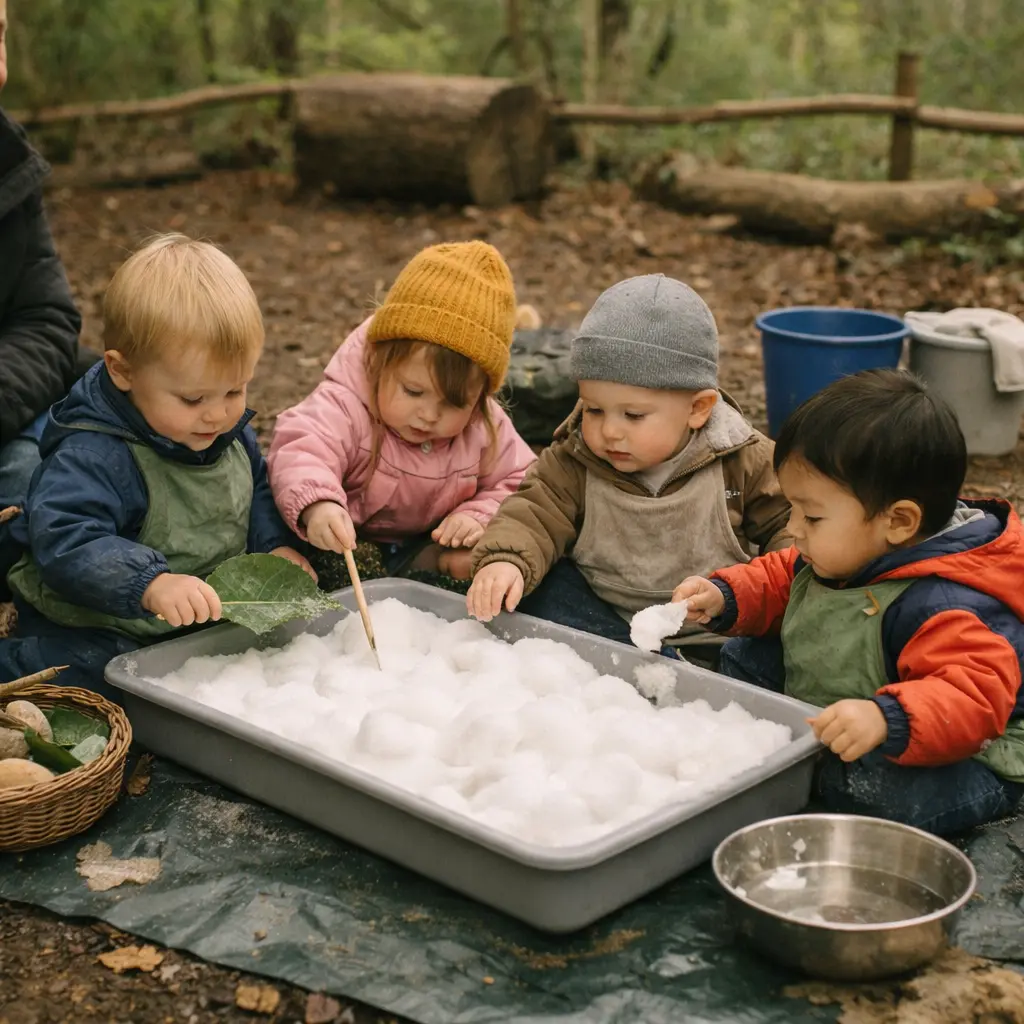
Set the foam on a groundsheet outdoors or in a sheltered outdoor area, choosing a spot with a clear boundary away from busy paths and checking the ground for hazards before children arrive. Provide a water bowl, a cloth, and a small bucket for used wipes at the edge of the space, and offer a separate basket of robust natural items such as broad leaves, smooth stones, and short sticks so children decide what to bring to the foam. Keep the foam container low and stable, and position it so children can kneel or squat without crowding.
The adult stays close enough to manage risk and makes deliberate decisions about when to intervene: they reposition the groundsheet if it becomes slippery, they limit the number of children at the tray if pushing starts, and they remove any natural item that begins to splinter or break into small pieces. The adult uses brief commentary rather than instructions (“cold wind”, “sticky on your fingers”) and waits for children to set the direction, noticing how they adapt when the foam changes outdoors. The adult responds to children’s cues by offering warm water for hands, suggesting a pause in a sheltered spot, or supporting turn-taking only when children cannot resolve it themselves.

Create a low “foam studio” with two connected work zones: a floor tray on a washable mat and a low table tray nearby, leaving a clear pathway between them so children can move materials and ideas. Arrange open-ended tools in small groups (spatulas, spoons, a small sieve, a brush) and place a basket of large tactile spring materials (broad leaves, big petals, smooth stones) within reach, with an empty space left intentionally for children to add their own found items or to clear an area for mixing. Set up a simple documentation area beside the studio with a clipboard, pen, and a place to put a few photos or quick sketches.
The adult chooses not to demonstrate a “right way” and instead listens for children’s theories, using reflective language (“I can see you’re testing how it spreads”, “You’re comparing fluffy and watery”). The adult decides when to add or remove a tool based on children’s actions, offering a sieve only when a child starts sprinkling or separating, and stepping back when children begin collaborating. The adult watches for repeated experiments, negotiation of roles, and moments where children change their plan, and responds by recording key phrases, returning children’s words back to the group, and adjusting the environment (for example, moving the second tray closer if children start carrying foam across the room).

Lay a neutral cloth on the floor and place a single wooden or metal bowl of edible foam on it, with one small wooden spoon and a folded cotton cloth for wiping. Keep the surrounding area uncluttered and quiet, and offer only one natural item if added at all, such as a broad leaf placed beside the bowl. Keep a second cloth and a small jug of water just outside the cloth boundary so the space stays calm and contained.
The adult begins with a calm, unhurried demonstration of one gentle stir and one slow hand press, then becomes mostly silent and present. The adult makes clear decisions about rhythm: they allow long stretches of repetition, they pause the activity for a simple wipe-and-breathe moment if a child looks overwhelmed, and they end by tidying slowly with the child watching or joining in. The adult observes for signs of discomfort with residue, over-excitement, or crowding, and responds by offering the cloth, widening the space between children, or quietly moving the bowl closer to the child who is working steadily.