Exploring soft water books in a shaded outdoor spot using touch and relative language
Sensory Play
Communication and Language
Literacy
Two children settle on the mat in the shade while an adult places a small basket of soft water books beside them. One child squeezes a book and rubs a bumpy patch with their thumb; the adult says, “bumpy,” and waits. The other child opens a different book and pats the page, then holds both books up as if comparing; the adult adds, “This one feels smoother.” A baby nearby mouths the corner of a book, and the adult shifts closer, keeping the book steady while the baby presses the page again.
Children explore soft, squishy water books in a shaded outdoor spot, noticing how each one feels in their hands. The experience invites close looking, turning pages, and repeated touching as children compare textures and features. Adults tune in to children’s focus and add simple relative words that match what children are already doing and noticing.
Step-by-Step Guidance
1. Choose a shaded outdoor spot with comfortable ground and low foot traffic. Place a mat or blanket to define the book area.
2. Put a small number of soft water books into a shallow basket or tray so children can see the covers and choose independently.
3. Sit nearby at the child’s level and allow children to approach, pick up, mouth, squeeze, or open the books in their own way.
4. As children touch and explore, model short relative words that match the moment: “smooth”, “bumpy”, “softer”, “bigger”, “same”, “different”. Keep language concrete and linked to what the child is doing.
5. When a child compares two books (or two pages), reflect the comparison without testing: “This one feels rough. That one feels smooth.”
6. If children begin to share, support turn-taking with simple phrases and waiting: “You’re holding it. Now it’s Sam’s turn.”
7. Follow children’s attention across pages. If interest drops, keep the books available and let children move away and return.
8. End by gathering the books back into the basket with the children who are still nearby, naming what you are doing: “Books in. All finished for now.”
Learning Objectives
Within Communication and Language, children may build understanding and use of relative language as they compare what they can feel and see (for example, rough/smooth, bumpy/flat, heavy/light). Within Literacy, children may handle books, explore pages, and begin to notice that books can be shared, revisited, and talked about. Within Physical Development, children may practise grasping, turning, pressing, and coordinating both hands while exploring the books.
Adult Role
Stay emotionally attuned by joining the child’s pace and noticing when they want closeness, space, or shared attention. Model relative language in short phrases that describe what the child can feel and see, rather than asking lots of questions. Scaffold lightly by holding a book steady, offering one page edge to start a turn, or placing two books side-by-side for an easy comparison, then step back once the child continues independently. Observe how the child explores (pressing, rubbing, turning, comparing) and adjust your input to match their focus. Hold responsibility for safety by checking books for damage, supervising mouthing, and keeping the shaded area comfortable and calm.
Observation Cues
Child repeatedly presses or rubs a page, then pauses as if noticing a change in texture.
Child chooses one book over another and brings it back again, suggesting preference or a developing comparison.
Child looks to the adult after touching a feature, as if inviting a label or shared attention.
Child uses or echoes relative words (big/small, soft/hard, wet/dry, same/different) during play.
Child turns pages in different ways (pinching, whole-hand swipe) and adjusts grip when pages stick or flop.
Two children gather around one book and negotiate turns, pointing to the same feature.
Time & Space
10–25 minutes, with children dipping in and out.
A shaded outdoor area with a defined ground space for a mat or blanket, plus room for children to move in and out of the book area.
Materials
Safety
Age adaptations
Budding Adventurers
Offer pairs of books with clear contrasts (very bumpy/very smooth; thicker/thinner) so children can compare without needing adult direction. Add a few relative words that fit their play: “heavier”, “lighter”, “longer”, “shorter”, “different”. If a child starts to “read” by talking through pages, mirror their phrasing and add one descriptive comparison at a time. Keep the shaded space defined so children can return to the books after moving around outdoors.
Curious Investigators
Include a wider range of textures and page features and keep books visible on the mat so children can sort or group them. Use richer comparative language in context: “rougher than”, “the smoothest”, “similar”, “not the same”. If children begin to talk together, support shared attention by repeating a child’s observation and adding one more detail: “You noticed bumps. These bumps feel bigger on this page.” Allow children to lead how the books are used, including making up stories from pictures.
Confident Discoverers
Provide several water books and enough space for children to lay them open side-by-side for comparison. Introduce precise relative language only when it fits: “thicker”, “thinner”, “more textured”, “less bumpy”, “almost the same”. Invite children to explain their choices in their own words and reflect back their comparisons. If children create their own sorting rules (by feel, size, favourite), stay with their system and help them find words for it without correcting.
EYFS Links
Communication and Language: adults add simple descriptive and comparative words in the moment, helping children connect language to what they can feel and see. Literacy: children handle books, explore pages, and experience shared book talk without needing a fixed story time structure. Physical Development: children practise grasping, squeezing, turning pages, and coordinating both hands while managing different textures and flexible pages. Personal, Social and Emotional Development: when books are shared, children practise waiting, turn-taking, and staying with a calm shared focus with adult support.
Ethos adaptations
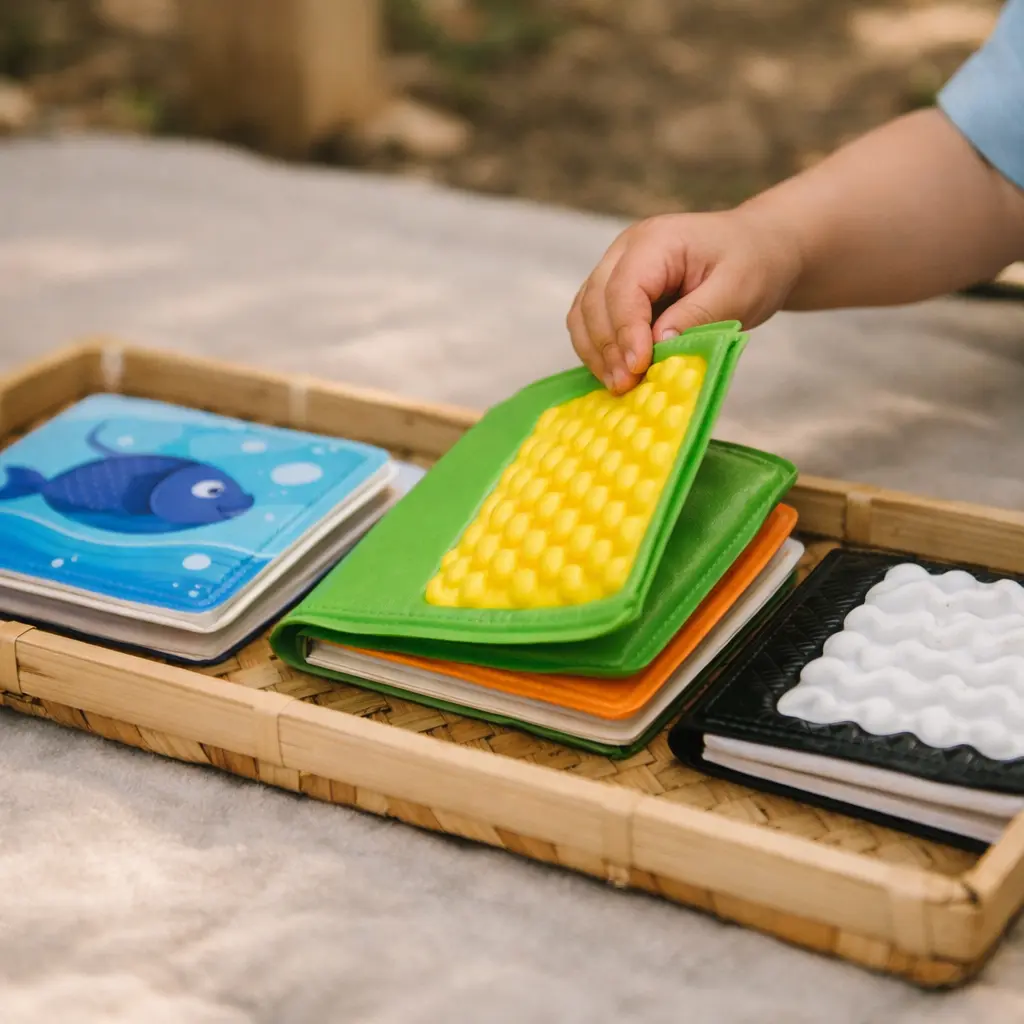
Place a small number of soft water books on a low tray on the mat, arranged left-to-right with covers facing up, and remove any extra items from the area so the choice is clear. Select books that isolate one main contrast (for example, one very smooth and one very bumpy) so the comparison is visible through touch. Keep the shaded space consistent and uncluttered so children can return to the same materials and repeat exploration.
Show one slow, silent action—pick up a book, open it, turn one page, close it, return it to the tray—then step back and allow uninterrupted handling. Use minimal language, offering a single label only when the child pauses on a texture (“bumpy”) rather than narrating continuously. Observe for concentration, repetition of the same page turn, careful control of grip, and moments where the child self-corrects by adjusting hands to manage floppy pages.
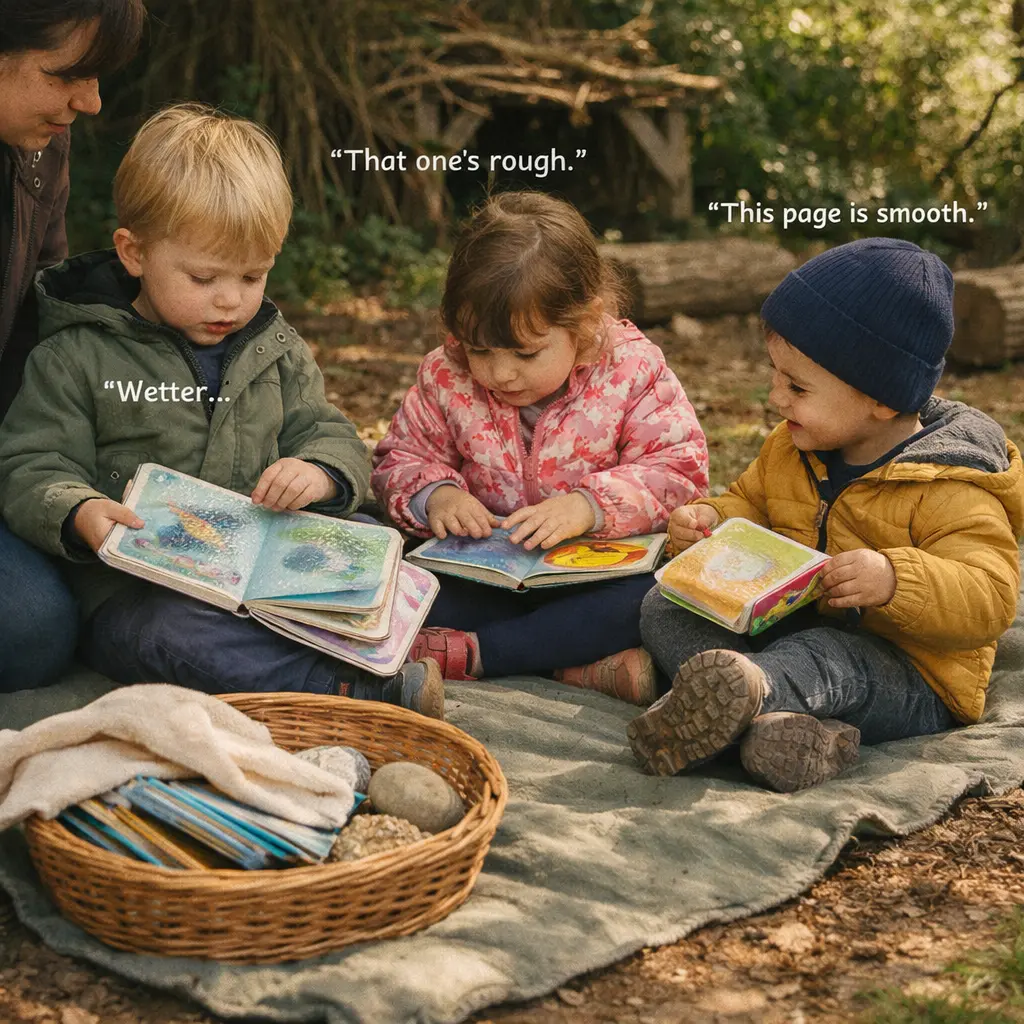
Set up in a sheltered shaded outdoor spot where children can sit on the ground and move freely between the book area and nearby natural features. Place the water books in a simple basket alongside a few safe natural items that echo the textures children notice (for example, a smooth stone and a piece of bark), without arranging them into a fixed task. Allow the outdoor conditions to be part of the experience, such as a light breeze turning pages or damp grass under the mat edge.
The adult stays close enough to manage risk and comfort, but avoids directing how children compare. Use brief, responsive language that follows the child’s attention: “rough”, “smooth”, “wetter”, “drier”, “heavier”. Observe how children choose where to sit, whether they bring books to a friend, and how they adapt when pages flap or surfaces feel different outdoors, stepping in mainly to support safe sharing and to keep the shaded base comfortable.

Create a clear invitation in the shaded area by arranging the mat as a small “book studio” with books opened to different pages, spaced so children can approach from more than one side. Add a low surface (an upturned crate or small table) so some books can be explored at standing height, and leave space for children to place books side-by-side for their own comparisons. Keep the basket nearby but not central, so the environment itself suggests browsing, returning, and grouping.
The adult listens and comments as a co-explorer, using language that extends children’s theories: “I can see you’re choosing the bumpiest page”, “You’re putting the smooth ones together”, “What happens if you press harder?” The adult follows children’s decisions about sorting, storytelling, or sharing, and documents key moments with a quick note or photo for later reflection with the child. Observe how children negotiate meaning together—pointing, repeating words, changing categories—and respond by offering one new comparative word only when it fits their shared focus.

Choose a quiet shaded spot and lay a plain cloth or mat to create a calm, contained book area, with only a few soft water books placed neatly to one side. Keep colours and surrounding items simple, and place the basket out of the main space so the cloth stays uncluttered and predictable. Bring the same books out and return them to the same place each time, so the flow stays steady.
The adult sits nearby as a calm anchor and demonstrates one gentle sequence without commentary: open, slow page turn, soft press, close, return. The adult keeps language sparse and warm, offering a few true-to-touch words only when the child pauses (“soft”, “rough”, “smooth”, “same”), and avoids questioning. The adult watches for children repeating the same page or movement and responds by allowing long repetition, stepping in mainly to steady a book, slow a rushed hand, or support a quiet handover when two children reach for the same book.