Exploring soft summer textured board books in a shady spot using relative language
Communication and Language
Literacy
Sensory Play
Two children sit on the blanket with a low basket between them. One child presses a thumb into a crinkly patch and then holds the book out; the adult leans in and says, “That feels rougher,” and lets the child pull the book back. Nearby, another child opens a thicker book and pats the cover twice, then places it next to a smaller one as if checking the size. The adult turns a single page slowly, stops, and watches while the children trace the pictures with their fingertips.
Children explore a small selection of soft, squishy, textured board books in a shady outdoor spot. The focus is on noticing differences and similarities through touch and looking closely, with adults offering simple relative words as children handle the books. The experience suits short, repeated visits, with children choosing which book to return to and how to explore it.
Step-by-Step Guidance
1. Choose a shady, calm spot outdoors and place a blanket or mat to define the book area.
2. Put a small number of textured board books in a low basket or shallow tray so covers are visible and children can choose independently.
3. Sit nearby at the child’s level and allow children to pick up, squeeze, pat, mouth, or open books in their own way.
4. Model gentle book handling with one book: hold it, turn one page slowly, and pause so the child can take over.
5. Use short, concrete relative language linked to what the child is doing: “softer”, “squishier”, “rougher”, “bumpier”, “bigger”, “smaller”, “same”, “different”, “more”, “less”.
6. When a child moves between books, name the comparison without testing: “This one feels rougher than that one.”
7. Follow the child’s focus. If they fixate on one texture, stay with that and repeat the same words consistently.
8. Offer simple choices only when needed to reduce frustration: “This book or that book?” then wait.
9. End with a calm tidy routine: invite children to place books back in the basket, then move the basket out of reach if the group is transitioning.
Learning Objectives
In Communication and Language, children may build understanding of simple descriptive and relative words as an adult names what is being felt and seen. In Literacy, children may develop early book-handling behaviours, such as turning pages, looking at pictures, and choosing a book to revisit. In Physical Development, children may practise grasp, page turning, and controlled squeezing as they explore different textures.
Adult Role
Stay emotionally attuned by noticing when a child wants closeness, space, or a pause, and respond with a calm presence and predictable tone. Model language by naming what the child is touching and comparing, using short phrases and repeating the same relative words so they become familiar. Scaffold lightly when a child is stuck (e.g., help separate pages, steady the book), then step back as soon as the child can continue. Observe how each child explores books (mouthing, squeezing, page turning, pointing) and adjust the number of books and the adult’s distance to protect concentration. Hold responsibility for safety by checking the area is shaded and comfortable, supervising mouthing closely, and removing any book that becomes damaged or has loose parts.
Observation Cues
Child repeatedly returns to one book or one texture and explores it in the same way (squeezing, rubbing, tapping). Child compares two books by holding them side by side or swapping hands, then pauses as if deciding. Child responds to relative words with an action (chooses the “softer” one, finds the “bumpy” page, looks for “bigger” pictures). Child uses their own sounds or words to label differences (e.g., “soft”, “more”, “this”). Child turns pages with increasing control, using fingertips rather than whole-hand grabbing. Child offers a book to an adult or peer, watching their reaction.
Time & Space
5–20 minutes, with the option to revisit daily in short bursts.
A shady outdoor spot with enough room for a small mat/blanket and 2–6 children to sit or lie comfortably around the books.
Materials
Safety
Age adaptations
Budding Adventurers
Include books with clearer contrasting textures (very bumpy/very smooth) and a couple with different sizes or thicknesses for “heavier/lighter” handling. The adult offers brief two-choice prompts when helpful (“rougher or smoother?”) and accepts non-verbal answers such as tapping the chosen page. Children may begin to “read” to the adult; the adult echoes their words and adds one relative word at a time to keep language manageable.
Curious Investigators
Add a small “compare spot” on the mat (a marked space or second cloth) where children can place two books side by side. The adult models comparative sentences (“This cover is softer than that cover”) and introduces “most/least” only when children are already comparing. Children can take turns choosing a page for the group to feel, while the adult keeps the focus on describing and comparing rather than quizzing.
Confident Discoverers
Offer a slightly wider range of textures and book formats (still robust) and invite children to sort books on the mat by a chosen idea (softest to roughest, biggest to smallest) if they show interest. The adult uses richer relative language (“similar”, “different”, “almost the same”, “much rougher”) and encourages children to explain their choices in their own words. Children may create simple “recommendations” for peers (“If you like bumpy, try this one”), with the adult reflecting back their comparisons.
EYFS Links
Communication and Language: adults model and repeat simple descriptive and comparative words linked to what children are touching and choosing, supporting understanding through real-time experience. Literacy: children handle books, turn pages, look at pictures, and begin to treat books as objects for shared attention with an adult. Physical Development: children practise grasping, controlled squeezing, and page turning, building hand strength and coordination through repeated, self-chosen actions. Personal, Social and Emotional Development: children may practise sharing space and materials, offering a book to an adult or peer, and returning to a familiar book for comfort and regulation.
Ethos adaptations

Place two or three textured board books on a small tray on a low mat, arranged left to right with covers facing up, and keep all other books out of sight. Choose one clear contrast set (for example: very smooth, very bumpy, very squishy) and remove books with extra flaps or sounds so the child can focus on touch and page turning. Keep the tray in the same position each time and leave a clear return space so the child can replace each book independently.
The adult decides to give one slow, mostly silent presentation, then withdraws to the side rather than sitting opposite the child. The adult decides to use only a small set of repeated words that match the child’s hands (“smooth”, “rough”, “softer”) and avoids questions or praise that pulls attention away from the materials. The adult decides to intervene only for specific reasons: to steady the spine for one page turn, to show how to return a book to the tray, or to remove a damaged book. The adult watches for repetition, careful grip changes that show self-correction, and long pauses that suggest concentration, and responds by reducing talk and keeping the space uninterrupted.

In a sheltered shady outdoor area, set the books on a groundsheet near natural textures such as bark, grass, and smooth stones so children can move between book textures and the environment. Provide fewer adult-defined boundaries: the basket sits open, and children can choose to sit, lie down, or carry a book to a nearby spot. Keep the selection robust and wipeable so the books can cope with outdoor handling and occasional damp.
The adult stays close enough to manage risk (uneven ground, children walking with books) and uses short observational language rather than directing how to explore. Children may compare a “bumpy” page to tree bark or a “smooth” page to a stone, and the adult responds to their comparisons with simple relative words and pauses. The adult notices when children seek challenge (balancing a book on a knee, turning pages in wind) and supports safety without taking over, allowing repeated returns to the same book across sessions.

Create a clear book invitation by spreading a large cloth as the shared reading floor, with books opened to different pages so children can enter from multiple starting points. Place a second smaller cloth nearby as a “touch and compare” space, and add a low mirror or reflective tray at the edge so children can see their hands and the textures as they move. Keep a simple documentation station in the environment (clipboard, pen, sticky notes) positioned where the adult can write without leaving the group.
The adult decides not to demonstrate first, and instead waits to see which books children choose and how they organise themselves around the cloths. The adult decides to use co-researcher language that follows children’s ideas (“I can see you’re lining them up,” “You’re testing with one finger,” “What happens if the pages touch?”) rather than steering towards a correct comparison. The adult decides when to step in for collaboration, for example by offering an extra open space on the compare cloth or by naming a turn-taking problem neutrally (“Two hands on the same page”). The adult watches for children’s theories (sorting by feel, matching pictures, repeating one texture), and responds by recording a short quote or sketch and then bringing it back into the moment (“You said ‘this is the roughest’—shall I write that next to it?”).
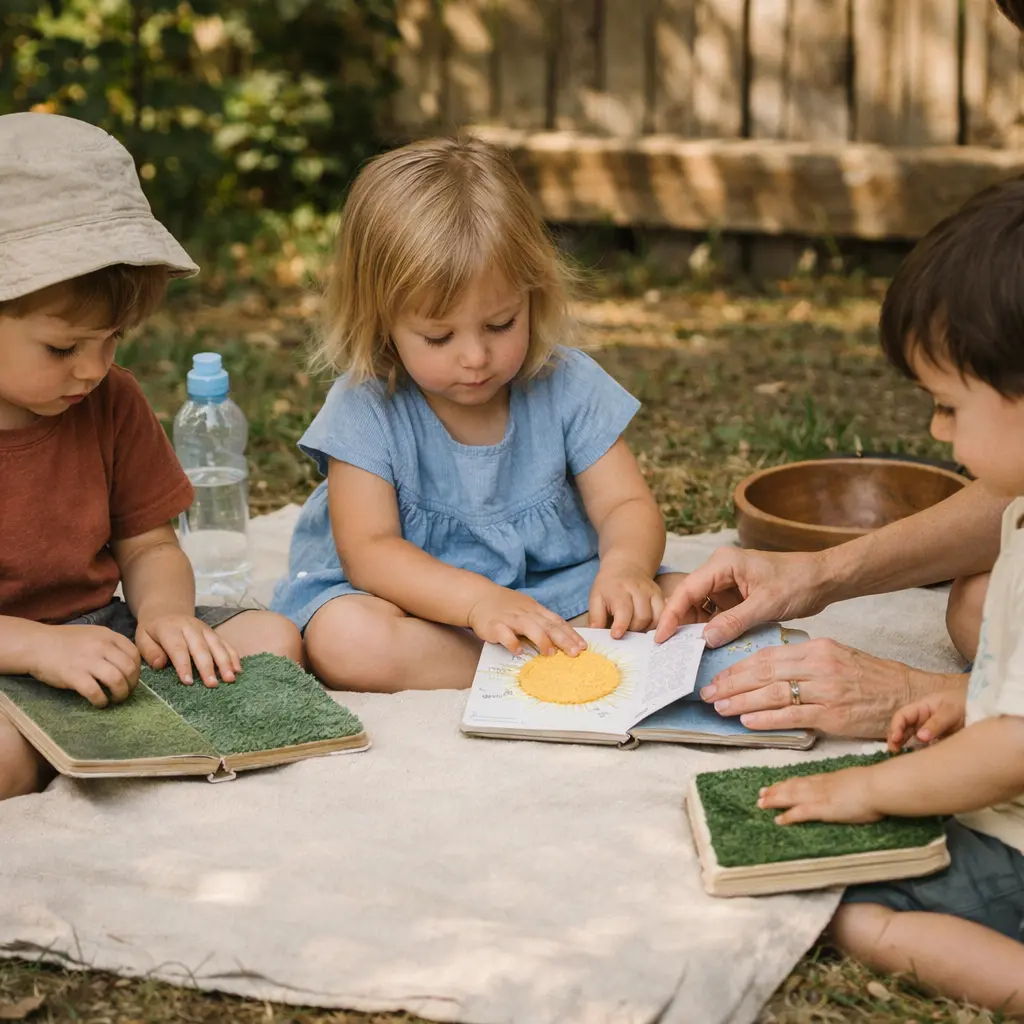
Lay a plain cotton cloth in a shady spot and place only two or three soft board books on it, chosen for calm colours and simple, natural-feeling textures. Keep the space uncluttered by storing spare books out of view and placing a small wooden bowl at the edge as the return place for finished books. Keep the flow predictable: books arrive on the cloth, children explore, then books return to the bowl before moving on.
The adult decides to model with hands rather than instructions, slowly turning one page and stroking one texture, then pausing so children can imitate in their own time. The adult decides to keep language minimal and rhythmic, repeating a small set of comparative words in a steady tone (“soft… softer”, “rough… rougher”) and allowing quiet gaps. The adult decides when to step in only for care and safety: to repair a bent page, to place a book back on the cloth if it is thrown, or to sit closer if a child needs calm support. The adult watches for children settling into repeated touch and slower movements, and responds by keeping the pace unhurried and the materials consistent.