Exploring soft balls in a washing basket ball pit for babies and young toddlers (6 months to walkers)
Sensory Play
Communication and Language
An adult sits on the floor with a washing basket on a non-slip mat, keeping one hand lightly on the rim as a toddler steps closer. The toddler drops a soft ball into the basket, then leans in to press both hands down on the pile and listen to the muffled squeak. A baby inside the basket pats a ball against their thigh and watches it wobble away; the adult says, “roll,” and waits. When a ball slips out through the side, the toddler retrieves it and holds it up; the adult nods and says, “in,” as the toddler posts it back through the top.
This activity uses a washing basket filled with soft balls to create a contained space for babies and young toddlers to explore with their whole body. Children often spend time feeling textures, shifting their weight, and moving balls in and out of the basket in repeated ways. The basket boundary can help some children focus, while still allowing plenty of choice and variation in how they play.
Step-by-Step Guidance
1. Check the washing basket for cracks, sharp edges, or rough plastic. Choose a clear floor space away from furniture corners.
2. Place a non-slip mat or a folded towel under the basket so it does not slide when the child shifts their weight.
3. Add a small number of soft balls first so the child has room to sit and move. Keep extra balls nearby to add later if needed.
4. Sit close, at the child’s level. For a baby, support them into sitting inside the basket, keeping one hand ready at their trunk if they are still unsteady.
5. Pause and let the child explore. Allow time for touching, mouthing, squeezing, and looking before adding any new prompts.
6. If the child begins to throw or drop balls out, keep the flow going by calmly returning one or two balls at a time, naming what you see: “out… in.”
7. For a child who is pulling to stand or cruising, position yourself so you can steady the basket and offer a hand if they choose to step in and out.
8. Adjust the level of challenge by changing the number of balls (more for deeper sensory pressure, fewer for easier movement) and by placing a few balls just outside the basket to invite reaching.
9. End with a clear transition. Help the child climb out or lift them out, then invite them to put a few balls back into the basket with you before moving on.
Learning Objectives
In Physical Development, children may practise grasping, releasing, reaching, and turning their body as they handle balls and adjust their position in the basket. In Communication and Language, children may attend to simple words and gestures linked to what they are doing, such as “in”, “out”, “more”, and “stop”. In PSED, children may build confidence with a familiar adult close by as they try new movements and tolerate small changes in balance and space.
Adult Role
Stay physically close and emotionally steady, especially for babies who are still developing balance. Use calm, simple language that matches the child’s actions, such as “in”, “out”, “roll”, “throw”, “stop”, and “again”, and leave space for the child to respond with sounds, looks, or movement. Step back when the child is absorbed in repeating an action, and scaffold only when they show they need help, such as getting stuck, tipping, or becoming frustrated. Observe how the child uses their hands, how they manage their body in a contained space, and what patterns they repeat, then adjust the number of balls or your proximity to keep the play safe and comfortable. Take responsibility for safety by stabilising the basket, monitoring mouthing, and stopping the activity if the child attempts to climb in a way that could lead to a fall.
Observation Cues
Does the child use one hand or two hands to grasp and release the balls?
Do they repeat a pattern such as throwing out, watching, then reaching for another?
Do they shift position to reach a ball at the side or behind them?
Do they show preferences for certain textures, sizes, or colours of ball?
Do they communicate “more”, “again”, “no”, or “help” through sounds, signs, eye contact, or reaching?
Do they begin to anticipate “in/out” games, pausing to watch the adult’s response?
Time & Space
10–20 minutes, with a shorter window for younger babies depending on comfort and attention.
A clear floor area indoors with space around the basket for balls to land and for the adult to sit close (about 2 x 2 metres).
Materials
Safety
Age adaptations
Budding Adventurers
Leave the basket as a “home base” and let the child choose whether to sit in it, stand beside it, or step in and out. Offer a simple challenge such as collecting balls that have rolled away and returning them to the basket, without making it a race. Use positional language the child can act on, like “next to”, “behind”, and “under your foot”, and notice any repeated transporting or throwing patterns.
Curious Investigators
Place two washing baskets a short distance apart and offer a low wooden plank or sturdy cardboard ramp for rolling. Provide balls of two distinct colours so children can plan "which basket" before they release. Step back to let pairs negotiate turns and predict speed, commenting on what you notice: “That red one zoomed down fast.” Stay ready to steady the ramp or remind about safe spacing as movement becomes energetic.
Confident Discoverers
Create a mini “delivery challenge”: position the basket at the end of a marked pathway made with floor tape or rope loops. Give each child a small cloth bag to collect balls from around the room and transport them while balancing along the path. Offer clipboards with simple tally marks so children can record how many deliveries they make. Observe how they organise routes and manage balance, stepping in only to recalibrate the pathway or support fair turn-taking.
EYFS Links
Physical Development: children may practise grasping, releasing, reaching, and shifting their weight as they handle balls and move in a contained space. Communication and Language: the adult can model simple, repeated words linked to action (“in”, “out”, “more”, “stop”), supporting understanding through consistent timing and gesture. PSED: a nearby, responsive adult can help children feel secure as they explore new sensations and small balance challenges, and as they manage brief frustrations such as a ball rolling out of reach.
Ethos adaptations
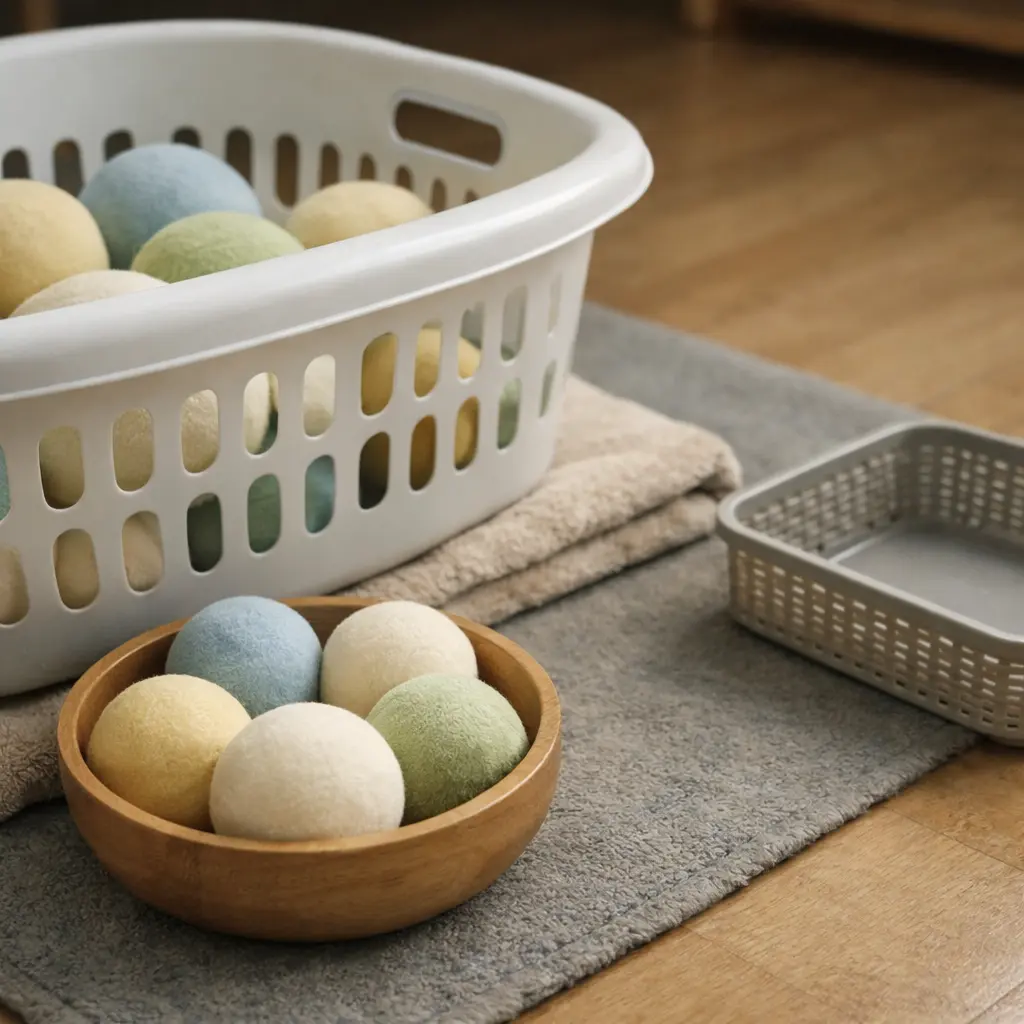
Place the washing basket on a defined mat and present a limited set of identical soft balls (for example, 6–8) in a small bowl beside it, with one second container placed to the right. Keep the area uncluttered and at floor level so the child can reach, carry, and return items independently, and remove extra toys so the main action stays clear.
The adult demonstrates the sequence once with slow, precise movements and minimal words, then sits back slightly to the side rather than facing the child. The adult decides to return only balls that roll beyond the child’s reach, and to steady the basket only if it shifts, so the child can manage most of the work. The adult watches for repetition, careful release, and self-correction (adjusting grip after a slip, changing hand position to reach), and offers a brief re-demonstration only if the child pauses and looks for help.
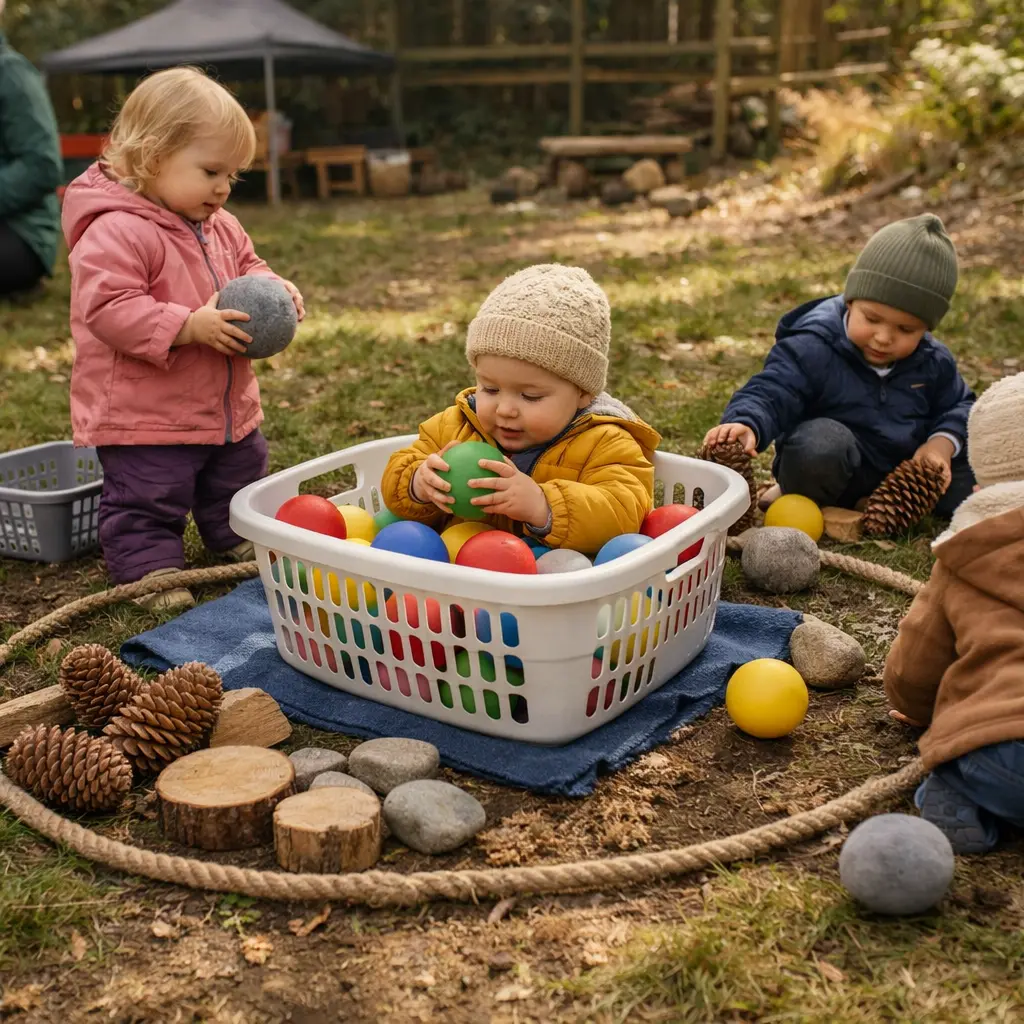
Set the basket on a sheltered outdoor surface such as grass, rubber matting, or a tarp, and use a rope circle or a line of sticks to mark a clear “throwing and carrying” boundary. Offer the soft balls alongside a small number of large natural loose parts that are too big to mouth (for example, big pine cones, smooth palm-sized stones, or short log rounds), keeping them in an open pile so children choose what to pick up and where to place it.
Before children begin, the adult decides to scan the ground for hazards (holes, sharp litter, slippery patches) and to reposition the basket if the surface feels unstable. The adult decides where to stand so they can see hands and mouths clearly, and steps closer when children lift items above shoulder height or move into another child’s space. The adult keeps language short and responsive (“heavy”, “wet”, “muddy”, “in”, “out”) and avoids setting a single game, then responds to what they observe by adjusting the challenge in the moment (removing a heavier object, widening the boundary, or offering a calmer spot to pause) while keeping the play child-led.

Create an invitation area with more than one entry point: place the washing basket on a low mat, position a shallow tub on a low step nearby, and add a low mirror or reflective tray beside them so children can see movement and filling from different angles. Offer a curated mix of soft balls in a few sizes and textures in two open bowls, spaced so children can approach, carry, and collaborate without crowding.
The adult decides not to demonstrate a “right way” at the start, and instead listens and comments on what children are trying: “You’re making it full,” “You moved the big ones first,” “You’re watching it roll.” The adult follows children’s theories by offering one small change when it fits (for example, sliding the mirror closer, moving a bowl to create space, or adding an empty container when children start transporting), rather than directing the play. The adult documents briefly with a sticky note or quick photo of repeated patterns and returns it to the children in the moment (“You both carried three, then swapped”), using this to support shared attention and turn negotiation.
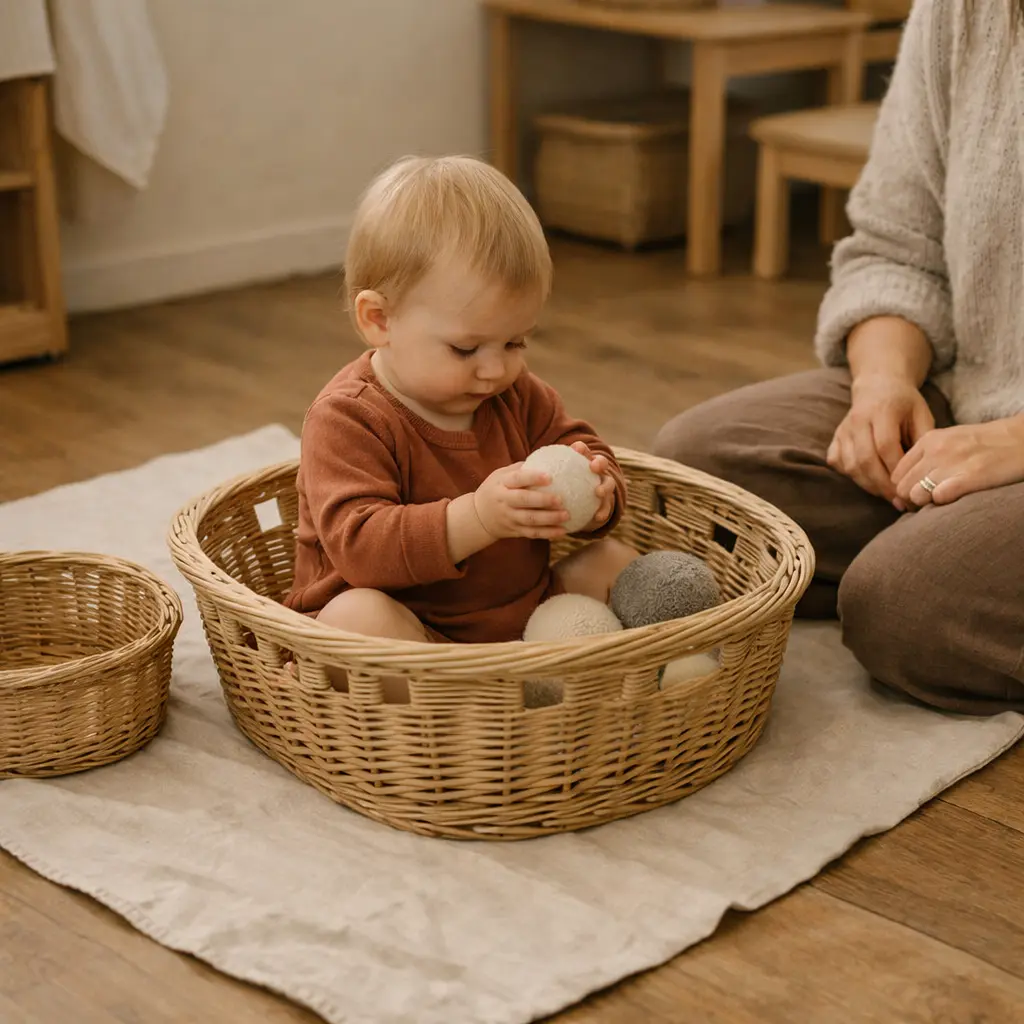
Lay a plain cotton cloth on the floor and place a sturdy basket on top to define a calm working space, offering only a small number of soft balls made from natural fibres or muted fabric. Keep the surrounding area uncluttered and quiet, with a second basket nearby for simple “in/out” movement, and avoid adding extra colours or noisy items.
Set the tone through imitation: the adult slowly places one ball into the basket, pauses, then lifts it out again, speaking only a few steady words if needed. Remain close and observant, allowing the child to repeat the same action for as long as they choose, and stepping in mainly to steady the basket or to support balance. Notice the child’s rhythm—fast tipping, slow placing, long pauses—and match your pace to help the experience stay settled and predictable.