Exploring rainbow bubble foam in a shallow tray with scoops and cups (2–4 years)
Sensory Play
Communication and Language
Two children stand at the tray, each holding a small cup. An adult places a mound of blue foam on one side and a mound of yellow foam on the other, then sets a single scoop between them. One child presses a fingertip into the foam and watches it spring back, while the other tips a cup and says, “It’s full.” The adult replies, “You’ve got blue in your cup,” and slides a cloth closer when the child wipes their hands. A third child leans in, points at the edge where the colours touch, and quietly says, “Green coming.”
Children explore thick, coloured bubble foam in a shared tray using simple tools and their hands. The foam’s texture and changing colours can invite slow, absorbed play, as well as quick experiments with scooping, piling and mixing. Adults can support children to notice what they feel and see, and to share space and materials with others.
Step-by-Step Guidance
1. Prepare the space: choose a wipe-clean floor area or a table with a washable mat. Place the shallow tray on a stable surface and keep cloths within reach.
2. Make the foam base: measure 2 parts water to 1 part soap into a bowl. Mix with an electric mixer until the foam becomes thick and holds its shape.
3. Create colours: divide foam into separate bowls or make separate batches. Add a few drops of food colouring to each and briefly mix until the colour is even.
4. Present the invitation: spoon or place the different coloured foams into the tray in distinct areas so children can choose whether to keep colours separate or combine them.
5. Offer tools: place a small set of scoops and cups beside the tray. Start with fewer items than you think you need to reduce crowding and noise.
6. Introduce calmly: name what is available (“bubble foam”, “blue”, “yellow”) and show one simple action such as a slow scoop and tip into a cup, then pause.
7. Support play as it unfolds: stay close enough to help with sharing and to prevent foam being rubbed into eyes. Add language that matches what children are doing (“You’re piling it up”, “The colours are mixing”).
8. Manage changes: if the foam starts to collapse, acknowledge it and allow children to explore the change in texture. Refresh with a small top-up only if it helps the play continue.
9. Close the activity: give a clear tidy-up cue, offer a cloth for hands, and wipe the tray together. If children want to keep a colour “recipe”, note it down with them using simple colour words.
Learning Objectives
Physical Development: children may strengthen hand control through scooping, squeezing, transferring and pouring foam between containers. Communication and Language: children may build vocabulary for texture, colour and change as they describe what they notice. Personal, Social and Emotional Development: children may practise turn-taking and managing preferences (wanting a colour, avoiding a texture) within a shared sensory experience.
Adult Role
Stay emotionally attuned to children’s sensory preferences, noticing who seeks touch and who needs distance or a cloth quickly. Model simple, descriptive language for what children can see and feel (colour names, “fluffy”, “slippery”, “mixing”), and mirror children’s own words without correcting their play. Scaffold only when needed—offer one tool, one action, or a boundary for shared space—then step back to let children repeat and vary their own ideas. Observe how children approach mixing, how they manage foam on skin, and how they negotiate tools, using this to decide whether to reduce materials, add a second tray, or create more space between children. Hold responsibility for safety by positioning yourself to prevent foam going into eyes, supporting hand-wiping before face-touching, and keeping the tray stable and the floor as dry as possible.
Observation Cues
Does the child return to a repeated action (scooping, patting, piling) and stay with it for a while?; What words or gestures do they use to describe texture and colour (e.g. “soft”, “tickly”, “pink”, “mixed”)?; Do they experiment with combining colours, separating them, or keeping them “the same”?; How do they manage foam on their hands—wipe, tolerate, seek more, ask for help?; In a shared tray, do they offer tools, wait, negotiate, or move away when crowded?
Time & Space
20–45 minutes, with the option to return to the tray later if the foam remains usable.
Wipe-clean floor area or a sturdy table with a washable mat; enough space for 2–4 children to stand or sit around the tray without crowding.
Materials
Safety
Age adaptations
Budding Adventurers
Provide 2–3 colours in separate “islands” in the tray so children can choose to mix or keep them apart. Add a couple of different container sizes to invite filling and tipping, and keep a clear boundary about foam staying in the tray. Model simple comparisons (“full/empty”, “big scoop/little scoop”) and support children to ask for a turn or swap tools.
Curious Investigators
Offer 3–5 colours and include a few transparent cups so children can watch colour changes as they transfer foam. Add a simple measuring cup and invite children to notice amounts in their own play (“two scoops”, “a little bit”), without turning it into a task. Support collaborative play by suggesting shared roles only when needed (one holds the cup, one scoops) and then stepping back.
Confident Discoverers
Provide multiple bowls of coloured foam and a larger tray so children can plan where colours go and how they will mix them. Add a small set of labelled cups (colour words or dots) so children can sort, compare and revisit mixtures they made. Use open prompts that extend thinking (“What do you notice when you mix these?”) and encourage children to explain their choices to peers while you observe and only step in for fairness or safety.
EYFS Links
Communication and Language: adults can model and respond to children’s words and gestures as they describe colours, textures and changes, supporting back-and-forth interaction during shared play. Physical Development: scooping, squeezing, transferring and pouring can build hand strength and coordination, especially when children repeat actions over time. Personal, Social and Emotional Development: a shared tray creates natural moments for turn-taking, negotiating space, and managing sensory preferences with adult support. Expressive Arts and Design: children may explore colour mixing and make choices about patterns, piles and combinations without needing a finished product.
Ethos adaptations
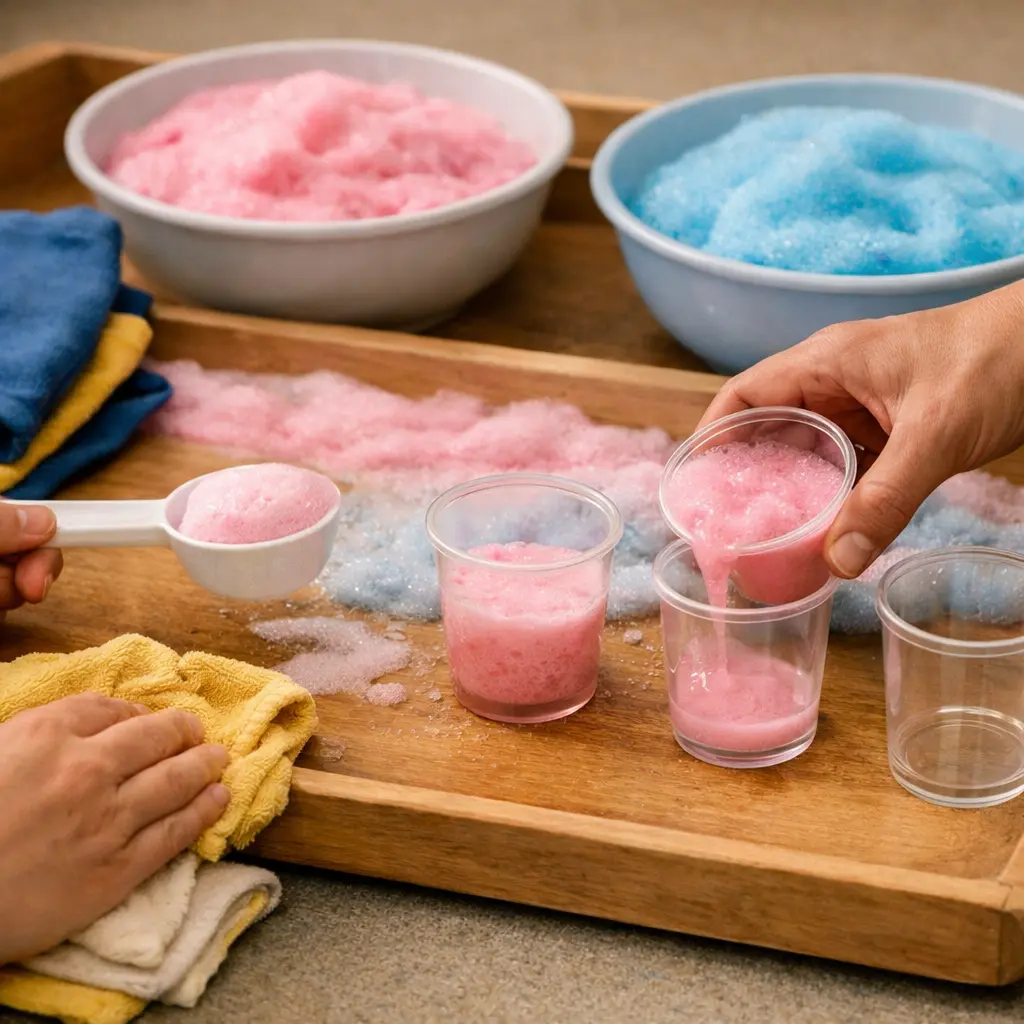
Prepare thick foam in two colours only. Place the two colour bowls at the top of the shared tray. Set one small scoop and two clear cups per child in spaced work spots, arranged left-to-right: bowl → scoop → cup 1 → cup 2. Remove extra tools and toys. Keep aprons and a small pile of cloths at the tray edge for the children to reach. Clear cups make levels and mixing visible; spills on the tray show overfilling so children can adjust without adult input.
Give one slow, quiet demonstration: take a scoop, level it on the bowl rim, place foam into cup 1, pour into cup 2, wipe a spill, return the scoop, then step back. Keep language minimal, naming a colour or texture only if the child initiates. Do not prompt turn-taking; the defined spots do that work. Observe grip, wrist rotation, steady pouring, and stopping at the cup rim. Notice repetition, deep focus, and how children manage preferences or waiting in the shared space.

In an outdoor or nature-integrated space, set the shallow tray on a low table, tree stump or on a flat patch of grass with a wind-shelter nearby; leave some uneven ground and natural textures visible. Materials such as hand-whisked foam made in small jugs, wooden spoons, metal or ceramic cups, shells, bark dishes, pebbles and real leaves are provided in an open-ended way rather than pre-arranged, with a few drops of food colouring added to separate bowls for children to self-serve and mix.
The adult observes from close enough to manage slipping or spills and to check water and ingredient ratios, offering only minimal, responsive prompts or a single-word label when asked. Children choose how to scoop, squeeze, layer and transfer foam, negotiate space and turn-taking, and may describe texture and colour as they play; the adult models calm handling, steps back to watch, and intervenes briefly for safety or hygiene before resuming observation.
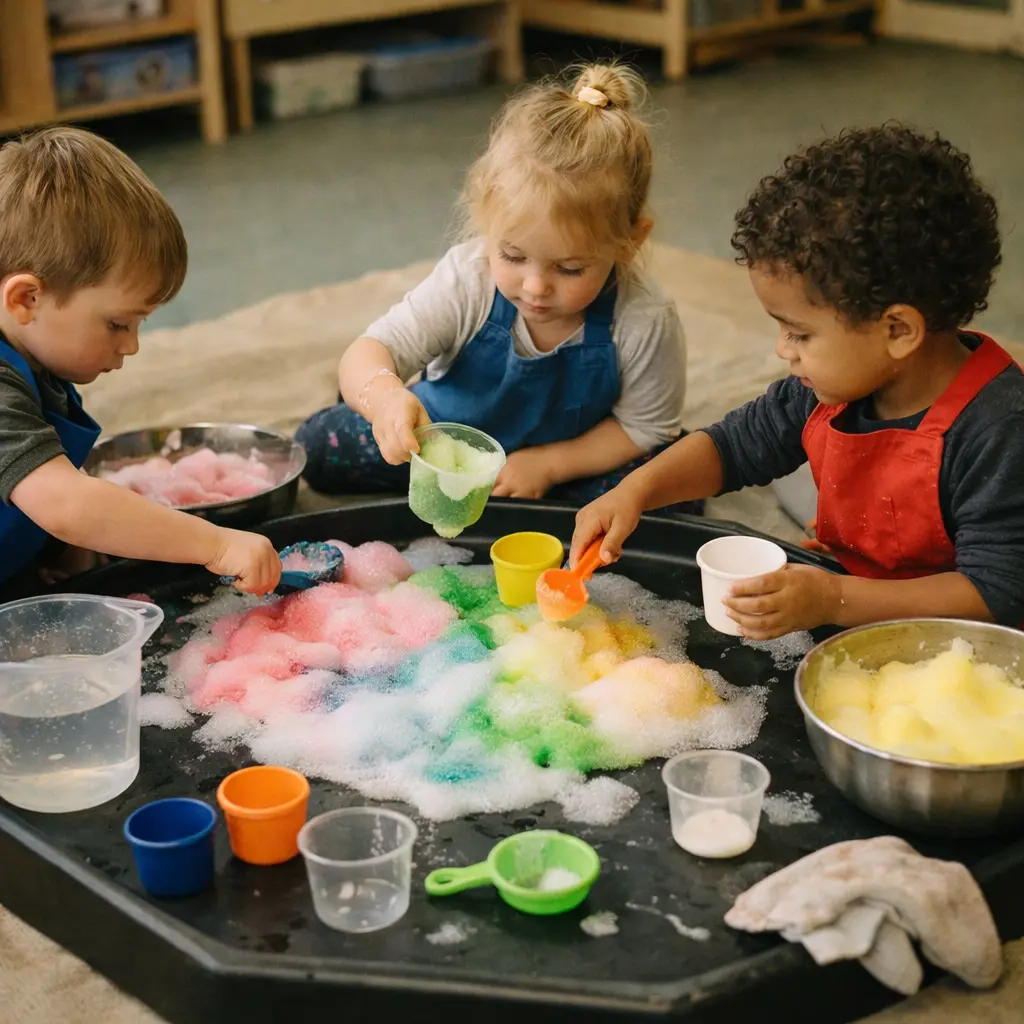
Set a low tuff tray with wide open access; place mixing bowls of plain and coloured bubble foam around the rim, with a jug of water nearby for diluting. Scatter small cups, beakers and scoops within reach, leaving clear spaces in the tray for piling, swirling or transferring. Keep aprons children-sized and self-selectable, and cloths at the edge for independent wiping. Ratios aren’t demonstrated; the measuring cup simply sits available so children can decide thickness, colour strength and combinations while sharing the same space.
The adult watches first, commenting rather than directing: "I can see your foam is sliding," "You’re trying to make that cup overflow," "What happens if water meets the red?" The child may switch tools, invent roles, compare heaviness, or step away to wipe then return, shaping the flow. The adult notices grip changes when scooping, repeated transfers, new words for texture and colour, and how children negotiate reach or turns. Safety stays active: eyes and mouths are monitored and hands can be rinsed.

Prepare a calm, uncluttered table with a neutral cloth under a single shallow tray, and offer only two softly coloured foams at first. Use natural-feel tools where possible, such as a wooden spoon and a simple metal cup, and keep the palette gentle rather than highly varied. Place a cloth for wiping hands beside the tray so the sensory experience stays contained and predictable.
The adult begins with a quiet demonstration of one slow scoop and pour, then remains present and steady with minimal language. Children explore through imitation, repeating the same movements and watching the foam change as it settles and blends. The adult observes pace, comfort with touch, and whether the child returns to the same action, stepping in only to keep foam away from eyes and to restore a calm rhythm when the space becomes crowded.