Exploring pitch and volume with a kitchen music band using pots, pans and wooden spoons
Communication and Language
Children use selected pots, pans and utensils as instruments to explore how everyday materials can sound different. The experience invites noticing pitch, volume and tone through repeated tapping, pausing and comparing. Adults pay attention to how children regulate force, share space and respond to each other’s sounds, offering simple vocabulary and calm listening cues.
Children explore everyday kitchen items as sound-makers and notice how different materials create different pitches, volumes and tones. The experience supports curiosity, experimentation and shared attention as children compare sounds and repeat patterns they enjoy. Adults can keep the space predictable and calm so children can focus on listening as well as making noise.
Step-by-Step Guidance
1. Prepare the space: choose a hard floor area with clear boundaries and place a non-slip mat or folded towels where the pots will sit to reduce sliding.
2. Select a small set of items: offer a few pots/pans and a few utensils with clear differences (size, material, shape) so sound contrasts are easy to notice.
3. Present materials simply: place pots open-side up and lay utensils in a low basket beside them. Keep extra items out of sight to reduce overwhelm.
4. Introduce the listening focus: model one or two taps on a pot, pause, and show listening with your body (still hands, eyes on the item). Keep your demonstration brief.
5. Invite exploration: allow children to choose an item and begin making sounds. Let them lead the pace and intensity.
6. Support comparison: when a child switches tools or surfaces, name what you notice (e.g. “metal pan… wooden spoon… quiet tap”) and pause so the sound difference is clear.
7. Offer gentle structure if needed: suggest a shared “listen moment” by raising a hand or using a simple cue, so children experience contrast between sound and silence.
8. Extend through variation: rotate one item at a time (a bigger pan, a different utensil) and watch whether children change force, speed, or where they strike.
9. Close calmly: give a clear ending cue, invite children to place utensils back in the basket, and stack pots together with adult support.
Learning Objectives
Children may explore sound through repeated actions, supporting Expressive Arts and Design as they experiment with how objects can be used. They may practise turn-taking and shared attention, supporting Communication and Language in a real, motivating context. Children may also refine hand and arm control as they grip, tap and change force, supporting Physical Development.
Adult Role
Stay emotionally attuned by noticing when children become over-stimulated or startled, and offer a quieter option, a pause, or space to step back. Model simple sound language (loud/quiet, high/low, fast/slow, metal/wood) and use short phrases timed with the child’s actions so words match what they hear. Scaffold only when it helps a child compare or regulate (offering one new tool, suggesting a listening pause, or showing a gentler tap), and step back when children are absorbed in repeating a pattern. Observe in the moment for how children control force, respond to others’ sounds, and manage turn-taking around preferred items. Hold responsibility for safety by keeping items stable, supervising tool use closely, and intervening early if banging becomes unsafe or distressing for others.
Observation Cues
Notices and reacts to changes in sound when switching between metal, wood and plastic items. Adjusts force (gentle tap to loud bang) and watches for adult or peer response. Repeats a rhythm or pattern and pauses to listen for an echo or a different sound. Chooses a preferred item and returns to it, showing sustained interest. Looks towards a peer’s instrument and copies the action or timing. Uses gestures or single words to request an item, a turn, or “more” sound.
Time & Space
10–25 minutes, depending on age, group size and noise tolerance.
Indoor space with a hard floor area and clear boundaries; enough room for children to sit or stand with an arm’s length between instruments. A nearby quiet corner supports children who need a break from noise.
Materials
Safety
Age adaptations
Budding Adventurers
Increase variety slightly (different pan sizes, whisk, ladle) and invite children to test how sound changes when tapping the rim, base, or side, without turning it into a task. Support early pattern-making by mirroring a child’s rhythm and pausing to see if they continue or change it. Introduce simple sorting language (big/small pan, metal/wood tool) and let children group items if they choose. Keep boundaries clear so children have space to move without colliding with others’ instruments.
Curious Investigators
Offer a wider set of sound options and invite children to compare “high/low” and “loud/quiet” using their own words, gestures, or drawings after the play. Support cooperative play by suggesting a shared start/stop signal and noticing who is watching and matching others’ timing. Add a simple challenge that stays child-led, such as making the quietest sound or finding two items that sound similar. Encourage children to care for the equipment by returning items to a labelled basket at the end.
Confident Discoverers
Invite children to plan a simple group arrangement (who has which pot/pan) and to experiment with repeating patterns, tempo changes, and contrasts between silence and sound. Offer vocabulary that fits what they are doing (steady beat, faster/slower, softer/harder) and encourage children to explain their choices. Add a recording option (adult-held device) so children can listen back and comment on differences they notice. Support negotiation and leadership by rotating roles such as starter, stopper, and listener, without forcing participation.
EYFS Links
Expressive Arts and Design: children explore and use media and materials in open-ended ways by creating and varying sounds with everyday objects. Communication and Language: adults model descriptive vocabulary and support listening and attention through short pauses and shared cues, helping children connect words to what they hear. Physical Development: children practise grip, arm control and force modulation as they tap, hold and switch tools, with adults supporting safe body awareness in a shared space. Personal, Social and Emotional Development: children may practise turn-taking, coping with waiting, and managing excitement in a group sound activity with adult co-regulation.
Ethos adaptations

Place 3–4 contrasting pots/pans on one non‑slip mat, arranged left‑to‑right from largest/heaviest to smallest/lightest, with handles facing the child. Put only two utensils (one wooden spoon, one silicone spatula) in a low basket beside the mat; offer one utensil at a time to keep the focus on pitch and volume. Remove other items and keep a clear floor around the mat so sound differences are easy to hear. Hang ear defenders within reach so children can choose them independently.
Give one slow, quiet demonstration: pick up one utensil, tap each pot once left‑to‑right, pause to listen, then repeat with softer taps; return the utensil to the basket and step back. Keep language brief and occasional (e.g., “loud/quiet,” object names) and avoid questions. Watch for repetition, careful grip and controlled force, natural pauses for listening, and whether children return the utensil before another turn. Note any preference for certain timbres and early turn‑taking signals.

In a sheltered outdoor area such as a garden corner, items are set on low logs, pallets, or the ground so children can move freely on uneven surfaces. Materials are arranged loosely: varied pots and pans, wooden spoons, a whisk and ladle, plus natural options such as sticks, smooth stones, pinecones, dry leaves for muting, and small tubs with water or sand to change tone. A rope or low branch can hold a few metal items for hanging sounds; anchors are checked secure, with clear space marked by natural markers.
The adult observes nearby, manages spacing, and offers minimal, timely prompts like “softer,” “harder,” “scrape,” or “listen,” using short pauses for shared attention. Children choose tools, strike, rub, drip water, or stuff leaves to alter pitch and volume, compare sizes and materials, echo each other’s patterns, and decide when to swap or rest. The adult models calm handling if needed, supports turn-taking and ear defenders on request, then steps back so experimentation can be repeated and revisited.
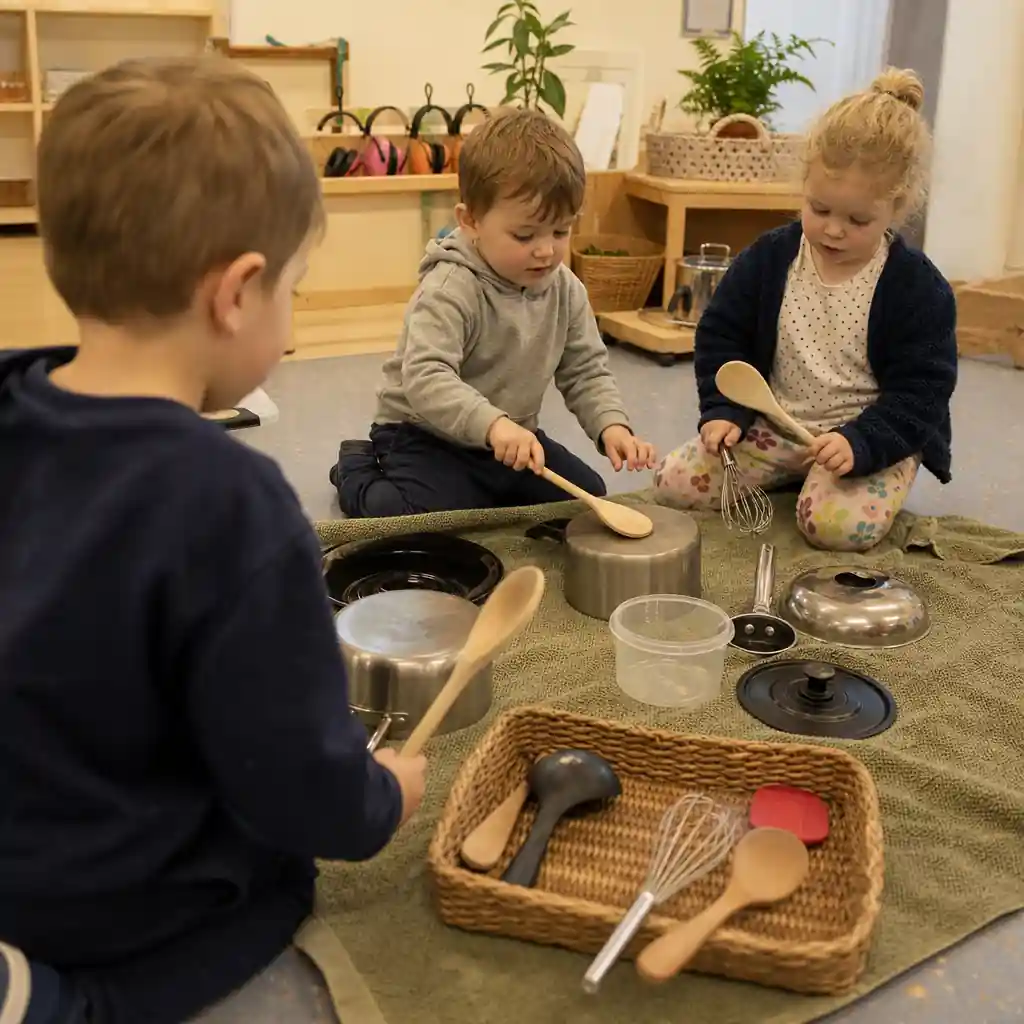
Low shelves or a low tray become the instrument stage: pots, pans, bowls and a mix of utensils are arranged within easy reach in small clusters with non-slip mats so children can move items and combine sounds. Add loose parts (wooden blocks, fabric, metal lids) and optional ear defenders nearby; nothing is prescribed or shown first. The space is quiet, with clear sightlines and gaps between work areas so children choose where to play, explore different sizes and materials, and invent uses for each object.
The adult stays beside the group as observer and co-researcher, using commentary such as "I can hear a high sound" or "What happens if you tap softer?" rather than giving instructions. The child may select tools, repeat rhythms, swap materials or invite peers; turn-taking and force control emerge naturally. The adult notices patterns of repetition, negotiation over choices, vocabulary used to describe sound, and changes in grip or arm control as embedded cues for assessment and next interactions.

A quiet corner is defined with a neutral wool felt cloth on the floor or low table; only three sound-makers are set out: two metal pots of different sizes and one wooden board or bowl. A small wicker tray holds three tools: two wooden spoons and one light metal whisk; a folded cotton towel under the pots steadies and softens resonance. A second wool cloth is available for dampening. Ear defenders sit at the edge for any child who needs them. The space remains uncluttered, with soft, even light and clear floor around the mat.
The adult demonstrates a single slow tap and a short pause, then a gentle hand-rest on a pot to change the tone, using minimal words and maintaining a calm tempo. They stay close, observing and keeping spacing safe, offering a quiet gesture for turn-taking and stepping in only to prevent overcrowding. The child selects one tool, explores soft and stronger taps, compares tones across items, returns to a favoured rhythm, listens in the pauses, and replaces tools on the tray between turns.