Exploring how balls move through rolling, gentle throwing and tracking games for mixed ages
Communication and Language
Children explore how different balls travel across space through rolling and gentle exchanges with others. Babies may focus on tracking and reaching, toddlers often experiment with carrying and pushing, and older children may refine control and cooperation. Adults keep the pace calm, notice how children adjust force and manage waiting, and offer small changes in distance or ball choice to support shared play.
Children explore how balls move in different ways, including rolling along the floor, travelling down gentle slopes, and moving between people. The experience supports shared attention, turn-taking and early friendships through simple, repeatable ball exchanges. Babies may focus on tracking and reaching, toddlers often explore balance and coordination, and older children may refine control and cooperation in small group play.
Step-by-Step Guidance
1. Prepare a clear area with enough room for balls to travel without hitting shelves or doorways. Place a mat for babies and a defined rolling lane using tape for older children.
2. Offer 2–4 balls with clear differences (size/texture). Place them in an open basket so children can choose.
3. Begin with rolling: sit or kneel at children’s level and roll one ball slowly across the lane or mat. Pause to allow tracking, reaching, or moving towards it.
4. Invite a return in any form. Accept pushes, taps, or a roll back. If needed, reduce distance and slow the speed.
5. Add a simple target option for children who seek it, such as rolling into a basket or between two cushions. Keep the target wide so success can vary.
6. Introduce gentle underarm throws for children ready for more challenge. Keep throws low and forward, and model stopping the ball with hands or feet.
7. Support turn-taking by naming whose turn it is and using a consistent cue (e.g., holding the ball still until a child looks or reaches). Keep waiting times short by offering a second ball if the group grows.
8. Vary the movement experience by adding a gentle slope. Place the board/tray securely and allow children to explore how the ball speeds up or changes direction.
9. Close by gathering balls back into the basket with children who are interested, noticing what they preferred (fast/slow, big/small, rolling/throwing).
Learning Objectives
Children may develop gross motor control through reaching, rolling, throwing and catching, linking to Physical Development. Children may practise attention, listening and simple back-and-forth interactions, linking to Communication and Language. Children may explore turn-taking, sharing space and managing feelings during waiting and joining in, linking to Personal, Social and Emotional Development.
Adult Role
Stay emotionally attuned by noticing excitement, frustration, and hesitation, and by keeping the pace calm and predictable. Model simple language that matches the action, such as “roll”, “stop”, “my turn/your turn”, “gentle”, and words for feelings when waiting is hard. Scaffold by reducing distance, slowing the ball, offering a larger ball for easier control, or widening the target; step back when children repeat a pattern confidently or begin negotiating turns themselves. Observe in action by watching how children track movement, adjust force, and respond to misses, and use those observations to decide whether to simplify, add challenge, or offer a parallel option. Hold responsibility for safety by controlling speed and height of throws, managing space, and choosing balls that match the children’s ages and mouthing needs.
Observation Cues
Tracks the ball with eyes and head, or shifts body position to follow its path. Chooses a way to move the ball (push, roll, underarm throw) and adjusts force after noticing what happens. Waits for a turn or signals for the ball using gesture, gaze, or words. Recovers after a miss (fetches, tries again, asks for help) and shows persistence. Notices others’ play and joins alongside, offering the ball or copying a movement pattern.
Time & Space
10–25 minutes, with flexible entry and exit for different ages.
Indoor clear floor space or a flat outdoor area, with a defined lane and a separate calm mat area for babies. Enough room for balls to travel a few metres without crossing busy walkways.
Materials
Safety
Age adaptations
Budding Adventurers
Add a gentle slope option and a clearer target choice (basket between two cushions). Invite children to compare what happens with different balls (big rolls slower, small changes direction more easily) using simple descriptive words. Support turn-taking in pairs or threes, and introduce a “ready hands” cue for catching attempts without insisting on success. Offer a second lane or second ball to reduce conflict when interest is high.
Curious Investigators
Offer a small set of balls with noticeable differences and invite children to choose a challenge: roll to a target, roll to a partner, or underarm throw to a marked area. Encourage children to notice and describe movement (fast/slow, straight/curved) and to adjust force intentionally. Support cooperative play by helping children agree simple rules such as one ball at a time in the lane, or taking turns to be the “roller” and “stopper”.
Confident Discoverers
Introduce more complex cooperation such as small-group passing patterns, aiming at targets from different distances, or creating two lanes with shared rules. Encourage children to refine technique (underarm throw, two-handed catch, stopping with control) and to reflect on what changed when they altered force or distance. Step back to allow children to manage turn-taking and fairness, stepping in only to support inclusion, resolve repeated conflict, or reset safety boundaries.
EYFS Links
Physical Development: Children may practise large movements through rolling, throwing, catching attempts, stopping, and moving their bodies to retrieve the ball, building control and coordination in a meaningful context. Communication and Language: Children may use gesture, eye contact and words to request the ball, respond to cues, and describe what they notice about movement, supporting attention and shared understanding. Personal, Social and Emotional Development: Children may experience turn-taking, sharing space, coping with waiting, and repairing play after a miss or disagreement, with adult support for calm boundaries and inclusive play.
Ethos adaptations
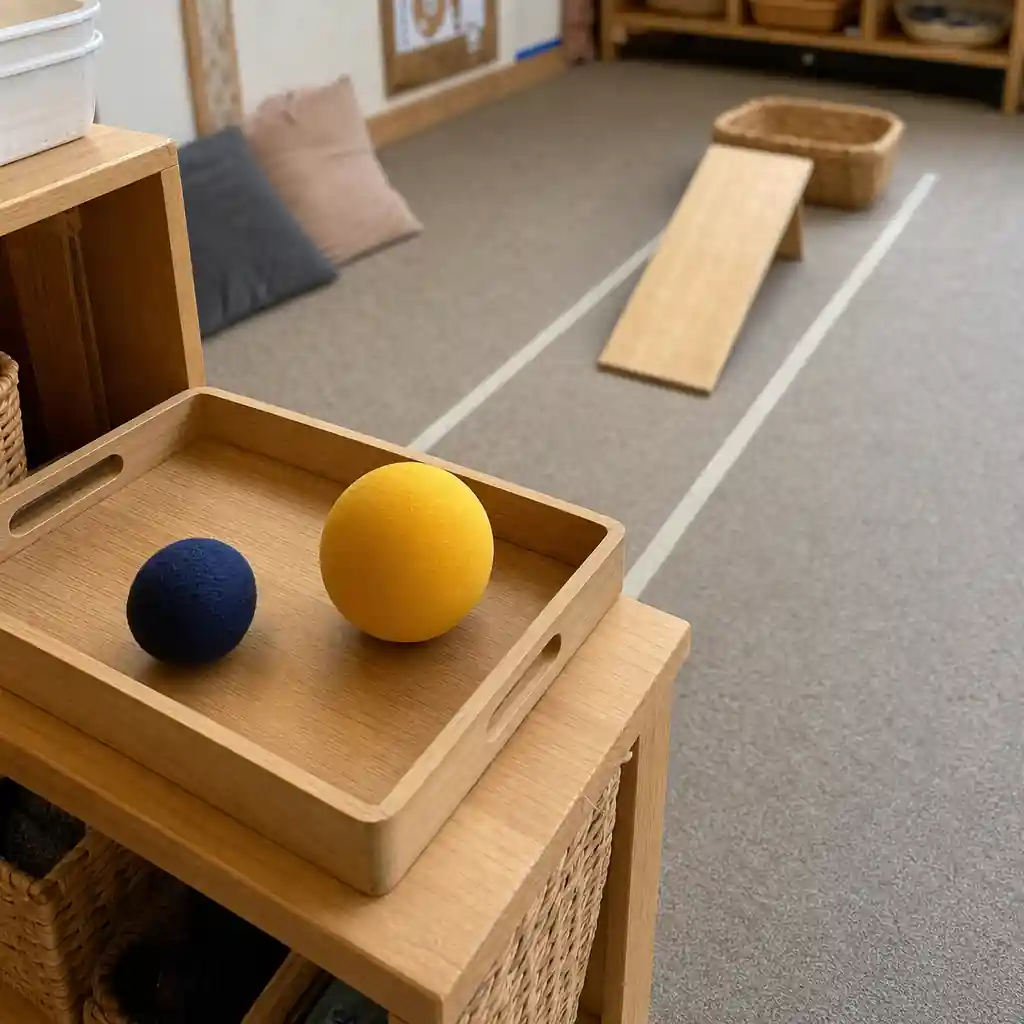
Select two balls (one small, one medium) and place them on a low tray at the child’s reach; remove extra balls. Mark a single rolling lane with tape and set one gentle slope or board so the path is obvious; place a single low basket as the target so success is visible if the ball reaches it. Keep the floor clear and present the materials in the same order (tray → lane → slope → basket) so the sequence is simple and the focus is on controlled rolling and passing.
Show the full sequence once with a slow, silent demonstration: pick up the ball, place it on the lane, let it roll to the basket, then return the ball to the tray. Step back and limit language to brief safety notes, avoiding prompts or questions while children practice. Observe for steady repetition, improving control of direction and force, clear waiting or joining signals, and whether children self-correct when the ball misses the basket.

In an outdoor or nature-integrated space such as a grassy patch, patio or garden with a gentle slope and varied surfaces, low logs or a shallow board create rolling channels and soft uneven ground offers managed challenge. Materials are arranged using a small selection of real and sensory alternatives alongside familiar soft balls: smooth wooden spheres or large tactile seed pods for older toddlers, soft fabric or foam balls for babies, a low hollow log or basket as a target, and cushions or rolled blankets as soft boundaries.
The adult observes nearby, checking safety and anchors, offering minimal, responsive prompts rather than directing play. Children choose where to place ramps, which object to test and whether to roll, gently throw or pass; children may set turn-taking rules, experiment with slope and surface, and repeat actions. The adult steps in to manage risk, model calm handling and use brief comments or single-word prompts to notice movement and social turns.
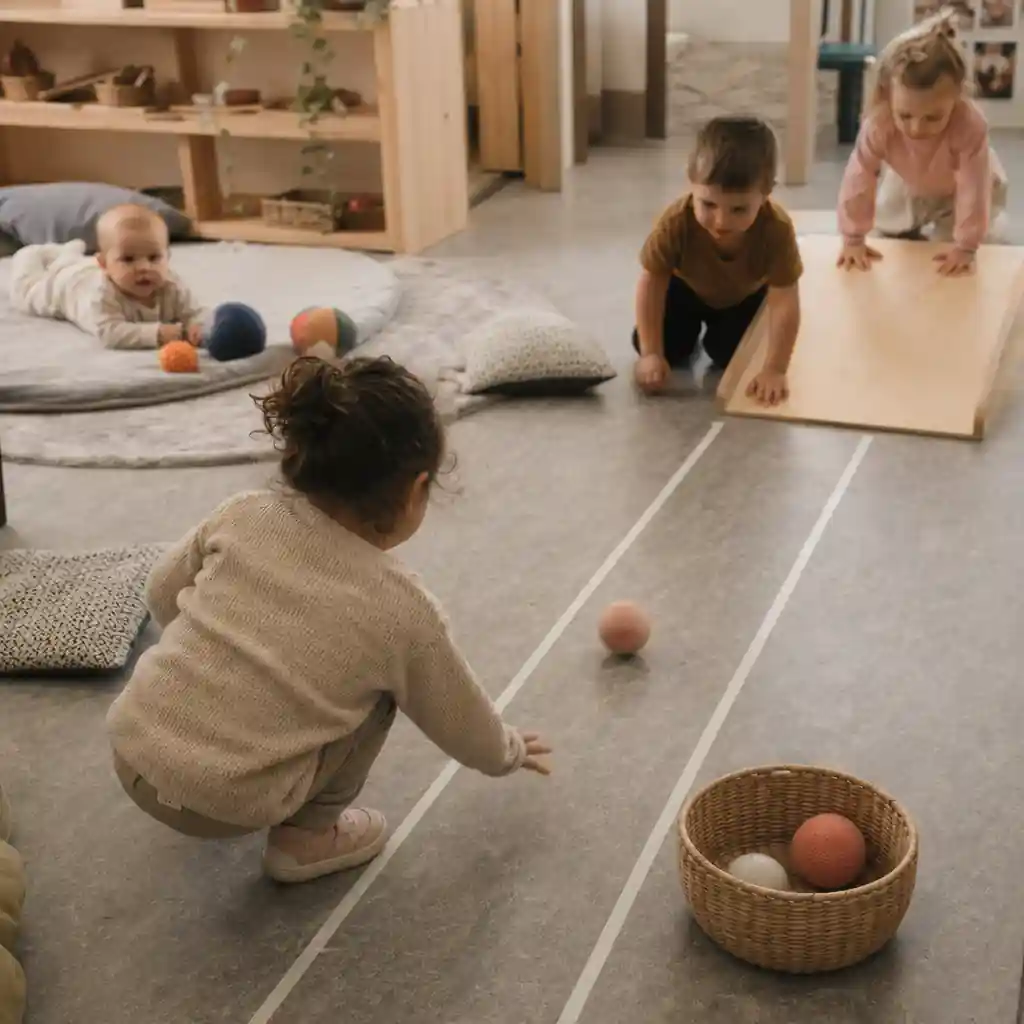
Clear the central floor so multiple low-interest stations can be chosen independently: a mat with scattered balls, a shallow tray or board set as a gentle slope, a taped rolling lane, and a low basket and cushions placed as soft boundaries. Materials sit in low trays or open baskets so the child may select size and texture without adult handing. The layout invites movement between areas, multiple simultaneous uses, and rerouting of paths so rolling, throwing or passing can be invented rather than prescribed.
The adult steps back as observer and co-researcher, offering brief, reflective language such as "I can see the ball is moving fast" or "You’re trying a different route" and questions like "What happens if the slope is higher?" The child may lead by choosing which surface, partner or target to use, repeating or abandoning actions. The adult notices moments for attention, shared gaze, reaching, turn-taking pauses and repair after misses, recording these behaviours within the flow rather than interrupting it.
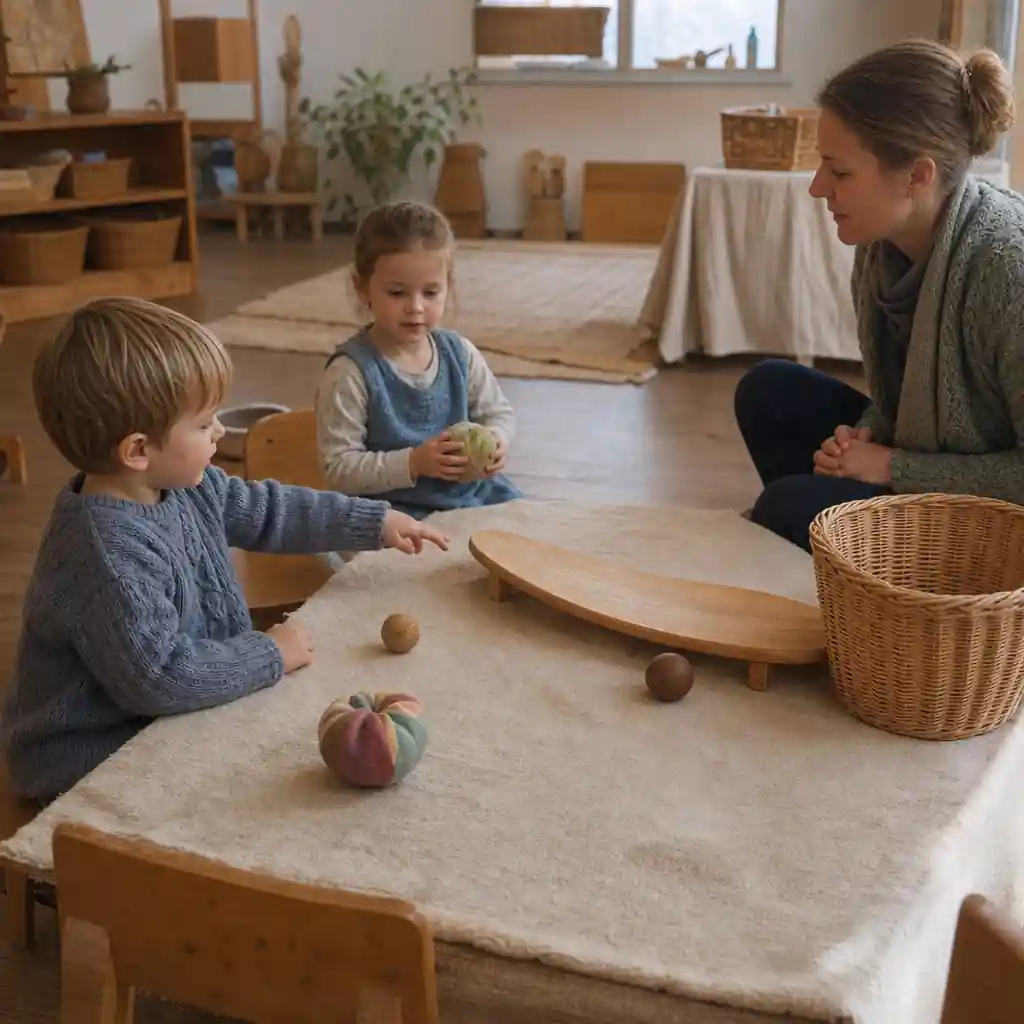
A calm area is defined with a neutral wool rug and a single cotton cloth as the working space. Only a few natural balls are set out: a soft knitted wool ball, a cotton-stuffed cloth ball, a light cork ball, and a small supple leather ball. A low wooden board makes a gentle slope; a wide wicker basket stands as an optional target. A simple rolling lane is marked with a length of undyed wool cord that can be lifted away. Soft boundaries are made with folded cotton blankets; all other items are cleared from view.
The adult demonstrates a slow roll and a quiet, open-palmed exchange, then sits nearby, observant and unhurried. Babies are placed close for tracking and reaching with very short, soft rolls; toddlers return to the slope, experimenting with distance and pace; older children choose simple back-and-forth passes or a small circle game, using eye contact and pauses for turns. The flow repeats at the children’s pace, with balls and board returned to the basket between rounds; the adult steps in only for safety or to steady the rhythm.