Exploring hairstyles with spaghetti strands and child-safe scissors for early cutting practice
Communication and Language
Understanding the World
Children use spaghetti strands as pretend hair to explore different hairstyles and talk about what looks similar or different across their creations. Adults support careful tool handling and offer language that stays respectful when children describe appearance. The activity can highlight how choices like length and placement change what children notice, and it gives adults clear moments to observe grip, coordination and turn-taking with shared resources.
Children explore pretend “hair” made from spaghetti strands and use it to talk about hairstyles, similarities and differences, and personal preferences. The experience offers a simple context for careful hand use, including early scissor control, without needing children to copy a set model. Adults can support respectful language about appearance and help children notice how different tools and hand positions change what happens to the strands.
Step-by-Step Guidance
1. Prepare the space: Cover a table, set out aprons, and place a lidded bin nearby for offcuts. Arrange scissors in a separate, clearly defined tool area.
2. Prepare materials: Portion spaghetti into a tray so strands are easy to pick up. Provide cardboard head shapes or paper plates ready for “hair” placement.
3. Introduce the idea: Explain that the spaghetti can represent hair and that people have many different hairstyles. Set a clear expectation for kind, respectful comments about appearance.
4. Model safe tool handling: Demonstrate carrying scissors with blades down, sitting to cut, and keeping fingers away from the cutting line. Show how to open-close the blades slowly.
5. Invite child-led design: Offer glue and allow children to choose where to place strands (top, sides, fringe). Avoid correcting “right” placement; focus on what the child is trying to make.
6. Support cutting practice: Encourage children to cut strands to change length or create a style. Offer one small suggestion at a time (e.g., how to hold the strand still) and step back to let them try.
7. Build conversation: Prompt children to describe what they notice about different styles and compare lengths and shapes. Link to real-life variety without ranking or judging.
8. Manage turn-taking: If scissors are limited, use a simple turn system (name cards or a timer) and provide an alternative fine-motor option (sorting strands, making “clips” with paper strips) while waiting.
9. Close the activity: Invite children to place finished heads on a drying area. Support tidy-up by collecting offcuts into the bin and wiping the table together.
10. Optional revisit: Keep dried heads for later discussion about same/different, counting strands, or retelling what choices were made.
Learning Objectives
Children may develop fine motor control through grasping, positioning and cutting, supporting Physical Development. Children may extend Communication and Language by naming features of hair and describing what they notice about length, texture and style. Children may also practise PSED skills by taking turns with tools and using respectful language when discussing similarities and differences.
Adult Role
Stay emotionally attuned by noticing confidence, frustration, or hesitation with scissors and responding calmly, offering reassurance without taking over. Model respectful language about hair and appearance, and gently reframe any unkind comments into neutral observations (e.g., focusing on length, shape, or choice). Scaffold only when needed: stabilise the card, offer a hand-over-hand start if invited, or suggest a simpler cut, and step back as soon as the child re-engages independently. Observe in action by watching grip, bilateral coordination (one hand holds, one hand cuts), and the child’s use of descriptive language. Hold responsibility for safety by controlling access to scissors, positioning children for safe spacing, and supervising closely during cutting and glue use.
Observation Cues
Chooses a grip and adjusts hand position to hold strands steady while cutting.
Opens and closes scissors with increasing control, pausing to re-aim.
Uses descriptive words such as long/short, straight/curly, thick/thin, same/different.
Shows awareness of others by waiting for a turn, offering tools, or asking for help.
Notices changes made by cutting and compares results across different “styles.”
Time & Space
15–30 minutes, with optional revisit once dry.
Table space for a small group with clear elbow room for scissor use, plus a nearby drying area for finished work.
Materials
Safety
Age adaptations
Budding Adventurers
Use cooked spaghetti strands and child-safe scissors with rounded tips, offering short strands first for easier control. Provide a small tray per pair to reduce grabbing and tangling. Adult models one simple cutting action and supports children to hold the strand away from fingers, offering frequent pauses and checking spacing between children. Encourage simple comparisons such as longer/shorter and noticing where hair is placed on the head shape.
Curious Investigators
Offer a mix of strand lengths and optional “accessories” such as paper strips for headbands or small paper circles for clips (large enough to avoid choking risk). Children can plan a style by choosing where to place hair and deciding what to cut. Adult introduces richer vocabulary (fringe, parting, ponytail, curly/straight as pretend descriptors) and invites children to describe similarities and differences without value judgments.
Confident Discoverers
Add challenge by including different cutting tools (standard child scissors and patterned-edge scissors if safe and appropriate) and thicker card for resistance. Invite children to create a small set of hairstyle cards showing variations (short, long, “spiky,” “bob”) using their own designs. Adult supports children to explain their choices, compare outcomes, and manage tools responsibly, stepping back to allow peer support and collaborative tidy-up routines.
EYFS Links
Physical Development: Children practise hand strength and coordination through holding, positioning and cutting strands, and through controlling tools safely. Communication and Language: Children use words to describe what they notice about hair length, placement and style, and listen to others’ descriptions during comparisons. Personal, Social and Emotional Development: Children practise turn-taking with shared tools, manage feelings when cutting is tricky, and learn to talk about similarities and differences in respectful ways. Understanding the World: Children notice human variation and personal choices in appearance, linking pretend representations to real-life diversity without ranking or stereotyping.
Ethos adaptations

Set out one cardboard head and a shallow tray with a limited number of spaghetti strands (five–eight) per child, arranged in a fixed order left-to-right. Place the child-safe scissors and a glue stick in reachable positions on the tray and remove extra materials so the task focuses on grasping, positioning and cutting a single strand at a time. Prepare each head with simple visual guide marks or shallow slits so children can see where strands belong and notice if a cut is too short.
Give a single, slow demonstration: show how to hold a strand, snip once or twice, and place it into a guide mark, then step back and use minimal language, keeping explanations to safety reminders only. Do not prompt while children work; instead watch for repeated attempts, steadyhand control, careful scissor positioning, turn-taking with tools and moments of concentration or frustration to note when to offer a brief, practical prompt or a change in tray setup.
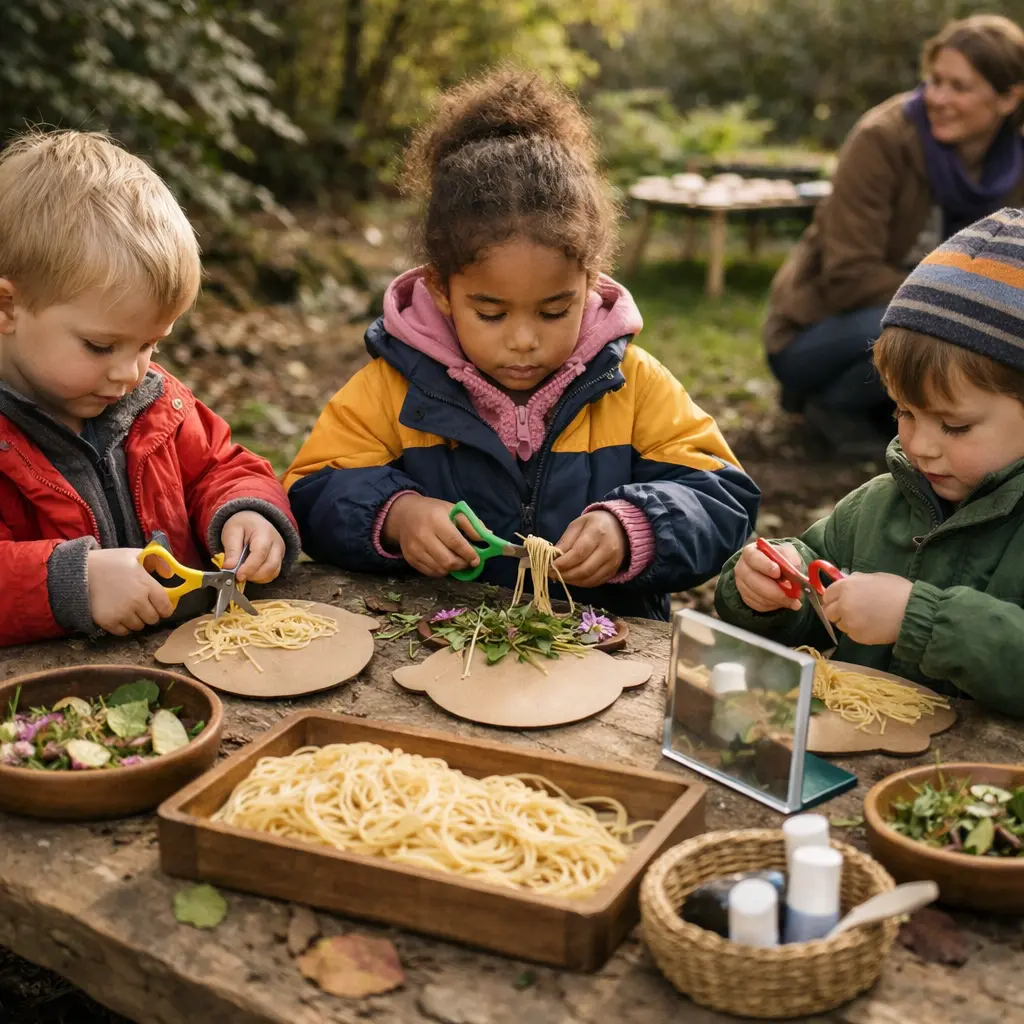
In an outdoor or nature-integrated space such as a sheltered patio, grass clearing or garden table, the activity moves away from a clinical table setup to surfaces with leaves, bark and stones nearby for decoration and sensory interest. Materials are arranged in open-ended trays: cooled cooked or dry spaghetti strands, cardboard head shapes or plates, unbreakable mirrors, child-safe scissors, glue spreaders and natural items (twigs, leaves, petals) for adding texture. Children may explore the strands freely without a fixed pattern, using imperfections and found materials to vary hairstyle choices.
The adult observes from a safe distance, briefly checks and models safe scissor handling, then steps back to offer short, responsive prompts or a single-word cue when asked; supervision and immediate intervention for safety are maintained. Children choose tools and roles, take turns, experiment with grip, cutting angles and placing natural embellishments, and may name or compare styles as they work while the adult notices and comments succinctly on actions or offers a question to extend talk.

Ethos adaptation: Arrange the table as a low, open studio area where trays of cooled spaghetti strands, dry alternatives, yarn, ribbons and loose natural fibres sit within easy reach alongside cardboard head shapes, mirrors and baskets of child-safe scissors and glue. Materials are not pre-cut or portioned; children select textures and tools, place items on heads or skin-like papers, and move between stations. Keep aprons, wipes and a lidded bin accessible so safety and comfort are maintained without adult gatekeeping; avoid example hairstyles so choices remain undirected.
The adult steps back as observer and co-researcher, offering commentary such as "I can see you’re holding the strand this way" or "What happens if you trim from the middle?" rather than instructions. The child may choose which tool, when to cut, and whether to repeat or abandon a style; turn-taking and respectful comparisons arise naturally as preferences are voiced. Observation cues are embedded: note shifts in grip, language used to describe length or texture, moments of problem-solving when cutting resists, and peer negotiation around tools and ideas.
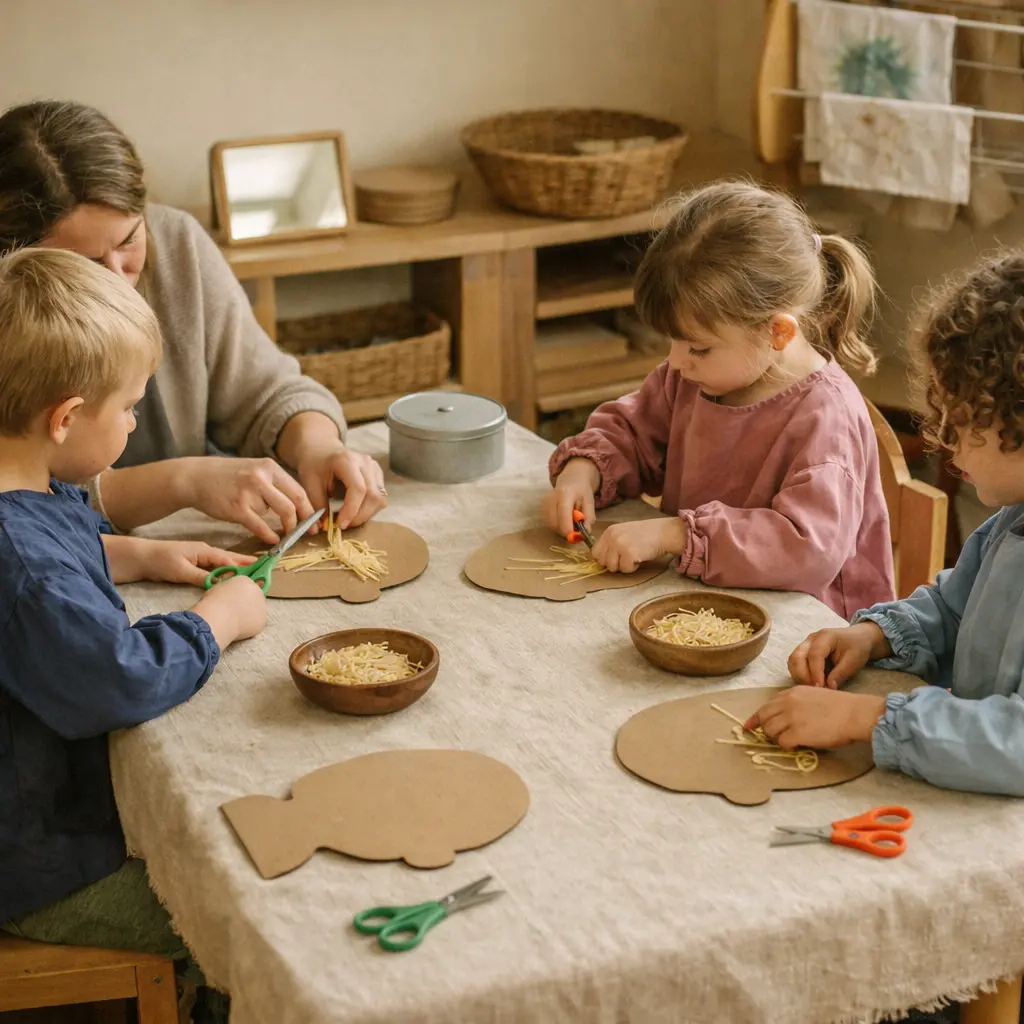
A calm table is prepared with a plain, neutral table covering and soft, even light. Each place has one cardboard head shape, a small wooden or ceramic bowl holding a modest bundle of lightly oiled, cooled spaghetti strands, and a pair of child‑safe, rounded‑tip scissors. Glue and additional decorations are not set out to keep the focus on texture and cutting. The unbreakable mirror remains at the edge for optional, brief self‑observation. Aprons are simple and muted. Only a small number of strands are presented at once to maintain a clear, uncluttered workspace.
The adult demonstrates a quiet, safe scissor hold and a single, unhurried snip of one strand placed along the head shape, modelling calm words for length and texture when relevant, and then watches. The child arranges and trims the strands in their own way, returns to repositioning and cutting, and shares tools in turn with nearby peers. The adult notices respectful language and gentle hand use, intervening only for safety or to steady materials. The rhythm is setup, repeated exploration, and a simple tidy of offcuts into the lidded bin.