Exploring floating and sinking with sensory boat play in blue-tinted water
Sensory Play
Small world play
Children explore a shallow tray of blue-tinted water with small boats and a few small-world figures, noticing how movement, load, and water changes affect what happens. Adults support careful handling, introduce simple words such as float, tip, and harbour, and keep the space manageable by limiting what is available at one time. Practitioners can watch for repeated testing, emerging story ideas, and how children negotiate shared access to a high-interest resource.
Children explore a water tray set up as a simple seascape, using small boats and small-world figures to create journeys, harbours, and changing conditions. The blue-tinted water and a small amount of glitter can add visual interest and invite careful noticing of movement and light. The experience can support sustained attention, imaginative thinking, and early scientific ideas as children test what floats, what tips, and what moves a boat along.
Step-by-Step Guidance
1. Prepare the space with a wipeable mat and towels within reach. Place the tray on a stable, low surface where children can stand securely.
2. Fill the tray with warm water to a shallow level. Tint with a small amount of blue colouring if used. Add a very small amount of glitter alternative if used, keeping the water clear enough to see objects beneath the surface.
3. Place boats and a limited number of small-world characters beside the tray in a simple layout. Add one or two larger items that can act as a harbour edge or docking point.
4. Invite children to choose a boat and explore how it sits on the water. Allow time for free exploration before adding language or extra items.
5. As children begin to create journeys or races, support them to notice movement: what happens when a boat is pushed gently, pushed firmly, or released.
6. Offer characters as optional “cargo” and pause to let children decide how many to add. If a boat tips, wait briefly to see if the child adjusts independently, then offer a simple prompt or demonstrate once if needed.
7. Introduce the idea of changing conditions only if it fits the play, such as making a “storm” by moving the water with a hand at the tray edge, or creating a calm “harbour” area near a container. Keep changes brief and return control to the children.
8. Maintain a manageable number of items in the water. Rotate materials by removing a few and offering alternatives to reduce clutter and support deeper exploration.
9. Close the activity with a clear transition: invite children to park boats in the harbour area, remove characters, and help with drying and wiping where appropriate.
Learning Objectives
Children may explore early scientific concepts linked to Understanding the world, such as floating, sinking, and cause and effect in water. Children may develop Physical development through controlled hand movements when placing, pushing, and retrieving objects. Children may build Communication and language as they name objects, describe what they notice, and listen to new vocabulary modelled by an adult.
Adult Role
Stay emotionally attuned by watching for signs of uncertainty around splashes, wet sleeves, or crowded space, and offer calm reassurance and practical support. Model simple, accurate language linked to children’s focus, such as float, sink, tip, balance, heavy, light, fast, slow, storm, and harbour, without turning the play into a lesson. Scaffold only when needed: wait to see what the child tries, offer a short prompt, and step back again so the child keeps ownership of the investigation. Observe in action by tracking repeated tests, problem-solving strategies, and how children include others, and use this to decide whether to simplify materials or extend the challenge. Hold responsibility for safety by supervising closely around water, managing slippery floors, and selecting materials that are safe for the age group.
Observation Cues
Notices and comments on what makes a boat move faster or slower across the water surface.
Adjusts hand pressure or direction when a boat tips, spins, or bumps into the tray edge.
Tests different objects or figures in the boat and watches for changes in balance.
Uses words or gestures to indicate ideas such as storm, harbour, deep, shallow, float, sink.
Sustains attention by repeating a self-chosen test (e.g., loading, unloading, re-launching).
Time & Space
15–35 minutes, depending on interest and how many children are waiting for turns.
A wipeable indoor area with a stable low table or floor-level setup, plus space for two to four children to stand without crowding. Access to a sink or water source nearby is helpful.
Materials
Safety
Age adaptations
Budding Adventurers
Introduce a small set of characters as passengers and a couple of harbour items to invite sorting and placing. Allow children to experiment with loading and unloading, noticing when a boat becomes unstable. Add glitter alternative only if it does not distract from seeing what is happening in the water, and keep it minimal. Offer a choice of cups for pouring near the tray edge to create gentle waves, and support children to keep water inside the tray with clear, calm boundaries.
Curious Investigators
Offer two or three different boat shapes to compare how they move and how much they can carry. Provide a defined harbour area and an open “sea” area using one larger container or floating ring, so children can organise routes without adult direction. Invite children to suggest what counts as a storm or calm water and to test their ideas, keeping the focus on noticing and adjusting. Add vocabulary such as steady, wobble, sink, rescue, and dock, and encourage children to describe what changed when they altered speed, load, or water movement.
Confident Discoverers
Add a simple challenge choice that children can set for themselves, such as transporting a set number of passengers without tipping, or reaching a harbour without touching the boat. Offer a small selection of “cargo” items that vary in weight and size (all safe and easy to clean) so children can plan and revise. Encourage children to make predictions and explain what they think might happen, and to compare outcomes across different boats. Support collaborative play by helping children agree shared rules for races or rescue missions, and by modelling language for negotiating roles and fairness.
EYFS Links
Understanding the world: Children can explore simple scientific ideas through hands-on testing of floating, sinking, movement, and cause and effect when water is disturbed. Communication and language: Adults can model precise vocabulary for what children notice, and children may practise describing changes, making requests, and listening to others’ ideas during shared play. Physical development: Children can refine hand control and coordination when placing figures, balancing loads, pouring small amounts, and retrieving items without splashing. Personal, social and emotional development: Shared access to a high-interest resource can support turn-taking, negotiating space, and managing frustration when boats tip or collide.
Ethos adaptations

Set a low water tray on a floor mat with aprons and a small towel within reach. Keep materials lean: two identical boats, four wipeable figures, one small harbour bowl, and one small cup marked with a single fill line. Fix a water-depth tape line inside the tray and a narrow load line on each boat so overfilling or tipping is obvious. Place items left-to-right on a shallow tray: cup, boat, figures, harbour. Keep optional tint very light and omit glitter. Children can fetch, use, and return each item independently.
Give one slow, quiet demonstration: fill to the line, place an empty boat, add one figure so the load stays below the mark, make a gentle push, then blot any spill and return everything to its place. Step back and keep language to brief safety notes. Do not prompt solutions. Watch for repetition, careful pouring to the line, control of hand and wrist, adjustments when the boat tips or sinks, and spontaneous words the child chooses for floating, sinking, fast, slow. Note signs of focus or fatigue before intervening.
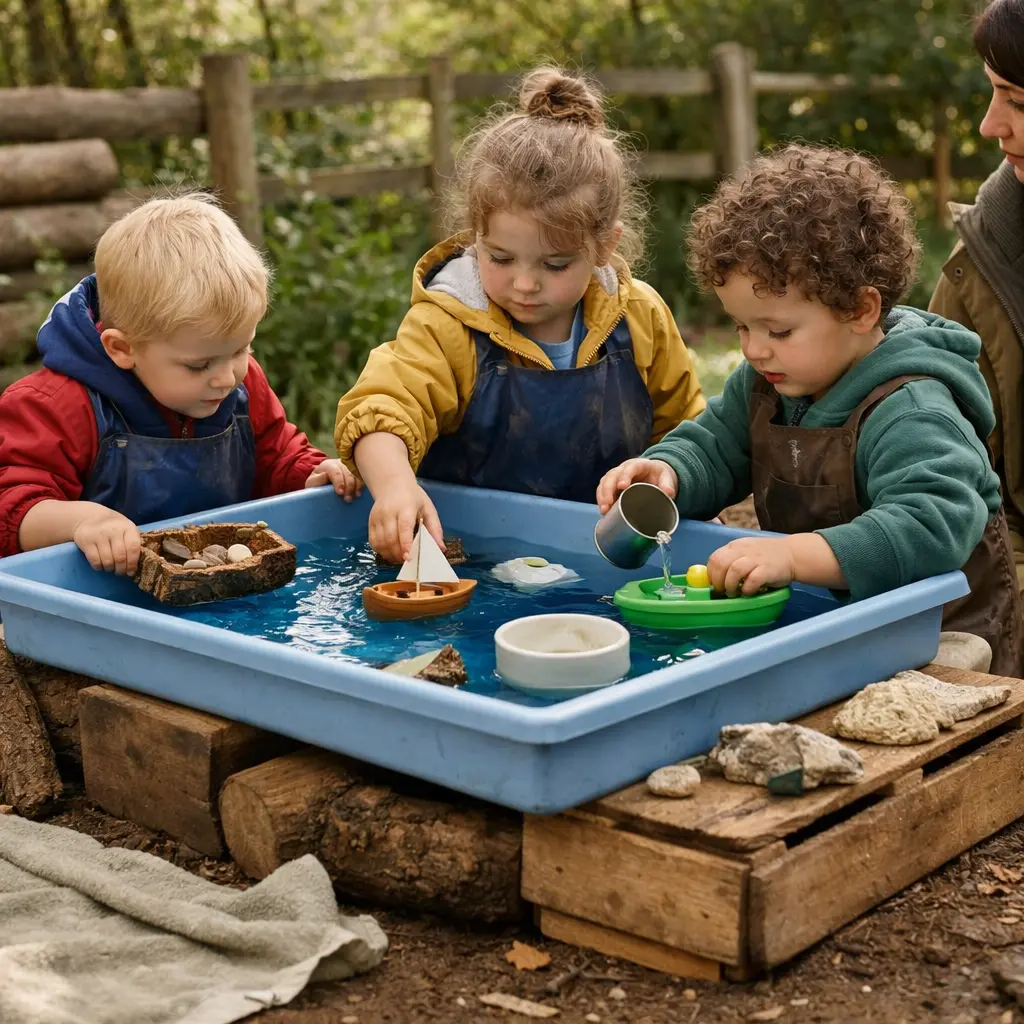
In an outdoor or nature-integrated space, set the shallow tray on low crates or directly on a sturdy picnic table in a garden or nearby green space with varied surfaces and room to move. Materials are arranged using real, open-ended items: sealed wooden or metal toy boats, hollowed bark, large shells, stones, twigs and leaves as cargo, and natural scoops (wooden cups). Warm water may be lightly tinted as before and biodegradable glitter may be omitted; absorbent mats and aprons remain available for spills.
The adult observes from close by, checking safety and cleanliness, offering single-word prompts or short questions rather than step-by-step instructions, and assisting only when needed (e.g. steadying trays, sanitising items). Children choose roles, test what floats or fills, pour and retrieve at their own pace, experiment with loading and balancing, and negotiate turns while the adult responds with concise observations to extend language and notice cause and effect.
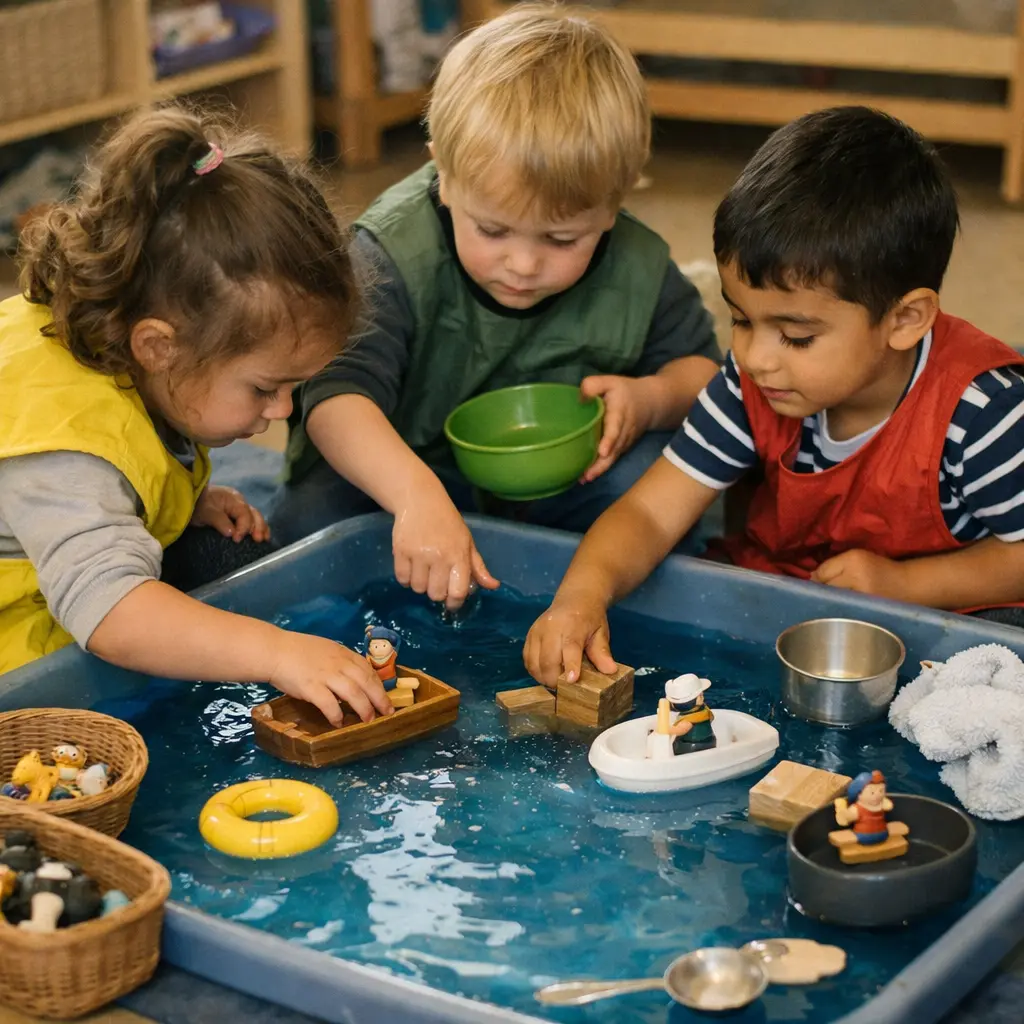
The tray is placed where children can approach from all sides and return independently, with boats, small-world figures, harbour items, scoops and towels laid out openly in visible groups rather than handed out as a single set. Warm blue-tinted water and a tiny sprinkling of glitter remain optional sensory elements; materials are presented as loose parts adults do not pre-assemble, so the child may combine a boat, a bowl and a scoop in unexpected ways, pause, repeat or abandon an arrangement without a prescribed outcome.
The adult steps back as observer and co-researcher, using commentary such as "I can see the boat tilting" or "You’re trying to move it that way" and occasional prompts like "What happens if you change how you push?" The child may lead investigations of floating, tipping and cause and effect, choosing tools and strategies; the adult notices moments of sustained attention, repeated testing, new vocabulary use and refined hand control and records these behaviours within the flow to maintain EYFS learning links.

A quiet corner is prepared with a neutral cotton cloth defining the space and a low-sided wooden tray or enamel basin set on a stable surface with clear, warm water. The materials are arranged simply: two sealed wooden boats, two plain wooden figures that can be cleaned, and one small metal cup for pouring. Absorbent cotton towels, a natural-fibre floor mat for spills, and cotton aprons are placed at the edge. Only these items are offered to keep the scene uncluttered and to centre attention on the movement of water and weight.
The adult demonstrates once by setting a boat on the water and releasing it without splash, then tilting a small pour from the cup to show a gentle current, using minimal words such as float, sink, and tip. The adult remains close, observing quietly and managing safety and shared access. The child returns to placing and removing figures, noticing when a boat stays level or overturns, repeating simple trials, adjusting pace, and tidying items back onto the cloth when finished.