Exploring flavoured jelly cubes in a shallow water tray for edible sensory play
Sensory Play
Children gather around a shallow tray where jelly cubes sit in cool water with a slotted spoon and small bowls nearby. Some children press the jelly between fingers, others lift pieces to watch drips fall back into the tray, and a few bring a small piece to their mouth. The adult stays close, removes any mouthed jelly from the water, and names sensations such as cold, slippery, and wobbly without directing what to do.
Children explore firm, wobbly jelly cubes in shallow water using hands and simple tools. The experience combines texture, temperature, smell and taste in a way that can feel safe and familiar because the materials are edible. Children may choose to squash, scoop, watch the jelly move in water, or taste small amounts. The adult keeps the space calm and closely supervised, following children’s cues around sensory comfort and food boundaries.
Step-by-Step Guidance
1. Prepare the environment: Choose a wipe-clean floor area or a table with a waterproof mat. Place the shallow tray on a stable surface at children’s height, with towels nearby for wet hands.
2. Prepare the materials: Add a small amount of cool water to the tray. Place 6–12 jelly cubes into the water, leaving space between them so children can reach without crowding.
3. Present the invitation: Set out 2–3 tools (for example, a scoop, a spoon and a slotted spoon) and a couple of small bowls. Keep extra tools out of sight to reduce clutter.
4. Support entry: Allow children to approach in their own time. Offer a dry spoon or bowl first for children who avoid wet textures, and let them decide when to touch the water.
5. Follow children’s exploration: Notice what children focus on (squashing, lifting, smelling, tasting, watching wobble). Add simple language that matches their actions, such as “wobbly”, “slippery”, “cold”, “smells sweet”, “breaking”, “floating”.
6. Manage tasting safely: If children choose to eat, support small portions and clear boundaries about what is for eating and what is for the tray. Remove jelly that has been mouthed and returned to the water.
7. Extend without taking over: If interest dips, add a few more cubes or offer a different tool. Keep changes minimal so children stay in control of the play.
8. Close the activity: Give a clear ending signal, help children wash hands, and involve them in simple tidy-up such as placing tools in a bowl and wiping the mat.
Learning Objectives
Children may explore sensory properties such as wobble, firmness, slipperiness and temperature through hands-on investigation (Understanding the World). Children may practise early fine motor control through grasping, squeezing, scooping and transferring (Physical Development). Children may build vocabulary for describing what they notice, including smell and taste words, with adult modelling (Communication and Language).
Adult Role
Stay emotionally attuned by watching for signs of sensory discomfort, such as pulling back, wiping hands repeatedly, or becoming tense, and offer alternatives like tools, a dry bowl, or a pause. Model language that names what children can notice without quizzing, using short phrases linked to actions and senses. Scaffold only when needed for access or safety, such as showing how to scoop once or reducing the number of cubes if the tray becomes overwhelming, and step back when children repeat actions with focus. Observe patterns over time, including preferences for certain flavours/colours, willingness to touch wet textures, and how children manage shared space. Hold responsibility for food hygiene and close supervision, especially around tasting, sharing, and any mouthing of tools.
Observation Cues
Reaches in quickly or hesitates at the edge; watches others before joining.
Uses different actions on the jelly: presses, pinches, tears, rubs, taps.
Chooses tools or hands and changes approach when jelly breaks apart.
Shows preferences by selecting certain colours/flavours or moving items away.
Uses descriptive words or gestures for smell, taste, cold, wet, slippery, wobbly.
Manages turn-taking around popular tools or spaces at the tray.
Time & Space
10–25 minutes, with flexibility for shorter turns for children who find wet textures challenging.
A wipe-clean floor area or a low table with a waterproof mat, with enough room for 2–6 children to stand around a shallow tray without crowding.
Materials
Safety
Age adaptations
Budding Adventurers
Add a second empty bowl so children can choose to sort or collect without being directed to do so. Introduce a wider range of tool actions, such as a small ladle for pouring water over jelly and a slotted spoon for lifting. Support children to notice changes as jelly breaks into pieces and mixes with water, using language like “smaller”, “squashed”, “melting”, “cloudy”. If children want to taste, support handwashing before and after and keep a clear boundary between tray play and eating pieces.
Curious Investigators
Offer a simple choice of flavours/colours in separate clusters in the tray so children can compare smell and appearance without being asked to complete a task. Add a timer-free challenge option such as transferring jelly pieces into a bowl without dropping, using a slotted spoon or tongs if appropriate for the group. Use open prompts that extend thinking without directing, such as noticing what happens to the water when jelly breaks apart. Support children to negotiate tool sharing and to decide together where collected pieces go (eating bowl, discard bowl, or back to tray).
Confident Discoverers
Provide a larger tray area with more space for collaborative play and add a second water container so children can choose where to work. Offer a small set of tools that allow precision (slotted spoon, small ladle, child-safe tongs) and a few bowls for self-chosen sorting by size, colour, or texture. Invite children to help set simple group agreements about hygiene and what happens to jelly that has been tasted. Extend language towards describing and comparing, such as “firmer”, “softer”, “stronger smell”, and support children to explain their choices to peers.
EYFS Links
Communication and Language: Adults can model descriptive vocabulary linked to real sensations (cold, slippery, wobbly, sweet smell) and support children to communicate preferences through words, signs or gestures. Physical Development: Handling jelly and tools involves grasp, squeeze, wrist rotation and hand-eye coordination, and children may practise managing wet hands and tools safely in a shared space. Understanding the World: Children can investigate materials and change by noticing how jelly breaks apart, moves in water, and alters the water’s appearance and smell as it disperses.
Ethos adaptations
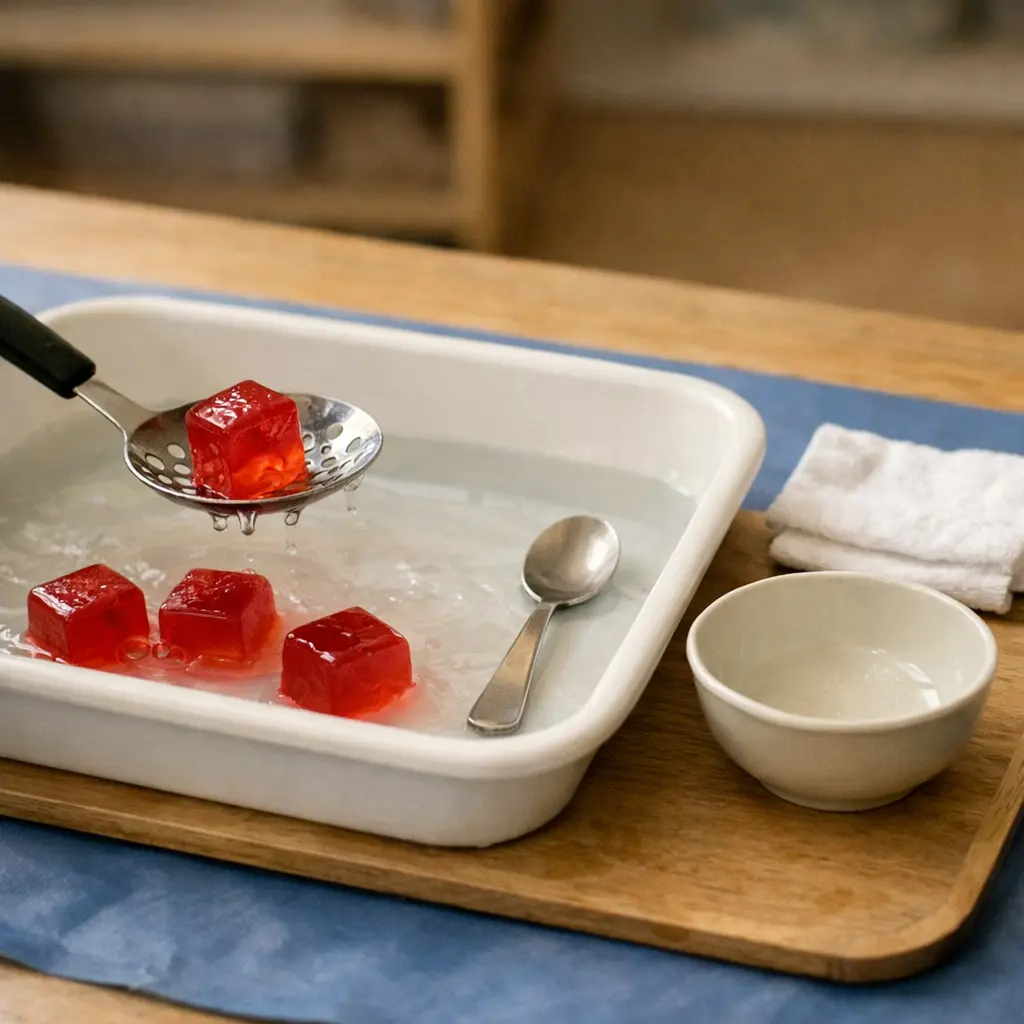
Place one flavour of firm jelly cubes in a shallow tray on a low table with a single small tray per child; limit cubes to four and provide one scoop, one spoon and one small collection bowl per child. Arrange tools in the order of use from left to right and include a cloth and discard bowl on the tray edge so children can reach, pour and return items independently. This simplifies the task to exploring wobble, firm break and scooping control.
Show the sequence once: lift a cube with the scoop, partially submerge, let it wobble and place it in the collection bowl, using minimal words. Then step back to a neutral position, keep language to short safety cues only, and avoid prompting. Observe for steady wrist rotation, repeated lifting or precise scooping attempts, signs of concentration or withdrawal, and whether the child notices changes in water or scent without adult direction.
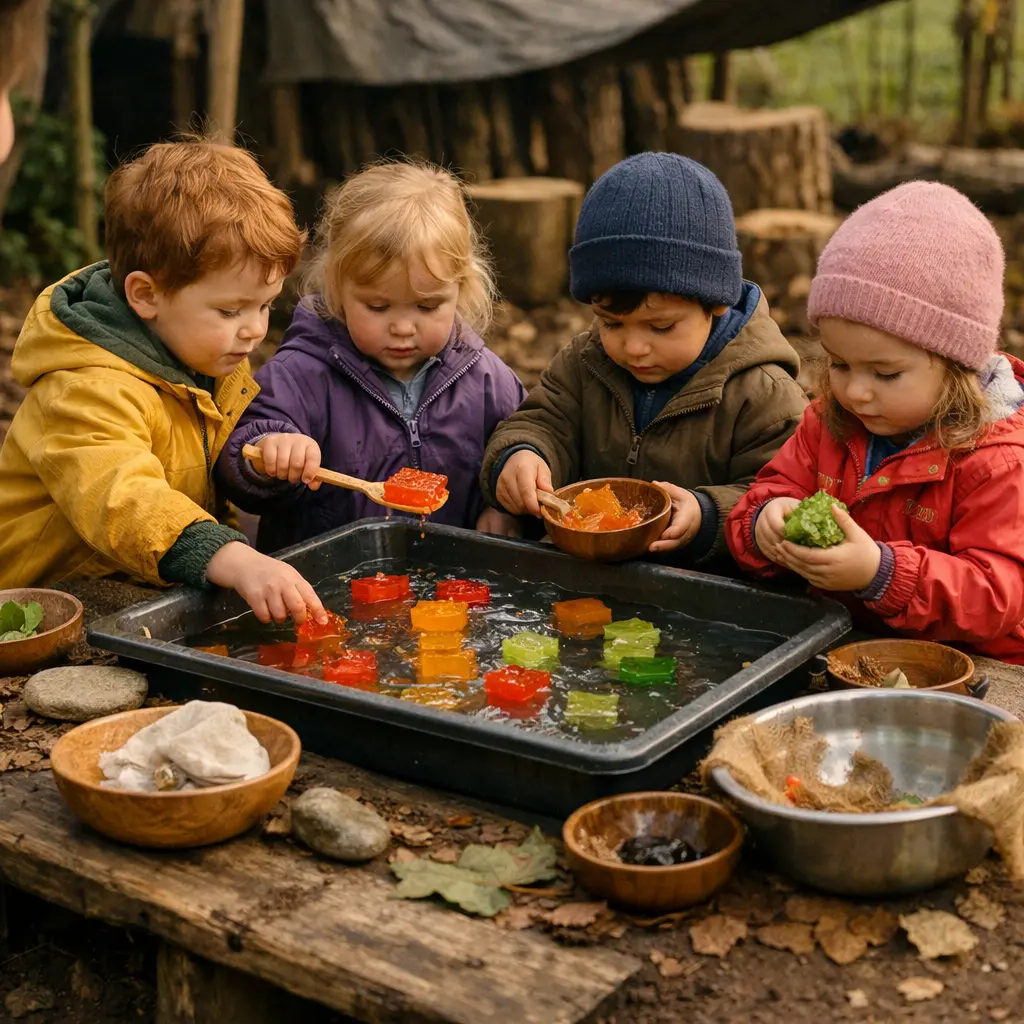
In an outdoor or nature-integrated space, move the shallow water tray to a sheltered corner of the garden or a paved area with a low log or crate as a table so children can stand or sit on uneven ground. Materials such as naturally flavoured jelly made from real fruit juice set in ice-cube-style moulds, wooden scoops, shallow wooden bowls, smooth stones, leaves and strips of burlap are provided in an open-ended way rather than pre-arranged, with spare cloths and a waste bowl nearby.
The adult observes from close by, checking safety and modelling brief vocabulary, then steps back to offer minimal, responsive prompts and single-word descriptions when invited. Children choose how to explore—squashing, scooping, lifting with wooden spoons, testing temperature and wobble, tasting small amounts if consented—and the adult intervenes only to manage spills, hygiene and food boundaries while supporting turn-taking and independent choice.
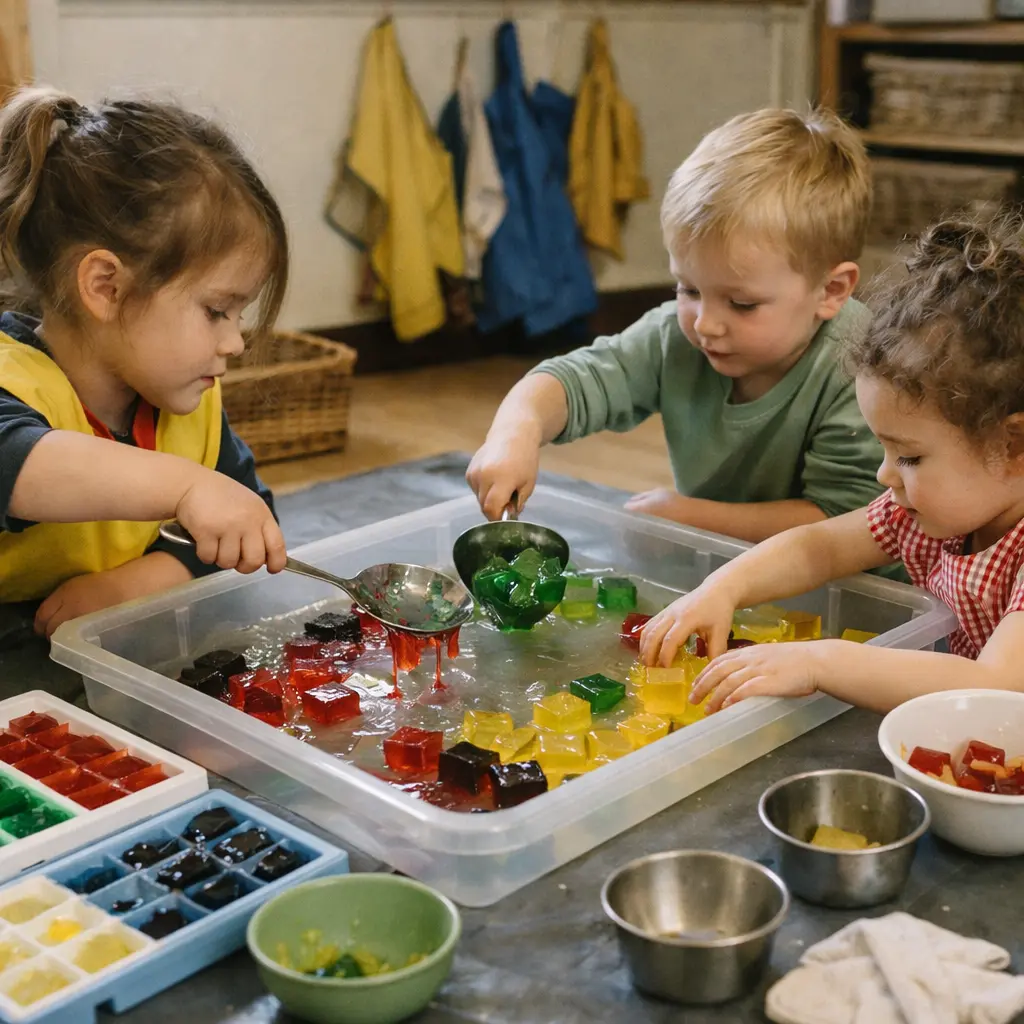
Set the shallow water tray at child height with space on all sides; place some firm jelly cubes already in the water and others still in their ice cube trays nearby so children can choose when and how to introduce them. Group large scoops, spoons, slotted spoon, small bowls, and cups within reach rather than handed out. Keep a clear area of water alongside a jelly-dense area to invite comparison, with aprons visible for self-selection and a wipe/discard bowl accessible so children can pause, remove pieces, or step away.
The adult stays close for food safety and sensory comfort, watching first. Use light commentary: “I can see that cube slipping away,” “You’re trying to catch the wobbly one,” “What happens if the piece stays in the water longer?” The child may sort cubes, test firmness, dissolve fragments, or create jelly “rain” with a slotted spoon, tasting small amounts by agreement. The adult notices grip changes, transfers, repeated experiments, descriptive words, preference signals, and how children track changes in the water.

A neutral cotton cloth defines a small, calm workspace with an enamel or stainless-steel shallow basin half-filled with cool water. Firm jelly cubes are prepared in advance using fruit juice and gelatine or agar, cut into simple blocks without added colourings. Only a few natural tools are set out: two wooden scoops or spoons, one metal slotted spoon, and two small ceramic bowls for collecting pieces, plus cotton cloths for hands and table. Spare cotton aprons sit nearby; handwashing and allergy checks are completed before starting.
The adult demonstrates a slow press, a steady scoop, and how to place a small piece into a bowl, without step-by-step talk, remaining close and observant. Quiet, occasional words name immediate qualities such as cold, wobbly, firm, sweet smell; tasting stays small, seated, and within agreed food boundaries. The child returns to grasping, squeezing, watching the jelly drift, transferring pieces, and, if chosen, tasting. Unhurried repetition is welcomed, ending with placing scraps in a bowl and wiping surfaces together.