Exploring farm animals in a cornflour cocoa mud tray with water for sensory play (1–4 years)
Sensory Play
Communication and Language
Two children stand at the tray while an adult places three chunky farm animals on the edge: a cow, a pig and a sheep. One child presses the pig into the brown, thick mixture and watches it slowly sink, then lifts it out and pats it flat with an open palm. The other child tips a small cup of water in and says, “More wet,” as the mud loosens and runs around the cow’s legs. The adult stays close and says, “It’s getting runnier now,” sliding a cloth nearer when the child rubs their fingers together and looks at their messy hands.
Children explore a shallow tray of cornflour-and-cocoa “mud” using small-world farm animals. The changing texture invites squeezing, patting, rolling and splashing, while children decide how the animals move and where they go. The play often becomes a mix of sensory investigation and simple story-making about farms, weather and animal care.
Step-by-Step Guidance
1. Prepare the space with a wipe-clean mat and a low table or floor area where children can stand or kneel comfortably. Place aprons/sleeves where children can choose them.
2. Add cornflour to the tray, then dust a small amount of cocoa powder over the top for colour. Keep extra cornflour and water nearby for quick texture adjustments.
3. Pour in a small amount of water and mix in the tray until you have a thick, muddy consistency. Aim for a shallow depth so animals can stand and children can see what they are doing.
4. Place a small set of farm animals beside the tray (not buried), so children can choose what to add. Offer a jug of water and one or two tools (for example a scoop and a brush) to avoid crowding.
5. Invite children to explore. Allow them to decide whether animals roll, stand, sink, splash, or get “stuck”. Stay close and narrate what you see using simple, accurate language.
6. If children ask for changes, support them to add a little water or cornflour and notice what happens to the texture. Keep changes small so the mixture stays manageable.
7. Support shared play by offering extra animals or a second tool when needed, and by naming turn-taking moments without directing the story.
8. Close the activity with a clear transition: offer a final moment to “park” animals on the tray edge, then move animals to a washing-up bowl or wipe station. Support handwashing and wipe down the area together.
Learning Objectives
Communication and Language: children may build vocabulary as they name animals, describe textures, and share simple ideas with others during play. Physical Development: children may practise hand strength and control as they scoop, press, pour and move animals through the mixture. Expressive Arts and Design: children may use the animals to create simple pretend scenarios and represent ideas through small-world play.
Adult Role
Stay emotionally attuned to children’s comfort with mess. Offer aprons, a cloth, or a nearby “clean hands” option without pressure, and accept children who prefer to watch first. Model language that matches what is happening: name animals, describe actions, and add texture words such as thick, runny, slippery, stuck, and splash.
Step in to scaffold when a child is unsure how to start, when sharing becomes difficult, or when the mixture needs adjusting; step back when children are repeating actions, building a storyline, or concentrating. Observe closely for how children manage sensory input, how they use tools, and how they communicate with peers. Hold responsibility for safe boundaries: keep the mixture shallow, supervise water use, prevent mouthing of materials, and support calm, hygienic clean-up.
Observation Cues
Does the child notice and comment when the mixture changes from powdery to thick or runny? Does the child use different actions (pat, squeeze, swirl, pour) to test what happens? Does the child move animals with purpose (lining up, grouping, making tracks, “washing” or “feeding”)? What words or sounds does the child use (animal names, action words, texture words like wet/dry/sticky/smooth)? Does the child watch others and join in, take turns with tools, or protect their space? Does the child tolerate messy hands, seek wiping, or return after cleaning?
Time & Space
15–35 minutes, plus clean-up time.
A wipe-clean floor area or low table space for a large shallow tray, with nearby access to handwashing and a drying area for animals.
Materials
Safety
Age adaptations
Budding Adventurers
Offer a wider tray and a small set of animals plus one jug for adding water with adult support. Add a brush for “washing” and a cup for pouring, keeping duplicates limited to reduce conflict. Use simple choices (“more water or more powder?”) and reflect their play (“the pig is stuck; you’re pulling it out”).
Curious Investigators
Provide a slightly larger range of animals and two tools that do different jobs (for example a scoop and a brush). Keep extra cornflour and water accessible so children can request changes and help adjust the mixture in small amounts. Extend language with gentle prompts about what they notice (“It’s getting runnier—what changed?”) and support cooperative storylines without assigning roles.
Confident Discoverers
Add a simple “care station” beside the tray: a bowl of clean water for rinsing animals and a towel for drying, so children can manage transitions in their play. Offer a small jug with a controlled pour and invite children to describe and compare textures as they adjust the mixture. Support longer shared narratives (for example, animals sheltering from “rain” or getting cleaned after the “field”) while keeping the play child-led.
EYFS Links
Communication and Language: children may listen to others’ ideas, use new words for animals and actions, and practise back-and-forth talk as they play alongside peers. Physical Development: repeated scooping, squeezing, pouring and moving animals can support hand strength, coordination and controlled movements, with opportunities to manage mess and hygiene routines. Expressive Arts and Design: small-world play allows children to represent experiences (farm, weather, animal care) and combine sensory exploration with imaginative scenarios that can change moment by moment.
Ethos adaptations

Set up one shallow tray on a low table or mat with a single bowl of mixed cornflour-and-cocoa, one small water jug marked with a single fill line, and three chunky farm animals placed in a row on a narrow tray to the side. Remove extra cups and tools so the child focuses on scooping, pressing and moving animals through the mud; provide one spoon and one cloth for wiping. Keep the workspace clear and reachable so the child can manage all steps independently.
Show the whole sequence once: lift an animal, scoop mud, pour water to the fill line, and return the animal to its spot, using a slow, quiet demonstration with minimal words. Then step back and limit language to brief safety reminders only. Observe for repeated controlled movements, careful pouring that shows self-correction, hand strength in scooping and returning, and signs of sustained concentration or shifting interest rather than directing play.
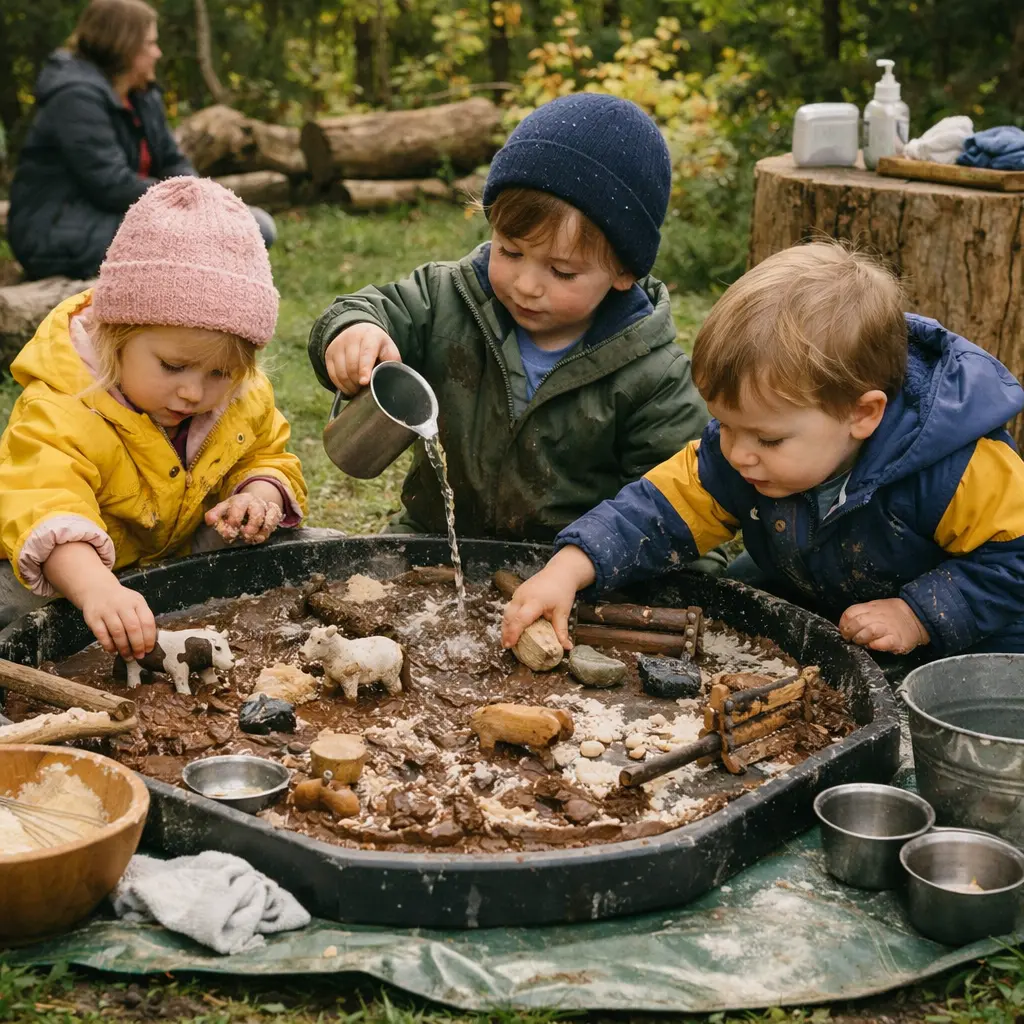
In an outdoor or nature-integrated space, move the shallow tray onto a waterproof groundsheet on grass or a sheltered patio so children can feel uneven surfaces and fresh air while they play. Materials such as a cornflour-cocoa mix are kept but complemented with natural alternatives: small wooden or stone farm animals, smooth pebbles, sticks for fences, and a jug of water for pouring. Materials are arranged openly rather than pre-set, with spare bowls, cloths and a handwashing station nearby for hygiene and quick checks.
The adult observes from a short distance, checking safety and the stability of the tray, then steps back to offer minimal, responsive comments or single-word prompts as needed. Children choose their pace, roles and stories, scooping, pressing, pouring and moving animals through changing textures and water with repeated exploration. The adult helps only to manage risk or join briefly on invitation, modelling calm handling and then returning to observation so children lead the play.

Ethos adaptation: Arrange the tray area as an open invitation—several low, reachable stations (tray, bowls of dry cornflour, cocoa, water) spaced so children can choose where to work, sit or stand. Replace single-purpose tools with a variety of loose parts: different cups, scoops, natural items (leaves, pebbles), cloths and brushes so materials can be combined, separated, pressed or floated. Keep handwashing and mats visible; materials remain accessible rather than being handed out in a fixed sequence so the child may enter and leave the play at will.
The adult steps back as observer and co-researcher, offering commentary not instruction: "I can see the mud feels different when you add water," "You're trying to move the cow through the puddle," "What happens if you use a brush?" The child may invent care routines, make weather stories, repeat actions or abandon and return; the adult notices language use, bilateral hand actions, turn-taking attempts and problem-solving strategies as natural observation cues embedded in the flow.

A low wooden tray is set on a neutral cotton mat to mark the play space, with a small bowl of water and an enamel jug at one side. The cornflour and a little cocoa are in a wooden bowl with a wooden spoon for mixing, then tipped into the tray. Only a few carved wooden or felted-wool farm animals are offered, along with one small wooden scoop, a ceramic cup, and a natural‑bristle brush. Soft cotton cloths for drying and a nearby handwashing station are prepared. Colours and quantities remain simple and calm.
The adult demonstrates quietly how to add a little water, stir, press the mixture with the palm, and rinse an animal, placing it on a cloth to dry, then steps back. Language is minimal; the adult observes and attends to safety and hygiene. The child mixes, squeezes, pats, pours, and moves the animals at their own pace, returning to familiar actions and simple stories about care and weather. Play closes with the child helping place animals on the drying cloth and wiping the mat.