Exploring cultural foods for snack time through a local walk and shared tasting
Communication and Language
Children explore a small range of culturally diverse foods as part of a shared snack routine, with options to include items sourced on a local walk and family contributions with clear ingredient information. Adults offer safe choices and simple preparation opportunities so children can notice smell, texture and taste at their own pace. Practitioners pay attention to children’s communication, willingness to approach unfamiliar foods, and how they manage turn-taking and hygiene within the group.
Children explore a range of foods linked to different cultures and communities, with a focus on noticing similarities and differences in smell, texture, appearance and taste. The experience can include a local walk to source a small selection of foods and an option for families to contribute traditional home-prepared items. Children may take part in simple preparation and serving, building familiarity with food routines and respectful curiosity about one another. The adult keeps the experience inclusive by offering choice, clear information and predictable routines.
Step-by-Step Guidance
1. Plan the focus: choose a small number of foods linked to cultures represented in the setting and local community, balancing familiar and less familiar options. Confirm dietary needs, allergies and restrictions, and decide which foods are safe to offer.
2. Prepare family contribution route (optional): send a clear request for traditional home-prepared foods with a requirement for a full ingredient list, preparation date, and storage needs. Confirm you can store items safely and that contributions align with allergy controls.
3. Set up the environment: create a calm snack area with a clear serving point, handwashing access, and a separate space for preparation. Place labels and ingredient sheets where adults can quickly check them.
4. Prepare for the walk: share a simple purpose with children (finding foods for snack) and show picture prompts. Agree boundaries, adult-to-child ratios, and how foods will be carried back safely.
5. On the walk: support children to notice food shops, markets or community spaces and to help select items from the planned list. Keep choices limited and predictable, and avoid unplanned foods that complicate allergy checks.
6. Return and transition: support handwashing and settle children into the snack routine. Place foods out in small portions with clear labels.
7. Invite children into preparation: offer a small number of safe tasks such as washing fruit, tearing bread, spooning dips, peeling easy skins, or arranging pieces on plates. Present one task at a time and keep tools consistent.
8. Offer tasting with choice: provide a familiar “safe” option alongside new foods. Encourage smelling, touching or licking as valid exploration, and accept refusal without pressure.
9. Support shared talk: model simple descriptive language (crunchy, smooth, sweet, salty, warm, cool) and respectful curiosity about where foods might be eaten or shared.
10. Close the routine: involve children in clearing, wiping tables, and sorting waste/compost where appropriate. Record any allergy-related notes, strong preferences, or emerging cultural links to revisit in future snack planning.
Learning Objectives
Children may broaden their willingness to explore unfamiliar foods through sensory investigation and shared snack routines, supporting Personal, Social and Emotional Development. Children may use words, gestures and signs to describe what they notice and to express preferences, supporting Communication and Language. Children may practise simple food preparation actions and self-care routines such as handwashing and serving, supporting Physical Development.
Adult Role
Stay emotionally attuned by noticing hesitation, excitement or worry around unfamiliar foods and responding with calm reassurance and clear choices. Model respectful language about difference, avoiding judgement words such as “weird” or “yucky”, and offer neutral descriptions that children can copy. Scaffold when a child wants to join preparation by breaking tasks into single steps and offering stable tools, and step back when children are safely managing a task or exploring independently. Observe closely for allergy risks, cross-contamination, and children sharing food; intervene early with clear, consistent boundaries and hygiene routines. Keep the experience inclusive by ensuring every child has a safe option and by valuing home knowledge without putting any child on the spot to represent a culture.
Observation Cues
Notices and comments on colour, shape, smell, texture or temperature of foods.
Uses words, signs or gestures to express preference, refusal, curiosity or uncertainty.
Watches peers and copies safe preparation actions (e.g. peeling, tearing, spreading) with support.
Shows awareness of turn-taking and shared routines (waiting, offering, passing, clearing away).
Makes links to home experiences (names a food, place, celebration, family routine).
Manages new tastes by taking small amounts, smelling first, or choosing a familiar option.
Time & Space
45–90 minutes depending on walk length and preparation time; tasting can be 15–25 minutes within that.
Access to a safe local walking route and a calm snack area with a handwashing point. A separate, clean surface for food preparation is needed to manage hygiene and allergens.
Materials
Safety
Age adaptations
Budding Adventurers
Offer a slightly wider range and include one food that can be prepared with a clear action (spreading, tearing, peeling). Provide child-safe tools and demonstrate one action at a time, keeping portions small to reduce waste and overwhelm. Invite children to help make a simple shared platter with labelled sections, supporting early categorising (soft/hard, sweet/savoury) without testing. Adults watch for food swapping and support children to ask for more using words or signs.
Curious Investigators
Include foods with more distinct flavours and textures and invite children to help create a simple tasting chart using pictures (liked/unsure/not today). Offer roles such as label maker, server with tongs, or ingredient checker with an adult, reinforcing that labels keep everyone safe. Encourage children to share home connections if they choose, and model respectful listening. Extend the walk by noticing community food places and adding new vocabulary linked to shops and ingredients.
Confident Discoverers
Invite children to help plan a small menu from a limited set of options, considering a class allergy list with adult guidance. Offer more complex preparation sequences with clear boundaries (wash, cut with a child-safe knife, arrange, serve) and introduce simple hygiene reasoning (clean hands, separate utensils). Support children to compare foods thoughtfully (similar to, different from) and to record observations through drawing or simple writing. Encourage children to practise hosting skills such as offering, checking consent, and clearing responsibly.
EYFS Links
Personal, Social and Emotional Development: Shared snack routines support children to practise turn-taking, expressing preferences, and respecting others’ choices, including refusal. Communication and Language: Adults model descriptive vocabulary and support children to communicate needs and curiosity about foods and home experiences. Physical Development: Handwashing, serving, and simple preparation actions support coordination and self-care routines, with adults adapting tools and expectations to age and safety. Understanding the World: Exploring foods from different cultures and local community sources supports children to notice diversity in everyday life and make links between home, setting and the wider community.
Ethos adaptations
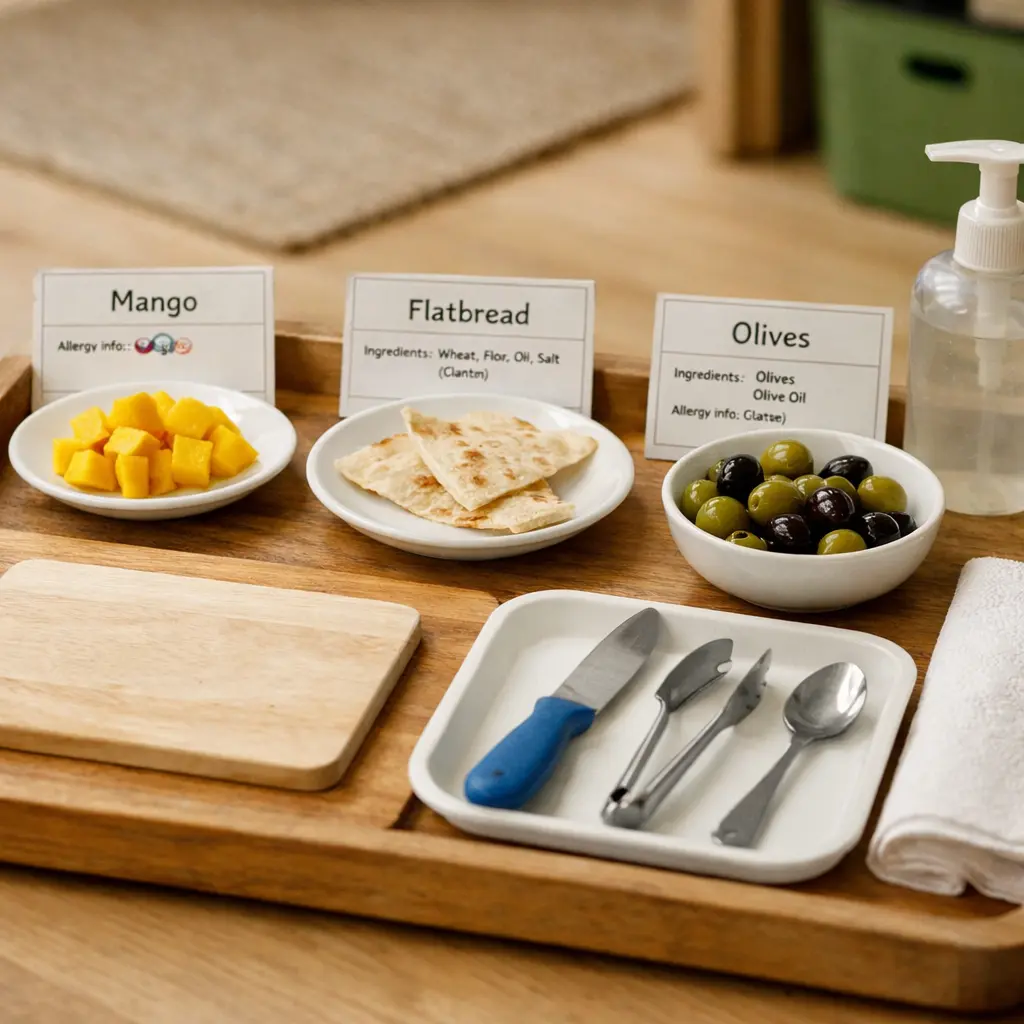
Set out a small, ordered selection of three foods on a low tray or on three marked mats so children handle one item at a time; place its allergen/ingredient card and a simple label beside each plate. Provide one set of child-sized serving tools and a single child-safe knife on a separate tray for chopping practice; remove extra containers and decorative items so the task is clearly about smelling, touching, cutting and tasting each sample in sequence. Keep handwashing supplies and waste bin within the same defined workspace.
Introduce the activity with one slow, silent demonstration: wash hands, use the knife to cut a small piece, show how to smell, taste and place the finished sample on the tray, then step back. Use minimal language afterwards, offering brief safety reminders only; avoid prompts or questions while children work. Observe for steady hand control, repeated exploration of a single food, emerging descriptive words or gestures, and clear signs of preference or refusal rather than directing choices.

In a nearby green space or sheltered garden area, move the tasting to a picnic-style outdoor setting with uneven grass, logs for seating and a low table or blanket on earth. Materials such as wooden boards, bowls, spoons and real fruit, breads and dips are provided in an open-ended way rather than pre-plated portions; leaves and clean large stones can be used as temporary serving bases. Children may collect safe natural items (twigs, leaves) to personalise plates as they follow a simple picture shopping list on the walk.
The adult observes from close by, manages food safety and allergies, prompts handwashing and checks consent but steps back from step-by-step instruction. Materials are arranged for choice and repeated tasting; the adult offers minimal, responsive language and single-word descriptors or questions when needed. Children choose, prepare and serve in small groups, pass items, describe smells and textures and may negotiate turns, with the adult intervening only to manage risk or hygiene.
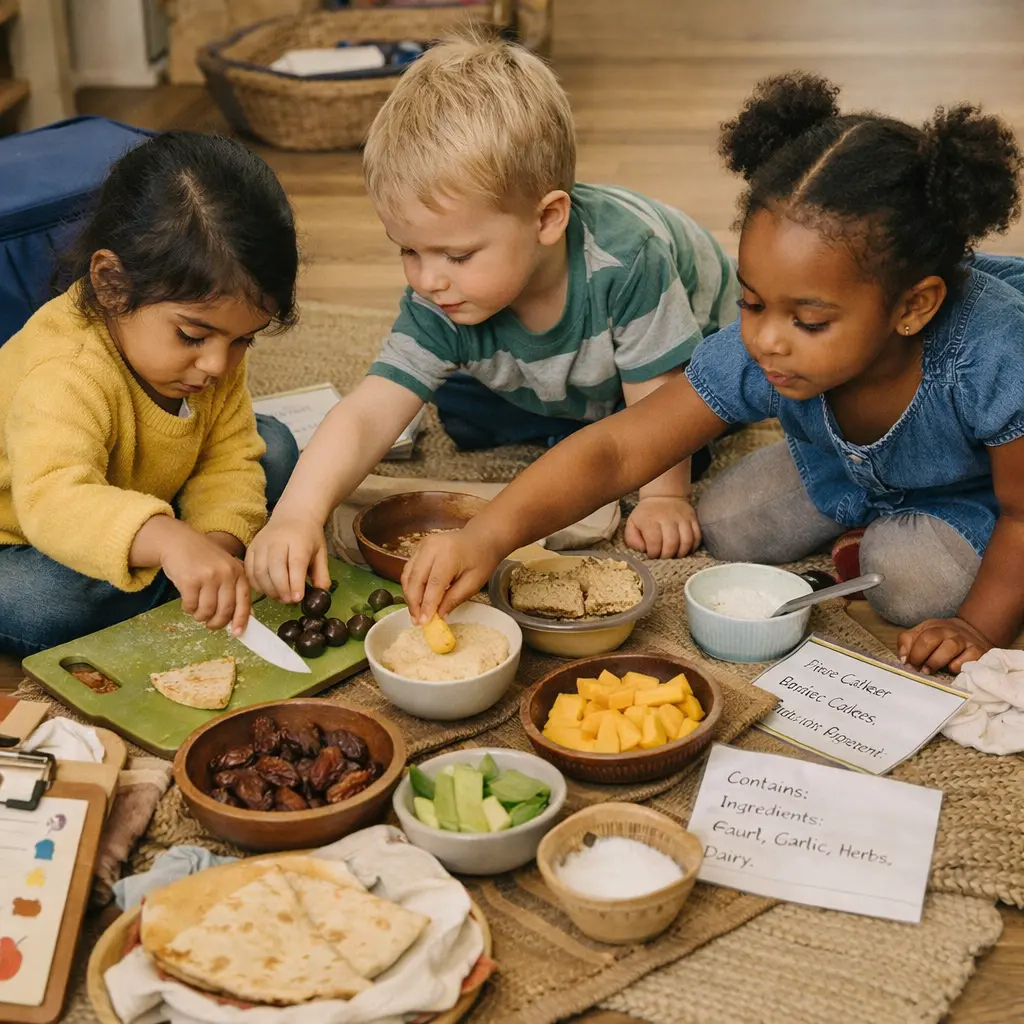
Reconfigure the snack area into low, open stations and a take-along collection point for the walk so materials invite self-selection: baskets, trays, clipboards with the pictorial shopping list, cool bag for perishables and a display table where foods sit loosely with child-sized bowls, spoons, fabrics, small scales and water jars. Allergen sheets and consent notes remain visible but do not predefine use; children may touch, smell, move and combine items so the materials remain multi-purpose and non-prescriptive, supporting safe exploration and familiar food routines.
The adult steps back as observer and co-researcher, using reflective commentary such as "I can see you’re noticing the texture" or "What happens if you try that with the spoon?" rather than directing steps, and offering ingredient information when requested. The child may choose routes: collecting on the walk, preparing, serving, tasting or declining; the adult notices emerging social negotiation, motor coordination during handwashing and cutting, new vocabulary, expressions of preference and patterns of return or avoidance, documenting these moments within the flow of the experience.

Choose a small number of simple, wholesome foods and present them in a calm, uncluttered space with natural materials (wooden boards, cloth napkins) and a predictable rhythm to the snack. Emphasise gentle preparation tasks that suit the group, such as washing, peeling, and arranging, keeping the sensory experience unhurried and avoiding overstimulation from too many options.
Use warm, simple language and model gratitude and care for food without requiring children to taste. Keep adult guidance steady and rhythmic, supporting children to join in through imitation rather than frequent instruction. Observe mood, appetite cues, and how children settle into the routine, responding by simplifying the environment, slowing transitions, and offering a consistent familiar option alongside any new food.