Exploring citrus slices in a water tray with jugs and cups for taste-safe sensory play (0–4 years)
Sensory Play
Two children stand shoulder-to-shoulder at the water tray while an adult kneels nearby with a towel folded on the floor. One child slides a lemon slice across the surface, then presses it under with fingertips and watches it bob back up. The other child fills a small jug from a cup, pours into a second cup, and says “More” as the water line rises. The adult names what is happening—“Float… and up again”—and shifts the jug slightly away from the edge when it wobbles.
Children explore floating, sinking, pouring and scooping in a water tray that includes sliced oranges, lemons and limes. The citrus adds smell, colour and texture, which can hold attention and invite repeated investigation. Because the materials are taste-safe, children who mouth items can be supported to explore more safely while adults stay close and responsive.
Step-by-Step Guidance
1. Prepare the area with a non-slip mat and towels where the tray will sit, and place a dry towel within reach for quick hands.
2. Fill the tray with a shallow level of warm water. Keep the water low enough that children can lean in without soaking sleeves.
3. Add a small number of citrus slices to start (a few of each). Check slices for pips and remove any loose peel pieces.
4. Place jugs and cups beside the tray, grouped so children can see choices. Include at least one cup that is easy to grip and one that holds more water for comparison.
5. Invite children to approach and explore. Offer a brief, simple model if needed: lift a slice, let it drip, place it back, then pour water from a cup into the tray.
6. Stay close as children pour and mouth items. If a child brings a slice to their mouth, name what you see and support safe pacing: “You’re tasting lemon. It’s sour.”
7. Follow children’s interests. If they focus on squeezing, offer a slice that is easier to hold; if they focus on pouring, place two cups side by side to pour between.
8. Support turn-taking when tools are limited by offering a second cup or narrating a wait: “You’re holding the jug. When you’re finished, it can be Sam’s turn.”
9. Refresh the experience by swapping in a few new slices when the water becomes cloudy, or by removing some tools to reduce clutter if children seem overwhelmed.
10. Close the activity with a clear tidy routine. Tip water away, wipe the tray, and dispose of used citrus. Offer handwashing and dry clothes if needed.
Learning Objectives
In Physical Development, children can practise grasping, pouring, squeezing and transferring as they handle citrus and water tools. In Communication and Language, children may build words for what they notice, such as wet/dry, float/sink, smooth/bumpy and sour/sweet. In Understanding the World, children can explore simple cause and effect as water level changes and citrus moves in different ways.
Adult Role
Stay emotionally attuned, especially for children who dislike wet sleeves or strong smells. Offer calm reassurance and a predictable presence near the tray so children can return to exploration after a startle or spill.
Model simple, accurate language that matches what children are doing: pour, fill, empty, squeeze, float, sink, slippery, sour, smell. Use short comments more than questions, and repeat key words as children act.
Scaffold only when it helps the child continue safely or successfully, such as steadying a jug for a first pour or offering a smaller cup. Step back when a child is repeating a sequence or concentrating, and avoid correcting their method if it is safe.
Observe in the moment: notice how children manage slippery objects, how they respond to citrus smell/taste, and how they negotiate tools with others. Hold the safety boundary by keeping water shallow, supervising mouthing, and removing any torn peel or small loose pieces promptly.
Observation Cues
Does the child bring citrus close to their nose, mouth, or cheeks, and how do they react to the smell or taste?
Do they experiment with floating and pushing slices under, then watching them pop back up?
Do they change their grip when a slice is slippery, or when a jug feels heavy?
Do they repeat a sequence (fill, pour, refill) and adjust when water spills?
Do they use words, sounds, or gestures to request a tool, comment on smell, or share a discovery?
Do they notice differences between orange, lemon and lime (colour, thickness, texture) and show a preference?
Time & Space
10–30 minutes, depending on children’s interest and how quickly the water becomes cloudy.
A wipe-clean floor area or low table space for a water tray, with room for 2–4 children to stand or sit around it and for towels nearby.
Materials
Safety
Age adaptations
Budding Adventurers
Offer cups in two clear sizes and one jug that becomes noticeably heavier when full. Add a small bowl beside the tray as a “citrus parking place” so children can move slices between wet and dry spaces. Support children to compare: “This cup is full. This one is empty.” If children start squeezing slices, name the change you see in the water and the slice.
Curious Investigators
Add a second container next to the tray (empty to start) so children can transfer water and slices between two spaces. Offer a simple choice of tools rather than many: one jug, two cups, one sieve. Use language that extends thinking without directing: “You pushed it down and it came back up. What do you notice?” Encourage children to describe differences between orange, lemon and lime using colour, smell and texture words.
Confident Discoverers
Provide a small set of matching cups and one larger jug so children can explore repeated filling and emptying. Add a clear container with a marked line (tape) for children who want a target for filling. Invite children to create their own sorting or patterning with slices (by colour or size) alongside the water play, and to explain their plan to a friend. Step back to allow collaborative problem-solving around sharing tools and organising the space.
EYFS Links
Physical Development: children handle slippery slices and manage pouring tools, which can build hand strength, coordination and control through repeated actions.
Communication and Language: adults can model clear vocabulary linked to what children are doing and noticing, supporting children to comment, request and share discoveries.
Understanding the World: children explore cause and effect (pushing slices under, watching them float; changing water level; squeezing and seeing juice mix), and notice differences between materials through sensory investigation.
Personal, Social and Emotional Development: when more than one child plays, the shared tray creates natural moments for turn-taking, coping with spills, and returning to play after frustration with slippery tools.
Ethos adaptations

Place a small tray beside the water tray with only three citrus slices (one orange, one lemon, one lime), one small jug, and one cup, each set on a marked spot so the child can return items independently. Keep the water level consistent and offer only one drying cloth placed at the top-right of the workspace, so drips become visible and manageable without extra adult tools. Replace mixed cups with one cup that has a clear fill line (tape) to isolate one controlled pour and make overfilling obvious.
Give one slow, silent demonstration (fill to the line, pause, pour, return each item to its spot), then sit slightly to the side and keep your hands in your lap unless safety requires otherwise. Limit language to precise naming and one boundary (“Water stays in the tray”), and avoid questions or extra suggestions while the child works. Watch for repetition, careful wrist control, and self-correction when the child notices a spill or a cup above the line; respond by quietly resetting the cloth or refilling the jug only after the child has tried, or when the child brings you the item to show they want help.

Set the water play outdoors on stable ground, using a large shallow tub and a second container for carrying and tipping, positioned so children can choose where to work (sun, shade, or a sheltered spot). Offer citrus slices alongside a small, checked collection of natural loose parts (smooth stones, leaves, short sticks) and one real, robust tool such as a metal ladle, keeping quantities low so children can find and return items. Keep a clear boundary line (cones, rope, or a log) that marks the water area and a separate dry area for placing found objects.
The adult does a quick site scan and makes three decisions in the moment: adjust the location if the ground becomes slippery, limit carrying distance if children start running with full containers, and pause the activity if the weather makes cold hands likely. Use short observations rather than instructions (“That stick makes a bigger splash”) and let children decide whether they are mixing, transporting, or testing what floats. Watch how children manage uneven ground, how they negotiate shared tools, and how they respond to splashes and changing weather; step in to steady a container, agree a turn-taking plan only when conflict builds, and then step back again.
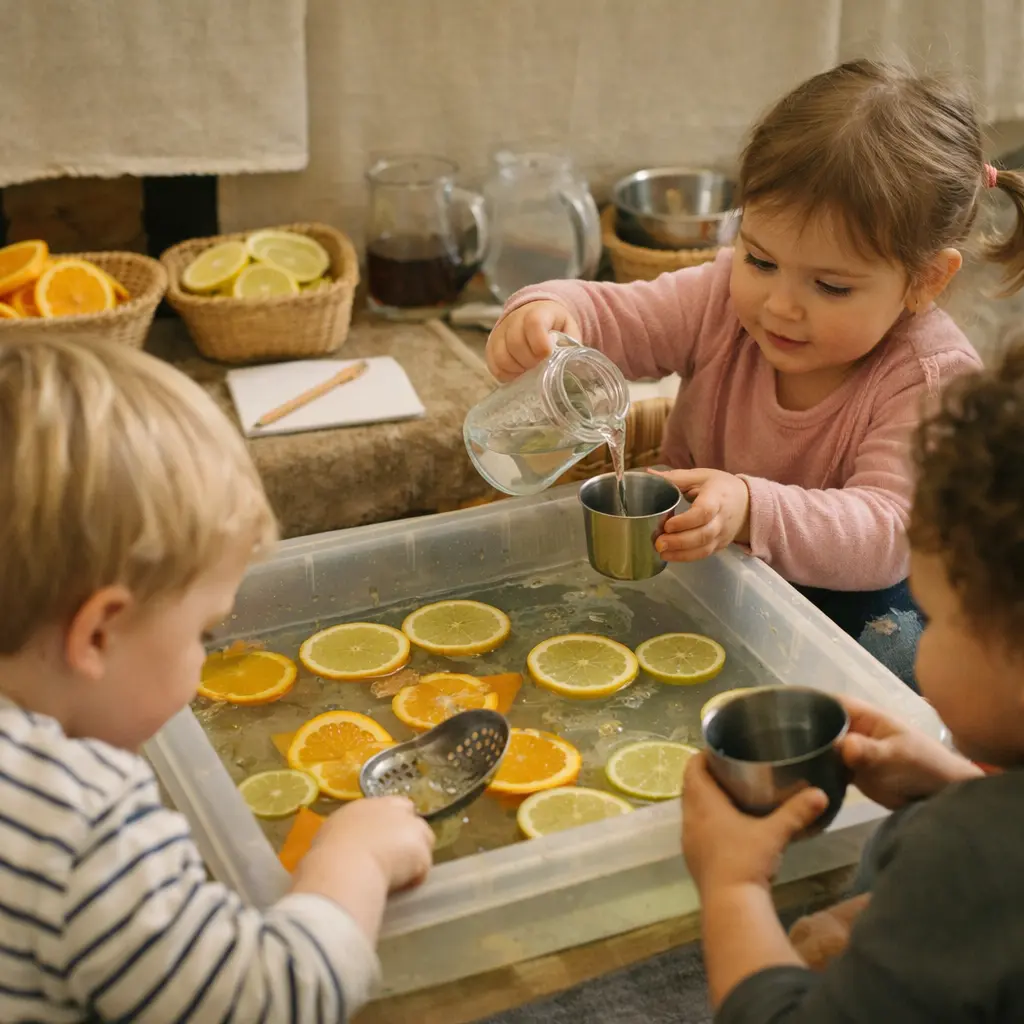
Reconfigure the space as a small “water and citrus studio” with the tray centred on a low table, a dry investigation area beside it (a cloth-covered surface), and materials displayed openly in shallow baskets so children can choose. Include citrus slices, jugs and cups, plus a few additional open-ended vessels (clear jars, metal bowls) to invite different ideas about pouring, collecting and showing.
Position yourself as a listener and co-researcher, using commentary that follows children’s theories: “You’re keeping the lime in the small cup,” “I can see you’re making the water smell stronger.” Offer a pencil and a simple sheet nearby for quick marks or a photo to capture children’s arrangements, then return to the play. Notice which combinations children repeat, how they collaborate around space and materials, and how their language changes when they compare orange, lemon and lime.
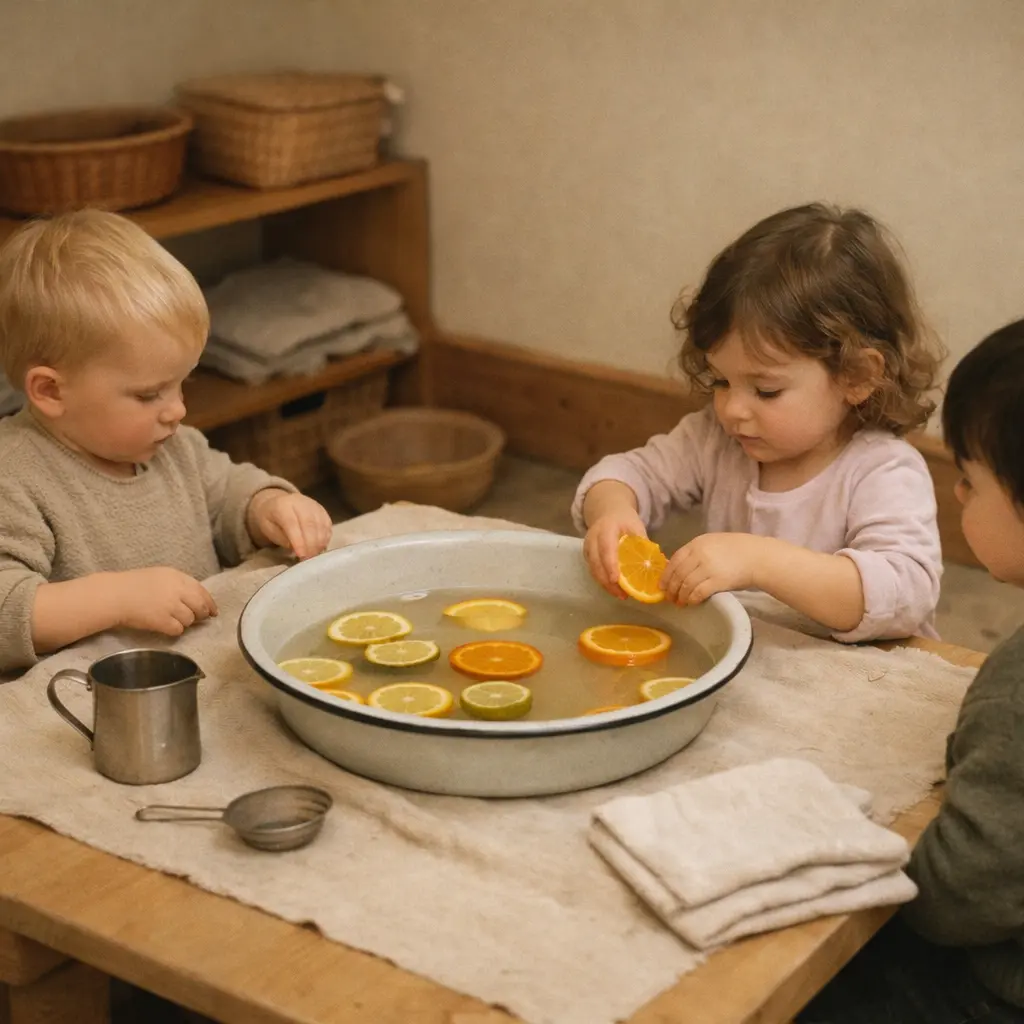
Lay a plain cotton cloth under a shallow bowl of warm water in a quiet corner, and offer only a few thick citrus slices with one small metal cup and one simple jug. Keep the space uncluttered by placing spare slices in a covered bowl just out of reach, and keep a second cloth ready for drying hands so the area stays calm and contained. Choose natural, muted items only and remove bright plastic tools from view.
The adult makes a steady rhythm: a quiet pour, a pause, a slow lift-and-drip, then stillness. Use minimal words that match the moment (“warm”, “drip”, “orange”) and avoid explaining or questioning while the child works. Watch for the child returning to the same movement, slowing to smell, or changing grip when the slice becomes slippery; respond by silently swapping in a fresh cloth, reducing the amount of water if splashing increases, or modelling one calm movement again only when the child seeks it.