Exploring cause and effect by pulling spring scarves from containers and refilling them (0–4 years)
Sensory Play
Two children sit on the mat with a tissue box and a short cardboard tube between them. One child pulls a yellow scarf from the tube, then pauses and peers inside, fingers searching for the next corner. The adult shifts the tube a little closer and says, “You found the end,” then stays quiet. The second child pushes a blue scarf into the tissue box slot, pats it down, and watches as a small triangle of fabric pops back up through the slit.
Children explore what happens when they pull lightweight scarves from different containers and then choose how to put them back. The repeated emptying and filling can feel satisfying and gives lots of chances to notice “more/less”, “in/out”, and “stuck/free”. Using a small range of textures keeps the experience sensory without becoming overwhelming.
Step-by-Step Guidance
1. Prepare a clear floor space and place a low-sided tray or mat down to catch scarves and define where the activity happens.
2. Choose 2–3 containers with clearly different openings (wide basket, narrow slit box, tube). Place them on the tray with space between each one.
3. Part-fill each container with one scarf so a small end is visible and easy to grasp. Keep the remaining scarves beside the tray rather than all mixed in.
4. Invite the child to explore. Let them choose a container and pull the scarf out in their own way.
5. As the child empties a container, pause before offering ideas. Watch whether they look for another scarf end, tip the container, or reach inside.
6. When the child shows interest in putting scarves back, model one slow refill into a container (push down gently, leave a small end showing), then return the container to the child.
7. Offer a second container as a “finished” place if the child starts collecting scarves, or keep the focus on emptying and refilling the same container if they repeat.
8. Rotate one container if interest drops (for example, swap a wide opening for a narrow slit) while keeping the number of materials small.
9. End with a simple tidy routine: place scarves into one container together, leaving one scarf end visible for the next time.
Learning Objectives
Physical Development: children can practise grasping, pulling, releasing and two-handed coordination as they remove and return scarves. Communication and Language: children may build understanding and use of simple positional words such as in, out, under, and more as they play. Understanding the World: children can notice simple cause and effect, such as how the container opening or material texture changes what happens when they pull.
Adult Role
Stay close and calm, matching the child’s pace and noticing when they are concentrating or becoming frustrated. Use short, descriptive language that fits what the child is doing, such as “You pulled it out”, “It’s stuck”, “In the box”, “All gone”, and pause to give the child time to respond. Step in to scaffold only when the child is stuck for a while (for example, by turning the container so the opening is easier to reach or by showing how to find the scarf end), then step back again. Observe grip, two-handed use, persistence, and whether the child repeats emptying and filling or changes strategy across containers. Hold responsibility for safety by checking containers for sharp edges, supervising any textured pieces closely, and keeping the play area clear to reduce slipping on scarves.
Observation Cues
Does the child use one hand or two hands to pull, and do they change grip when the scarf catches? Does the child repeat emptying and filling in a steady pattern, or switch between containers to compare? Do they look inside, tip the container, or reach in when the scarf end is hard to find? Do they use words or gestures like “more”, “again”, “stuck”, “in”, “out”, or offer a scarf to an adult or peer? Do they begin to push scarves down to make space, or pause to watch what happens when they pull quickly versus slowly?
Time & Space
10–20 minutes, with the option to return to it across the day.
A clear floor area with room for a low tray or mat and for scarves to spread without becoming a trip hazard; suitable for indoors or a sheltered outdoor space.
Materials
Safety
Age adaptations
Budding Adventurers
Provide 4–6 scarves across 3 containers, including one that needs more control (cardboard tube or lidded tub with a hole). Let the child decide whether to sort by colour, fill one container completely, or move scarves between containers. Introduce simple choices in language: “Which one next?” and positional words: “under”, “inside”, “through”. If frustration rises, adjust the challenge by widening the opening or leaving a longer scarf end visible.
Curious Investigators
Add a clear “start” container and an “all back” container so children can create their own systems for emptying and refilling. Include one container that changes the effect (drawstring bag that tightens, or a narrow slit box) and invite predictions in the moment: “What do you think will happen if you pull fast?” Support children to describe texture and movement: “slippery”, “stuck”, “slides”. Allow peer play where one child refills while another pulls, stepping in only to support turn-taking if needed.
Confident Discoverers
Offer a small set of containers with clearly different mechanisms (tube, slit box, drawstring bag) and a limited number of scarves so children can notice differences without clutter. Children can set their own challenge, such as keeping one end showing each time, timing how long it takes to empty and refill, or creating a simple rule for sorting. Use richer language when it fits the play: “narrow/wide”, “tight/loose”, “faster/slower”, and reflect back children’s ideas rather than correcting their method.
EYFS Links
Physical Development: repeated pulling, grasping, releasing and pushing materials back into containers gives practice with hand strength, coordination and controlled movement. Communication and Language: adults can model simple action and positional words in a meaningful context, and children may use gestures or words to request “more” or describe what is happening. Understanding the World: children can notice cause and effect as different openings and textures change how easily a scarf moves, and they can test their own ideas by repeating actions.
Ethos adaptations

Place one posting-style container and two scarves on a small tray on a low shelf, with the scarves folded the same way and one end clearly visible. Choose one container that makes the control of error clear (a slot that shows when the scarf is aligned) and remove extra containers so the focus stays on one movement. Put a small work mat beside the shelf and keep spare scarves out of sight so the child can carry the tray, work, and return it without adult sorting.
The adult makes a brief, precise presentation: carries the tray to the mat, sits to the side, and demonstrates once with slow hands and minimal words (pinch, pull, fold, post, leave a small end showing). The adult then steps back and avoids questioning or repeated prompting, only naming an action if the child seeks language (“pull”, “in”, “out”). The adult watches for repetition, careful alignment at the slot, and self-correction when the scarf bunches; if the child struggles for a sustained period, the adult adjusts one variable only (re-folds a single scarf, rotates the box so the slot faces the child, or swaps to a slightly wider slot) and returns to observing.
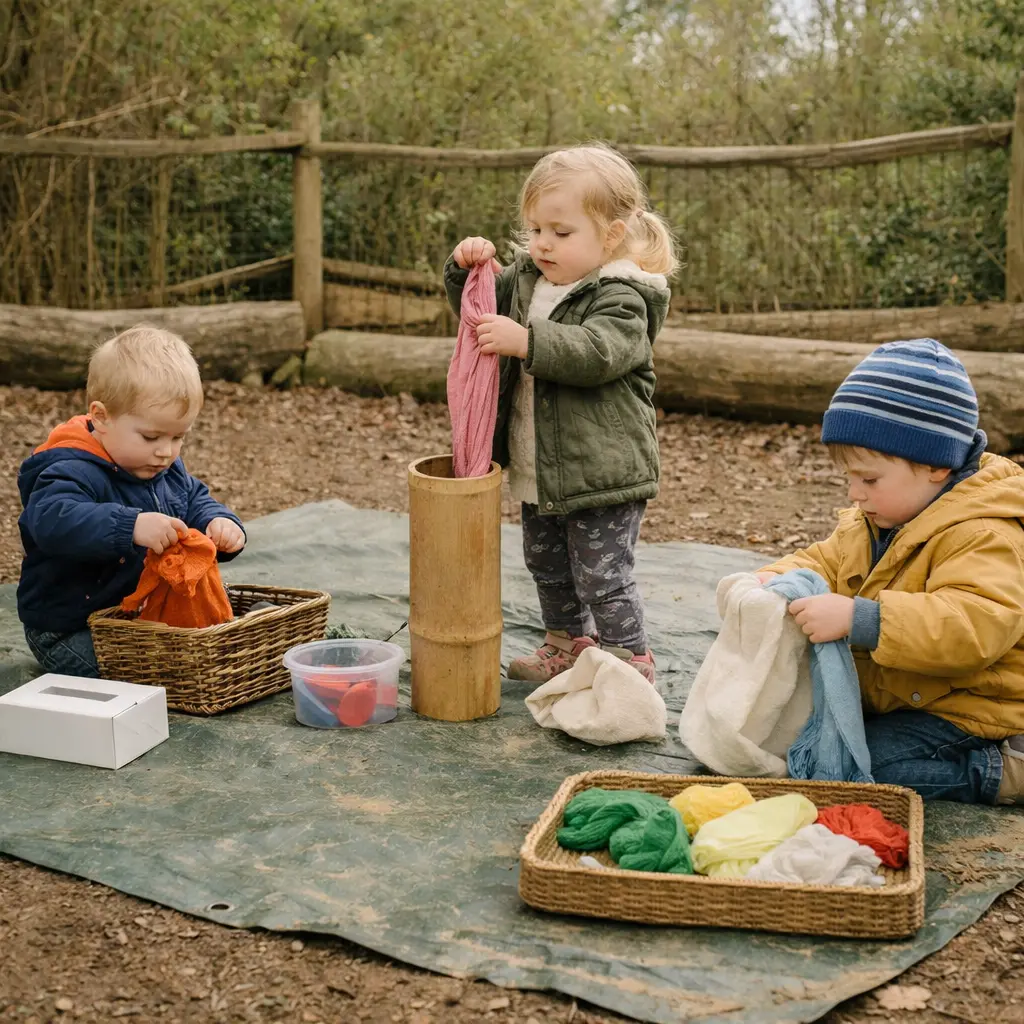
Set the activity in a sheltered outdoor spot on a groundsheet near natural boundaries (a log edge or low fence line) so scarves do not travel far in wind. Offer a small basket, a cloth bag, and a short section of wide bamboo or drainpipe, plus a few cotton squares or old scarves that can get damp. Place materials in two small piles a short distance apart so children can choose where to work and can carry items between places.
The adult makes three clear decisions: checks the ground for trip hazards and positions the groundsheet on the flattest area; agrees a simple boundary for where scarves can be carried; and keeps one hand free to steady a pipe or basket if it tips. The adult uses brief commentary rather than instructions (“It snagged on bark”, “That one is heavy with water”) and pauses to let children test ideas. The adult watches for wind lifting fabric toward faces, children wrapping scarves around necks, or running with long fabric, and responds by moving the activity to a calmer spot, swapping to shorter cloths, or offering a safer carrying method without taking over the play.
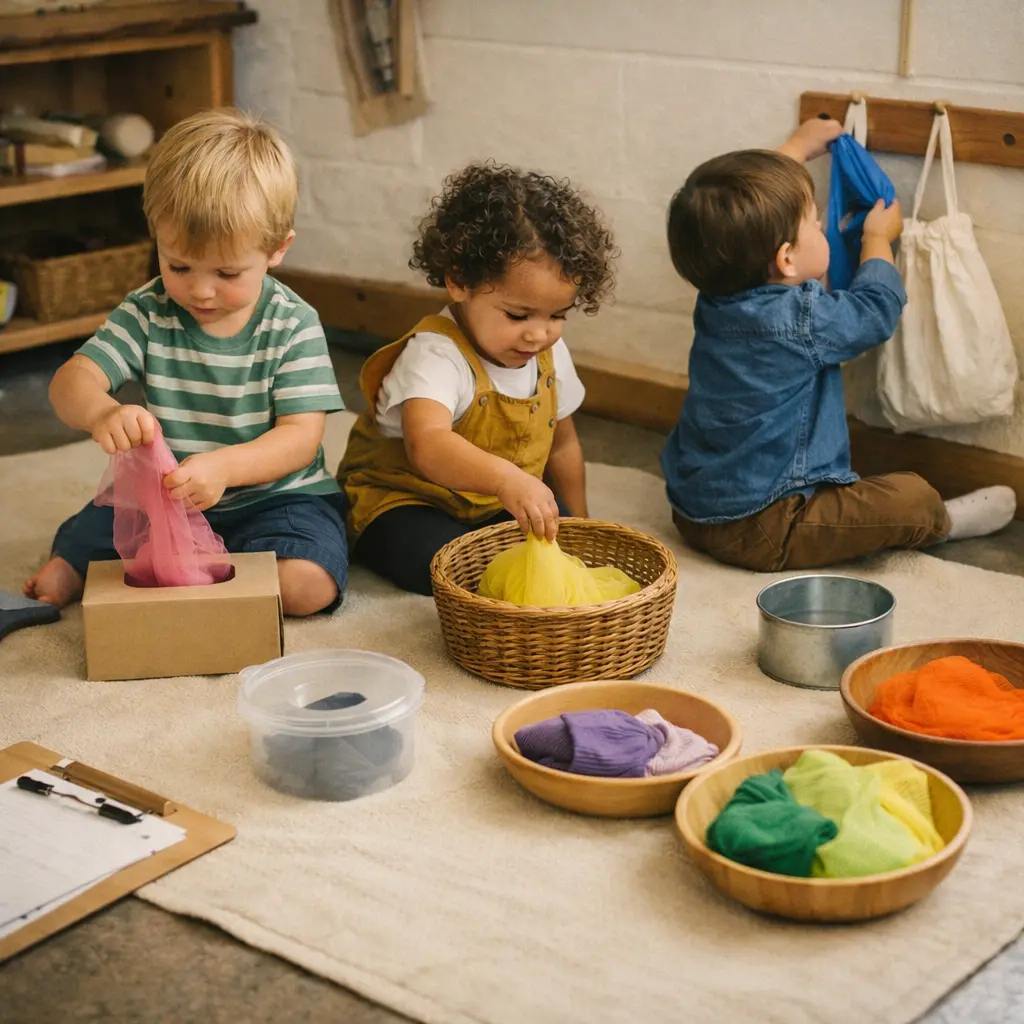
Create an invitation space with a large neutral mat and three distinct areas that change how children approach the materials: a low basket zone, a box-with-slot zone, and a hanging bag zone fixed at child height on a stable hook or frame. Place scarves and textured fabrics in shallow open bowls so children can see and select, and leave an empty clear space beside the mat for spreading, sorting, and returning to ideas. Keep a clipboard and pen nearby for quick notes, and position it where the adult can write without stepping into children’s space.
The adult makes deliberate choices to follow children’s direction: listens for children’s theories about what makes a scarf “fast” or “stuck”, mirrors their language (“You’re testing the narrow opening”), and offers open prompts only when it fits (“What changes if you swap fabrics?”). The adult observes collaboration and negotiation when children share the hanging bag, and steps in only to support access (lowering the bag, widening space between zones, or adding a second bag if crowding builds). The adult documents a short quote or photo of a child’s method and brings it back later to revisit, adjusting the environment in response rather than teaching a set method.
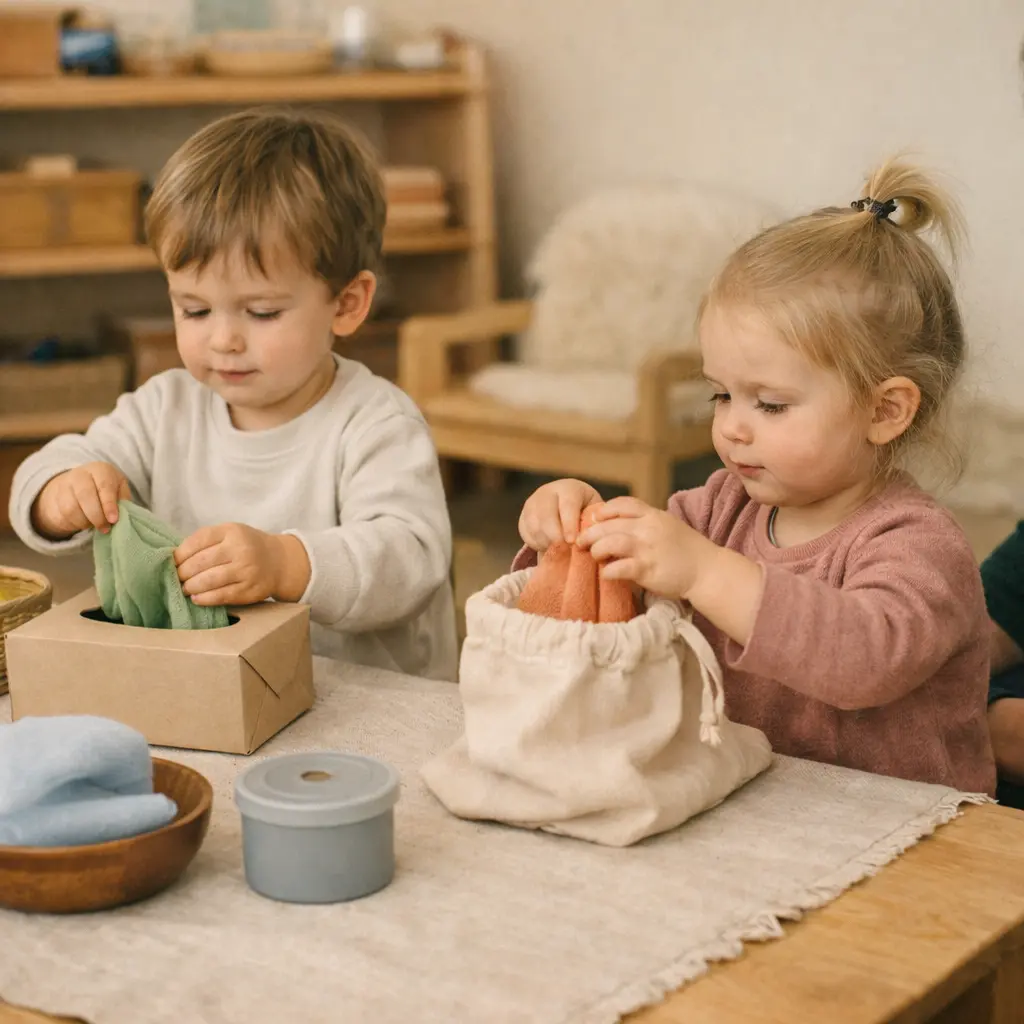
A calm floor space is prepared with a plain cloth as the base, and only one or two natural-fibre scarves (silk or cotton) are offered with a simple basket and a soft cloth bag. The colours are muted and the materials are limited so the child can focus on the feel and movement of the fabric without a busy layout.
The adult demonstrates quietly how to pull a scarf out and place it back in, then remains close and observant with minimal speech. The child repeats the emptying and filling at their own pace, pausing to feel the fabric and watch it fall. The adult intervenes only to steady a container, prevent fabric covering the face, or model a slower movement if the child becomes rushed or tangled.