Exploring bubble making with wands and biscuit cutters at a small-world bubble station (1–4 years)
Sensory Play
Communication and Language
Three children gather around the low tray on a towel while an adult crouches at the edge, watching their hands. One child dips a star-shaped biscuit cutter and holds it still, staring at the shiny film; another child waves a wand in a wide arc and laughs as a cluster of small bubbles drifts past their shoulder. The adult says, “You’re holding it steady,” then slides a cloth closer when a drip runs down the side of the bowl. A child points and calls, “Big one!” and the adult answers, “That bubble is floating slowly,” as the children reach up to pop it.
This activity offers children an open-ended bubble station where they can explore how bubbles form, move, and pop. Children often become absorbed in repeating actions, noticing changes when they swap tools or adjust their movements. The experience can support shared attention and turn-taking as children watch each other’s bubbles and comment on what they see.
Step-by-Step Guidance
1. Choose a space that can cope with drips (outdoors, or indoors on a wipe-clean floor) and place a non-slip mat or towel down.
2. Set a low, stable tray or bowl on the mat. Pour in a shallow layer of bubble mix so children can dip without submerging hands.
3. Place a small selection of tools beside the tray: one or two bubble wands and a few biscuit cutters in different sizes. Keep extras out of reach so the choice stays manageable.
4. Invite children to the station in small numbers. Show the boundary: where the tray stays and where tools are placed when finished.
5. Model once, slowly: dip a tool, lift it, pause, then move it through the air. Use simple language such as “dip, lift, wave” and then step back.
6. Let children choose tools and movements. Stay close enough to prevent slipping and to support sharing of space.
7. Add language as children play by describing what you see: “That one floated up,” “Lots of tiny bubbles,” “You waved it slowly.”
8. If a child is frustrated, offer a brief reset: wipe the tool, re-dip, and model a gentler lift, then return the tool to the child.
9. Support turn-taking by offering a second dipping dish or by naming a simple pattern: “You first, then me,” while keeping the play child-led.
10. Close the station with a clear tidy routine: tools back to the side, wipe drips, and wash hands.
Learning Objectives
Within Communication and Language, children may build vocabulary as they describe what they notice (for example, big, small, fast, floating, pop). Within Physical Development, children may practise controlled arm movements, hand strength, and coordination as they dip, lift, and wave different bubble tools. Within Understanding the World, children may begin to notice simple cause-and-effect as they test how different shapes and movements change the bubbles they make.
Adult Role
Stay emotionally attuned by noticing excitement or frustration and offering calm reassurance without taking over. Model a small amount of language that matches what children are doing, using short descriptive phrases rather than lots of questions. Scaffold only when needed (for example, showing a slower lift if bubbles keep popping), then step back so children can repeat and test their own ideas. Observe how children choose tools, persist with a challenge, and negotiate space with others, and use this to decide whether to reduce choices or add a second dipping point. Hold responsibility for safety by managing slippery patches, keeping bubble mix away from faces, and supervising tool use closely.
Observation Cues
Does the child repeat a movement (slow wave, quick flick) and watch for a change in the bubbles?; Does the child swap between a wand and a biscuit cutter and comment on what looks different?; Does the child adjust how long they dip or how gently they lift the tool after a bubble pops quickly?; Does the child track bubbles with their eyes or body, reaching, pointing, or moving to follow them?; Does the child invite others in, offer a tool, or wait for a turn at the tray?
Time & Space
10–25 minutes, with the option to revisit across the day.
A small outdoor area or an indoor wipe-clean space with room for 2–4 children to stand and move safely around a low tray.
Materials
Safety
Age adaptations
Budding Adventurers
Provide two dipping points (two shallow plates) so children can play alongside each other with fewer conflicts. Add a small jug for the adult to top up bubble mix while children keep playing, and offer cutters in two sizes to invite comparison. Model short phrases that help children negotiate (“my turn”, “your turn”, “swap”) and step in early if the floor becomes slippery.
Curious Investigators
Offer a wider range of biscuit cutter shapes and invite children to test their own ideas about what changes bubbles (tool, speed, height). Add a simple “bubble parking” area (a towel spot) where children place tools to drip before re-dipping. Use language that extends thinking without directing: “You changed to a bigger shape—what did you notice?” and “That one popped quickly—what might you try next?”
Confident Discoverers
Include a small set of agreed roles (bubble maker, tool washer, floor checker) that children can choose and swap, keeping the play cooperative. Offer a timer for turn-taking if needed and invite children to compare bubbles using their own measures (“bigger than my hand”, “three at once”). Encourage children to suggest station rules for safety and fairness, then refer back to their ideas during play.
EYFS Links
Communication and Language: children may listen and respond to simple words and phrases linked to what they can see, and may begin to use descriptive language as they watch bubbles float and pop. Physical Development: children may practise fine and gross motor control through dipping, lifting, and waving tools, and learn to manage their bodies in a space where the floor can become slippery. Understanding the World: children may explore cause-and-effect by changing tools and movements and noticing how this alters the bubbles they make. Personal, Social and Emotional Development: children may practise turn-taking and coping with small frustrations when bubbles pop or tools need sharing.
Ethos adaptations

Place the bubble work on a low tray with a clearly defined workspace and only two tools available: one wand and one large biscuit cutter, both returned to the same marked spots each time. Use a shallow dipping dish with a visible fill line and keep one folded wiping cloth in a set place; the adult refreshes the mix only to the line, removes extra tools, and positions the tray so the child can reach without leaning over it.
The adult gives one slow, precise demonstration with minimal words, then sits slightly back and avoids prompting, praise, or repeated demonstrations unless the child asks. The adult watches for repetition, careful control of movement, and self-correction (for example, changing lift speed after the film breaks), and responds with small, practical decisions only: sliding the cloth closer when drips appear, restoring the tools to their marked places if the layout drifts, offering a single neutral cue such as “tray” or “cloth” if the child’s hands move towards their face, and pausing the activity briefly to wipe the floor if slipping risk increases.

Set the station outdoors on grass or a hardstanding area near a sheltered spot, accepting that wind and weather will change what happens. Provide bubble mix in a sturdy bowl, plus real, simple tools including wands and a few metal biscuit cutters, and add natural wind indicators nearby (a strip of fabric tied to a low branch or a ribbon on a stick) so children can notice gusts.
The adult stays close to manage risk on uneven or wet ground and responds to children’s choices rather than setting a sequence. Children may run to follow bubbles, test different places (open area, near a hedge), and return to re-dip when they choose; the adult offers short observations like “The wind pushed it sideways” and steps in mainly to prevent slipping or crowding.
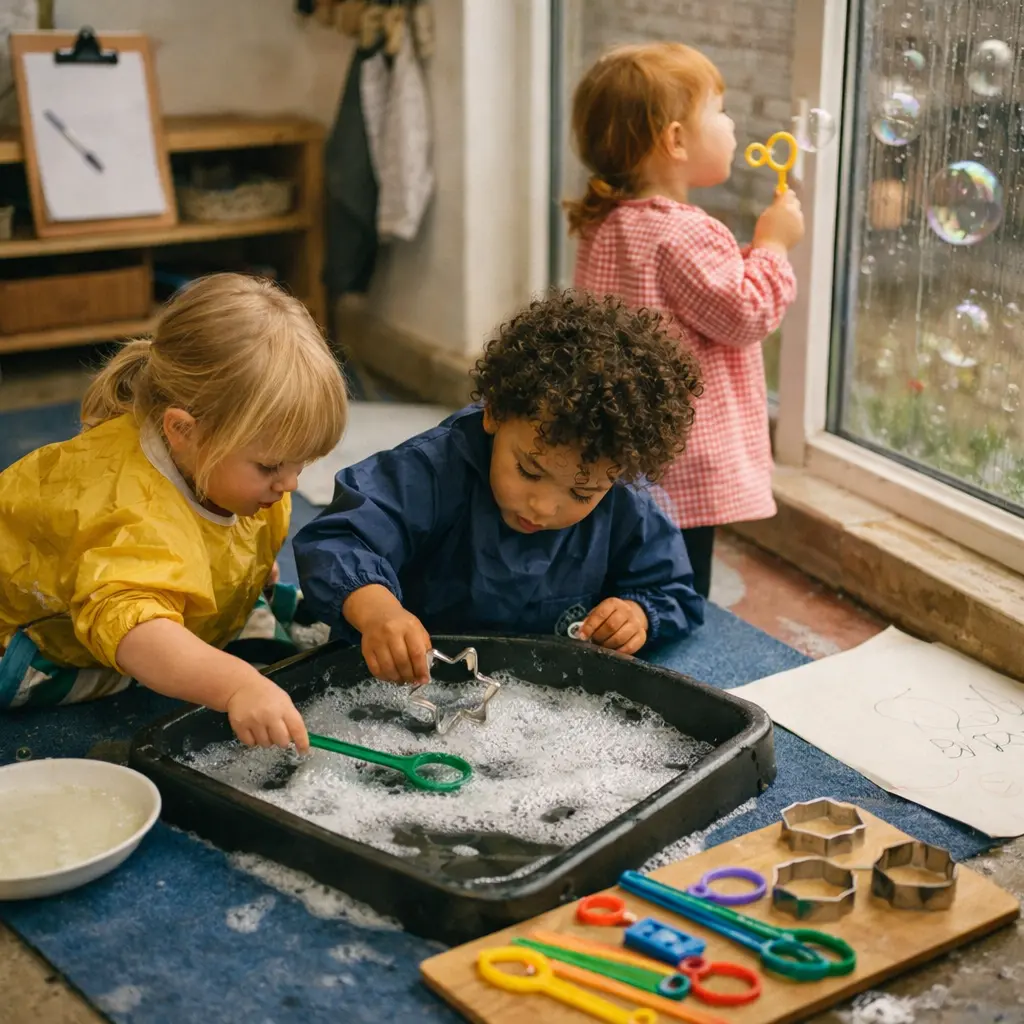
Arrange the space as an invitation with multiple entry points: a low table or ground mat with the bubble tray, a separate “tool area” with wands and biscuit cutters laid out visibly, and a nearby clear wall or window panel where bubbles can be watched as they land and slide. Add a simple documentation spot (clipboard and pen for the adult, or a large sheet of paper for quick marks) placed where it does not interrupt play.
The adult listens and follows children’s theories about what makes “more bubbles” or “bigger bubbles,” using commentary such as “I can see you’re changing the speed” and “You’re watching where they land.” The adult resists correcting and instead offers materials in response (for example, bringing one larger cutter when children compare sizes), noticing collaboration, shared language, and how children negotiate space around the tray.

Create a calm, uncluttered bubble area with a neutral cloth under a single bowl of bubble mix and only two quiet-handling tools set out at once (for example, a simple wand and one sturdy cutter). The adult keeps extra tools out of sight, places a single cotton wiping cloth in the same spot each time, chooses a steady place for the bowl so the space stays predictable, and limits the sensory load by keeping the mix unscented and the area visually simple.
The adult begins with a quiet, unbroken demonstration at a slow pace, then remains nearby as an anchor with minimal language and no questioning. The adult watches for children settling into repeated rhythms (dip, lift, wave) and responds through clear, practical decisions: slowing their own movements if the play becomes rushed, silently replacing the cloth when it becomes too wet, moving the bowl back onto the cloth when it drifts, and stepping in only to wipe drips underfoot or model one careful movement again when a child pauses and looks for help.