Exploring a single-colour sensory tray with matching objects and a colour book
Sensory Play
Colours
Communication and Language
A single-colour sensory tray sits beside a matching picture book, offering a focused invitation to notice texture and hue. The arrangement prompts simple sorting and shared colour talk, while the adult quietly attends to comfort with the materials and emerging descriptive language.
Children explore a sensory tray where the base and objects are all one colour. The experience invites children to notice sameness and difference, handle a range of textures, and make simple choices about what to pick up, move, or group. A colour-themed book sits alongside to support shared attention and vocabulary in a calm, open-ended way.
Step-by-Step Guidance
1. Choose one colour for the session and select a base that suits the age group and setting (for example, shredded paper or pom poms for younger children; rice only for older children with close supervision).
2. Prepare the space with a mat under the tray and a clear boundary for where materials stay. Place a small basket nearby for children who want to collect or carry items.
3. Fill the tray with the single-colour base. Add a small number of matching objects at first, keeping them easy to see and pick up.
4. Place the colour book beside the tray, open to a page that strongly shows the chosen colour. Keep it within reach but not inside the sensory base.
5. Invite children to approach in their own time. Allow initial free exploration of touching, picking up, and moving materials.
6. Model a simple action once, such as placing one object into the basket or resting an item on the book page, and pause to see if children copy or adapt the idea.
7. Offer language that matches what children are doing: name the colour, describe texture and size, and use simple comparative words (same, match, soft, smooth, heavy, light).
8. If children begin sorting or grouping, support by adding one more matching object at a time. If attention drops, reduce the number of items and return to the book for shared looking.
9. Close with a clear tidy routine. Offer a small, manageable job (e.g. putting objects into a container) and keep the base contained to the tray.
Learning Objectives
Children may build early colour awareness through repeated exposure to one colour across different materials. The activity can support Communication and Language as children attend to an adult, objects, and a book together, and hear simple descriptive words. It can also support Physical Development as children practise grasping, releasing, scooping, and placing with small objects.
Adult Role
Stay emotionally attuned by watching children’s cues for curiosity, uncertainty, or sensory discomfort, and adjust the pace or materials without drawing attention to mistakes. Model short, accurate language linked to the child’s focus, including the colour name and one extra descriptor (soft, bumpy, big), and repeat key words naturally. Scaffold lightly by offering one idea at a time (a basket for collecting, a single object to match to the book) and step back when children are absorbed or have created their own system. Observe in action by noting how children approach texture, how they manage small items, and whether they seek shared attention with the book. Hold responsibility for safety by controlling item size, supervising closely, keeping the tray boundary clear, and removing any items that are mouthed or thrown.
Observation Cues
Looks closely at objects and pauses as if comparing shades or textures within the same colour. Groups items together or separates them by type (soft/hard, big/small) without adult prompting. Uses gestures, sounds, or words to request a preferred item or to show an adult what they have found. Sustains attention at the tray, returning to the same action (pouring, picking, lining up) several times. Handles materials with increasing control, adjusting grip for different shapes and textures.
Time & Space
10–25 minutes, depending on age, group size, and sensory tolerance.
A low table or clear floor area with a wipe-clean mat under a single tray. A nearby shelf or surface for the book and a container for tidying.
Materials
Safety
Age adaptations
Budding Adventurers
Offer a wider mix of same-colour objects with clear differences (soft/hard, round/flat) and introduce a simple scoop and cup for filling and emptying. Keep the book open nearby and invite children to find “same colour” items to place beside the book, allowing them to decide what counts as a match. Support early categorising by offering two containers (one for “in the tray”, one for “in the basket”) and naming what you notice rather than directing a correct method.
Curious Investigators
Use a base that supports tool use, such as shredded paper or rice with close supervision, and include tongs or a spoon for children who are ready. Add objects that vary by shade within the same colour family and include a few items that are similar in shape but different in texture to prompt comparison. Encourage children to create their own sorting rule (by texture, size, shade) and use the book to connect images to real objects, modelling words like lighter/darker and smooth/rough.
Confident Discoverers
Offer a more complex set of same-colour items including different shades and materials (fabric, plastic, paper), and provide two or three tools (tongs, scoop, small cup) so children can choose. Place the colour book with a blank sheet and a single-colour crayon nearby so children can represent what they notice without needing a finished product. Support children to explain their sorting choices, compare shades, and negotiate shared space and resources with peers, stepping in mainly to help with turn-taking language and safe tool handling.
EYFS Links
Communication and Language: Adults can model simple colour and texture vocabulary linked to what children are holding and noticing, supporting attention and shared focus with the book. Physical Development: Handling small objects, scooping, and placing can support hand strength and coordination, with tools offered only when children show readiness. Understanding the World: Children may notice how materials feel different even when they look the same colour, supporting curiosity and comparison. Personal, Social and Emotional Development: Taking turns at a shared tray and coping with sensory preferences can support self-regulation and respectful interaction when adults name feelings and offer choices.
Ethos adaptations
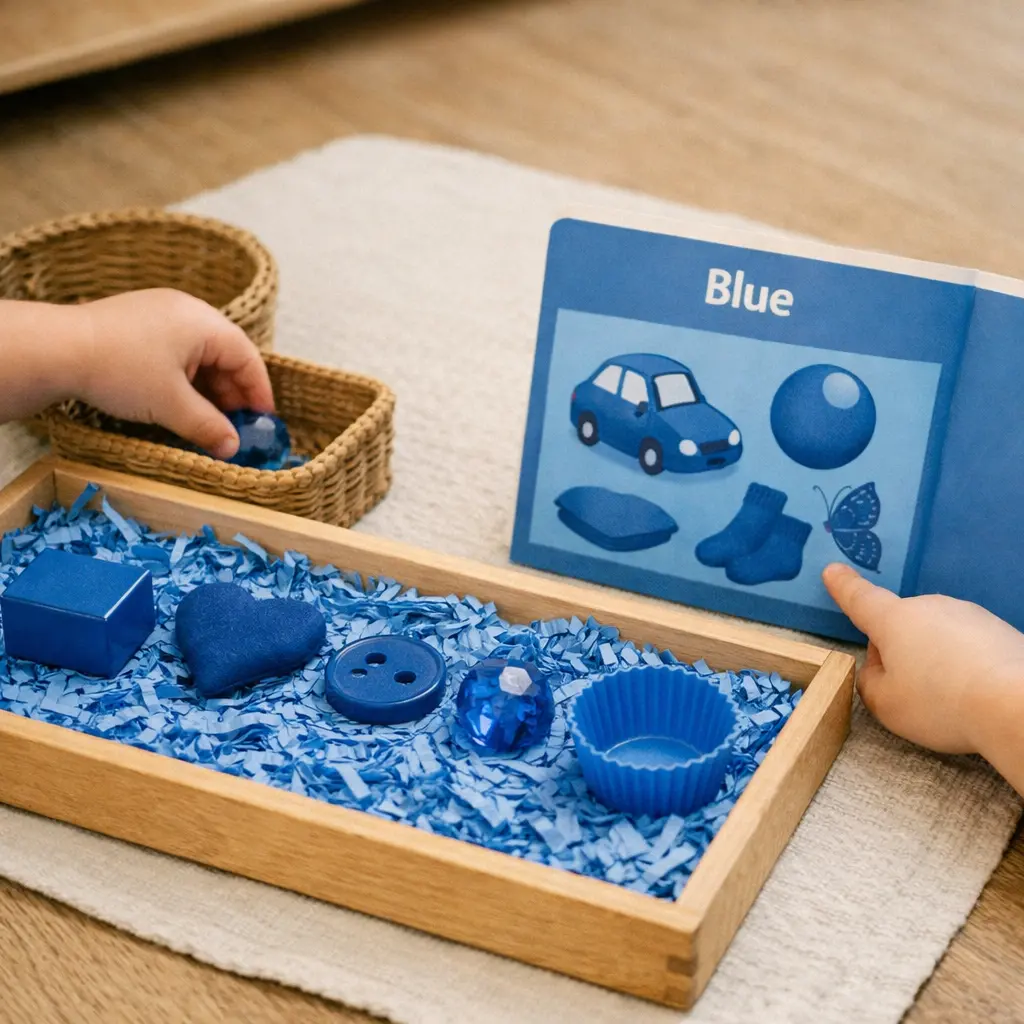
Set out one low-sided tray on a mat with a single chosen base material and a reduced selection of same-colour objects (no more than six distinct items) placed in a clear order (by size or texture) around the tray. Provide one small basket for “found” items and leave optional tools (scoop or cup) off the tray until a child shows readiness. Keep the colour book beside the tray, face-up to one page, so the matching task (pick, handle, place) is simplified and the visual goal is obvious and reachable.
Show the sequence once: pick an object, place it in the intended area, and point briefly to the book page, then step back and use minimal language (short labels only). Avoid questions or step-by-step prompts; offer the tool only when the child attempts it independently. Observe for repeated choices, steady grasp-and-release patterns, changes in pressure or wrist control, signs the child matches objects to the book page, and moments of sustained concentration or disengagement.
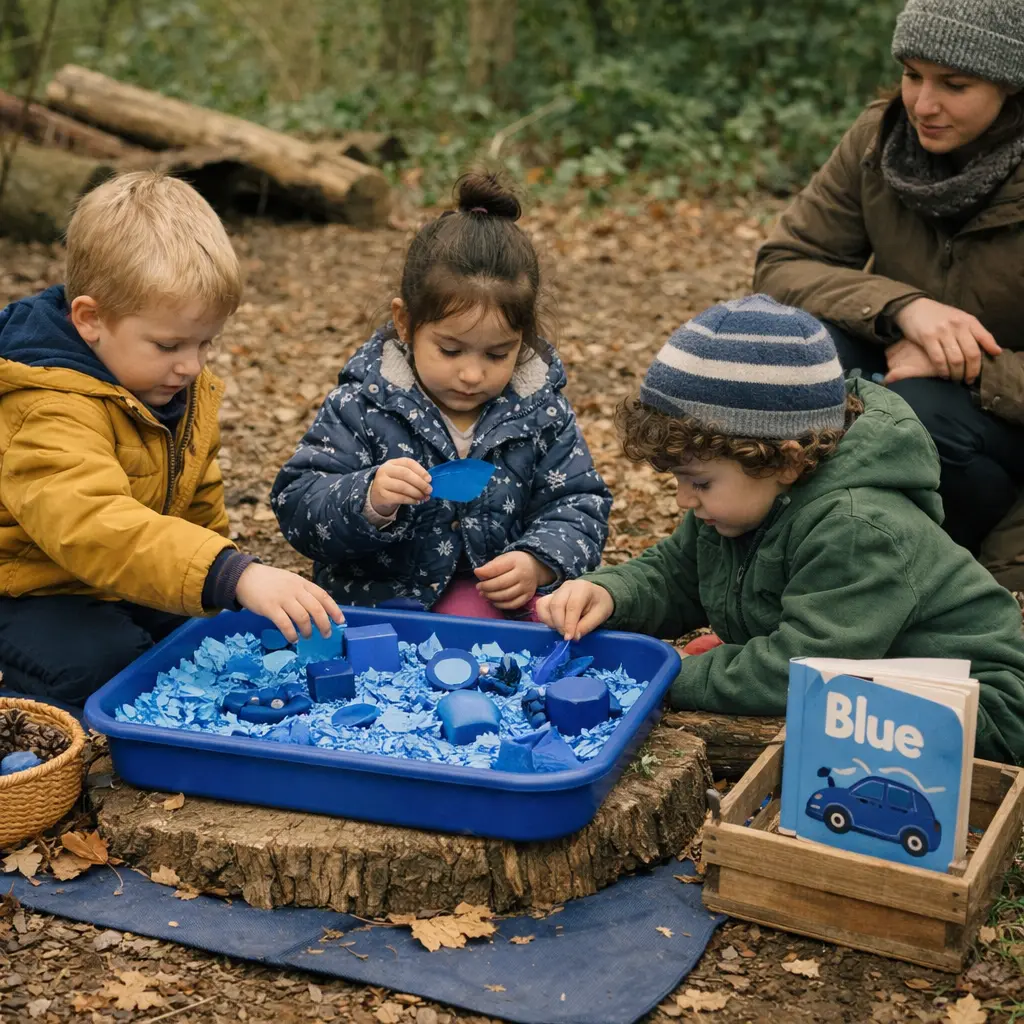
In an outdoor or nature-integrated space, the sensory tray is set on a low stump, bench or blanket on grass or compacted earth so children can access it at floor level; natural scatter such as dry leaves, moss, sand or a bed of coloured petals serves as the single-colour base. Materials such as locally collected stones, wooden beads, seed heads, pinecones, bark pieces, feathers or fabric scraps in the chosen colour are provided in an open-ended way rather than pre-sorted plastic sets.
The adult observes nearby, crouched at a distance to monitor safety and offer short, responsive prompts or single-word descriptors when invited, rather than giving step-by-step instructions. Children choose, gather and add their own finds, scoop, sort and group at their own pace, use the colour book outdoors for shared attention, and may repeat actions or change ideas while the adult checks small-item risk and steps in only when necessary.
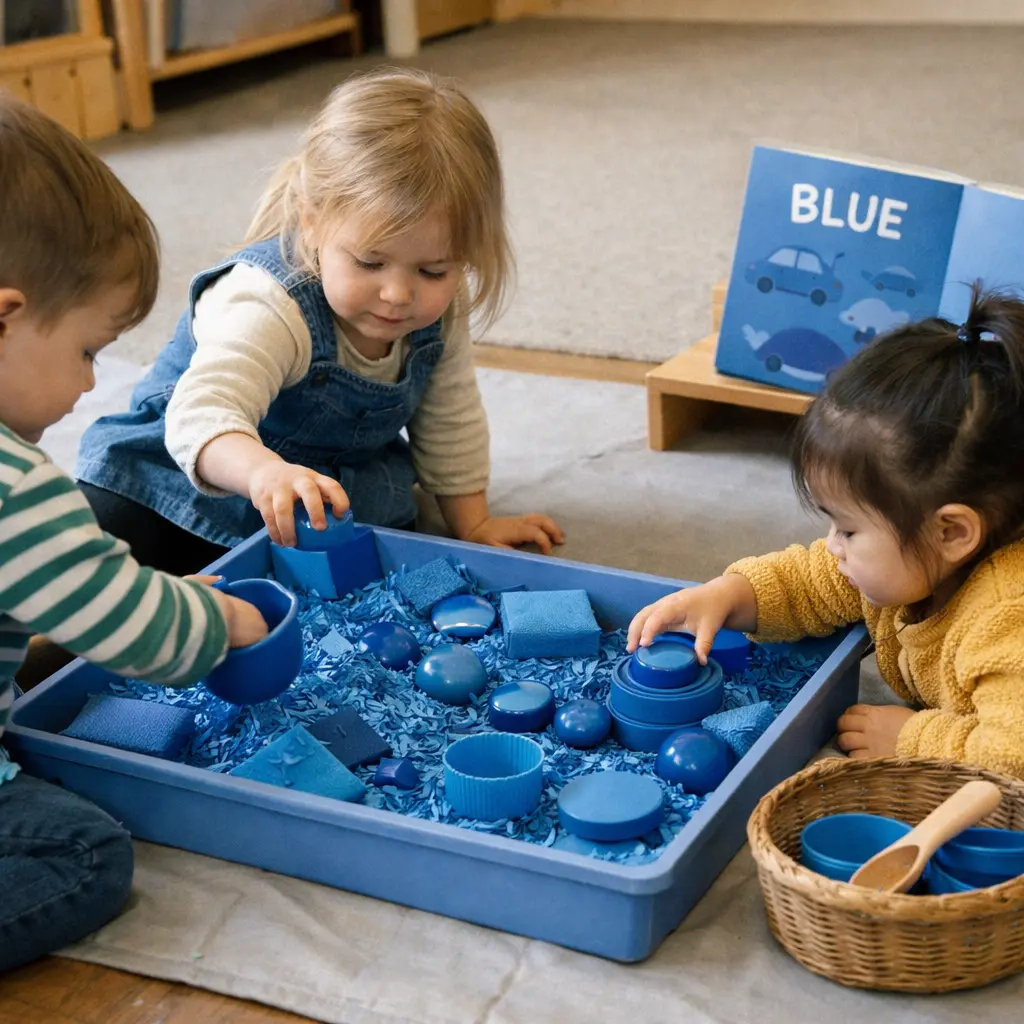
Place the low-sided tray on a floor mat in soft light, with clear space for two or three children. Fill with one-colour base, then seed clusters and singles of same-colour loose parts (fabric scraps, lids, large buttons, chunky beads, small boxes, silicone cases) at different distances and depths. Keep an open basket and a spoon/scoop/cup to one side for self-selection (omit rice or tiny items for non–age-appropriate groups). Stand the colour book nearby, openable anywhere, not set to a specific page.
Stand back as co-learner, using noticing language: “I can see that piece is smooth,” “You’re trying to cover the cup,” “What happens if the big box goes under the paper?” Follow their choices—children may bury, pour, line, sort, carry to the basket, or match pages loosely to objects. The adult notices grip changes, hand-to-hand transfers, pacing, attention to shade/texture, shared glances, and turn-taking. Capture a quick photo or note of repeated actions and words, while staying alert to safe mouthing, spills, and space to pause or return.
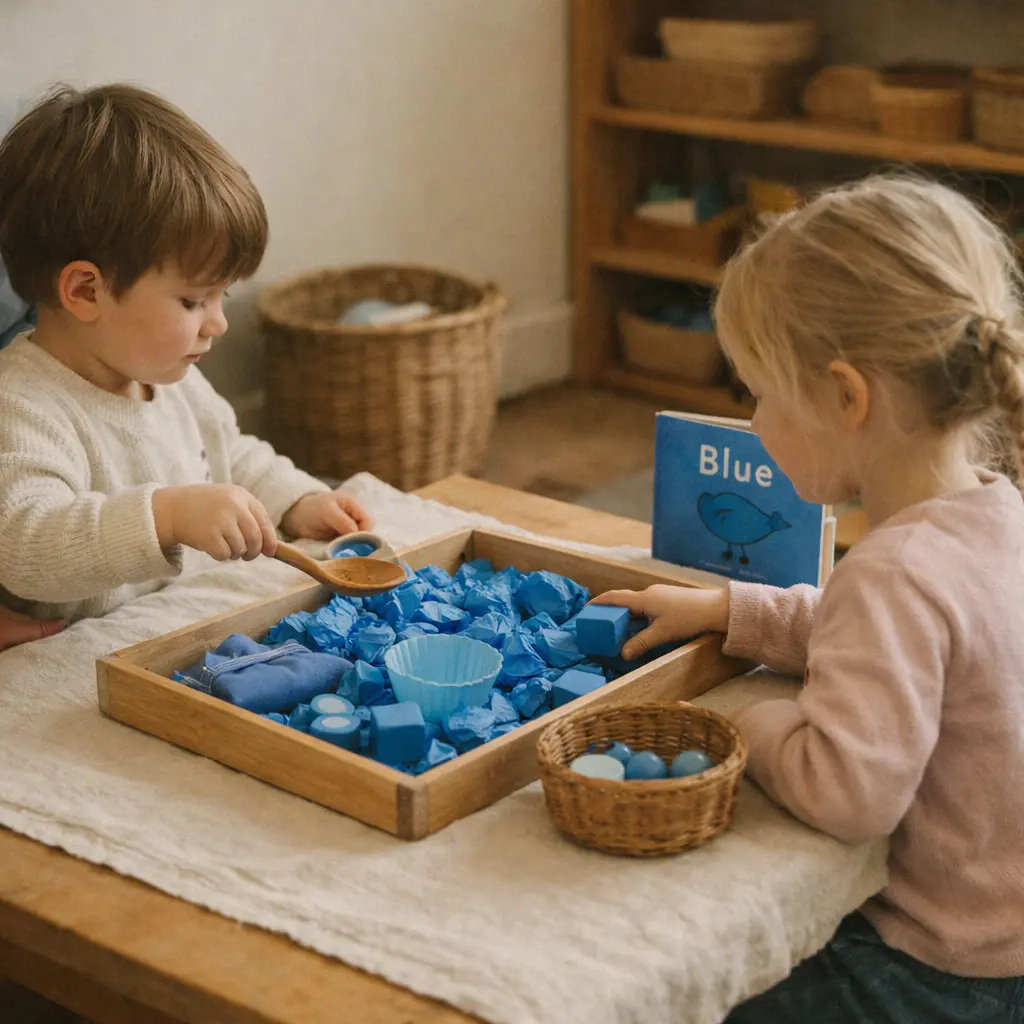
A quiet corner is set with a neutral cotton mat and a low-sided wooden tray or shallow card box to define the space. The base is one softly toned colour chosen from shredded paper, tissue pieces, or dry rice. Only a small number of items in the same colour are offered: cotton fabric scraps, wooden buttons or beads, small card boxes, and a wicker basket for “found” pieces, with a small wooden spoon or metal scoop. A simple colour-themed book rests to one side within easy reach.
The adult sits close and demonstrates once, slowly scooping, releasing, and placing, then watches quietly. Brief, concrete words name the shared colour and textures as the child handles items or looks toward the book; pages are turned only when the child shows interest. The child returns to picking up, grouping, filling and emptying at their own pace, repeating as needed. The adult maintains safety and calm turn-taking, and models a tidy rhythm by quietly returning pieces to the basket and smoothing the mat.