Exploring a local library space with books, simple instruments and shared toys for early years children
Literacy
Communication and Language
Music and movement
Children and adults spend time in a local library, using the children’s area to browse books and explore any shared resources available, such as simple instruments or toys. Children may notice pictures, print, and how the space is organised, and may practise being alongside others in a calm public setting. Adults pay attention to children’s comfort, voice level, and choices, offering small supports for sharing and settling.
Children spend time in a local library as a different, low-cost environment to explore. They may browse books, notice how the space is organised, and choose from any child-friendly resources the library offers, such as simple instruments or shared toys. The experience can support confidence in community spaces and shared routines, with plenty of opportunities for quiet focus and small social moments.
Step-by-Step Guidance
1. Prepare the visit: check opening times, children’s area location, and any library expectations (e.g. food policy, instrument/toy area rules). Plan a short route and a clear meeting point.
2. Arrive and orient: pause at the entrance to help children notice the change of environment. Name key features simply (desk, shelves, children’s area) and set one or two shared expectations (quiet voice, walking).
3. Offer a choice focus: invite children to choose where to start (books, a display table, a cosy seat, or the children’s resources area). Keep the choice limited and visible.
4. Support browsing: stay close enough to help with shelf access and handling. Model how to take one item at a time, look, and return it to a clear place.
5. Share books in short bursts: follow children’s interest in pictures and topics. Use brief comments and questions that do not demand performance (e.g. naming, noticing, wondering).
6. Explore library resources: if instruments or shared toys are available, support careful handling and turn-taking. Keep the group small around popular items and offer a nearby alternative to reduce waiting pressure.
7. Include a simple “find” prompt if helpful: suggest noticing something specific in the environment (a colour, an animal, a sign) to support purposeful wandering without rushing.
8. Transition to borrowing or finishing: if borrowing is part of the visit, keep it simple and predictable (choose a small number, carry to desk). If not borrowing, end with a calm shared moment (one final page, a short sit).
9. Leave and reset: gather belongings at the agreed point. Name what is happening next (walking out, travel back) and support children to regulate after the quieter environment.
Learning Objectives
Children may build familiarity with books and print in a real-world setting, supporting Literacy. Children may practise listening, turn-taking and simple conversational exchanges with adults and peers, supporting Communication and Language. Children may begin to manage shared expectations in a public space, supporting Personal, Social and Emotional Development.
Adult Role
Stay emotionally attuned to children’s comfort in a public space, noticing signs of overwhelm (clinging, loud voice, darting) and offering closeness, a quieter corner, or a shorter stay. Model calm, respectful library behaviour through your own pace, voice level, and careful handling of materials. Use simple language modelling linked to what children notice (labels, pictures, sounds), and repeat key words without quizzing.
Scaffold when children need help accessing shelves, sharing resources, or understanding boundaries; step back when a child is settled in browsing or looking closely at a book. Observe in action by tracking what draws children in (topics, textures, sounds, seating) and how they manage shared space. Hold responsibility for safety and safeguarding: keep the group within sight, manage transitions, and maintain clear headcounts, especially near exits and busier areas.
Observation Cues
Notices and points to pictures, symbols, letters, or signage in the library environment. Chooses a book type (e.g. familiar character, factual pictures, sensory book) and sustains attention for short periods. Uses quiet voice, whispering, or adjusts volume after an adult models it. Waits, watches, or offers an item to another child when resources are shared. Asks for help to find something, or uses gestures to indicate preferences. Shows curiosity about non-book resources (e.g. instruments, puzzles) and explores them with care.
Time & Space
20–60 minutes depending on age, group size, and children’s regulation needs.
A local library with a children’s area; access to seating for shared reading; clear meeting point near the children’s zone.
Materials
Safety
Age adaptations
Budding Adventurers
Add a simple purpose such as finding a favourite topic (animals, vehicles) or spotting a familiar symbol on signs, without turning it into a task. Encourage children to carry one chosen book to a seat and return it with adult help, building a routine around care of shared materials. If instruments are available, keep exploration brief and supported, focusing on gentle sounds and stopping/starting together.
Curious Investigators
Invite children to notice how books are grouped (by topic, by series, by size) and to use picture cues on shelves with adult support. Offer small-group moments: one group shares a book with an adult, another explores a quiet resource area, rotating based on interest. Support children to ask staff for help with finding a section, modelling polite greetings and simple questions.
Confident Discoverers
Support children to make and follow simple plans within the space (choose a section, select a book, find a place to look, return it). Encourage children to notice print in the environment (labels, author names, signs) and to talk about differences between books (fiction/non-fiction pictures, longer/shorter). Where appropriate, involve children in the borrowing process by carrying books, waiting at the desk, and checking items against a simple agreed limit.
EYFS Links
Communication and Language: Children may listen to short shared reading, attend to environmental sounds, and use gestures or words to express preferences in a real community setting. Literacy: Children may handle books, notice pictures and print, and begin to understand that books are organised and shared in particular ways. Personal, Social and Emotional Development: Children may practise being in a public space with shared expectations, manage small frustrations around waiting or sharing, and build confidence through predictable routines. Understanding the World: Children may learn about a local community resource and what happens there, noticing roles (staff, visitors) and how the space is used.
Ethos adaptations

Prepare a low shelf or tray on a small mat with a very limited set of items: three curated picture books linked to the short interest list, one simple instrument and one shared toy. Arrange items left-to-right in the order you want them used and provide a child-sized basket for returns; place a single visual cue card for “quiet voice / walking feet” on the tray. Remove all other toys and adults’ materials so the purpose — choosing, handling and returning one item at a time — is clear and reachable.
Introduce the setup with one calm, slow demonstration: carry the tray, select one book, sit on the mat, show one page and place the item back in the basket. Then step back and use only brief safety reminders; avoid prompting or constant questions. Observe whether the child repeats the routine, handles pages with care, waits or shares without adult direction, and manages the return step — note signs of concentration, self-correction and turn-taking.
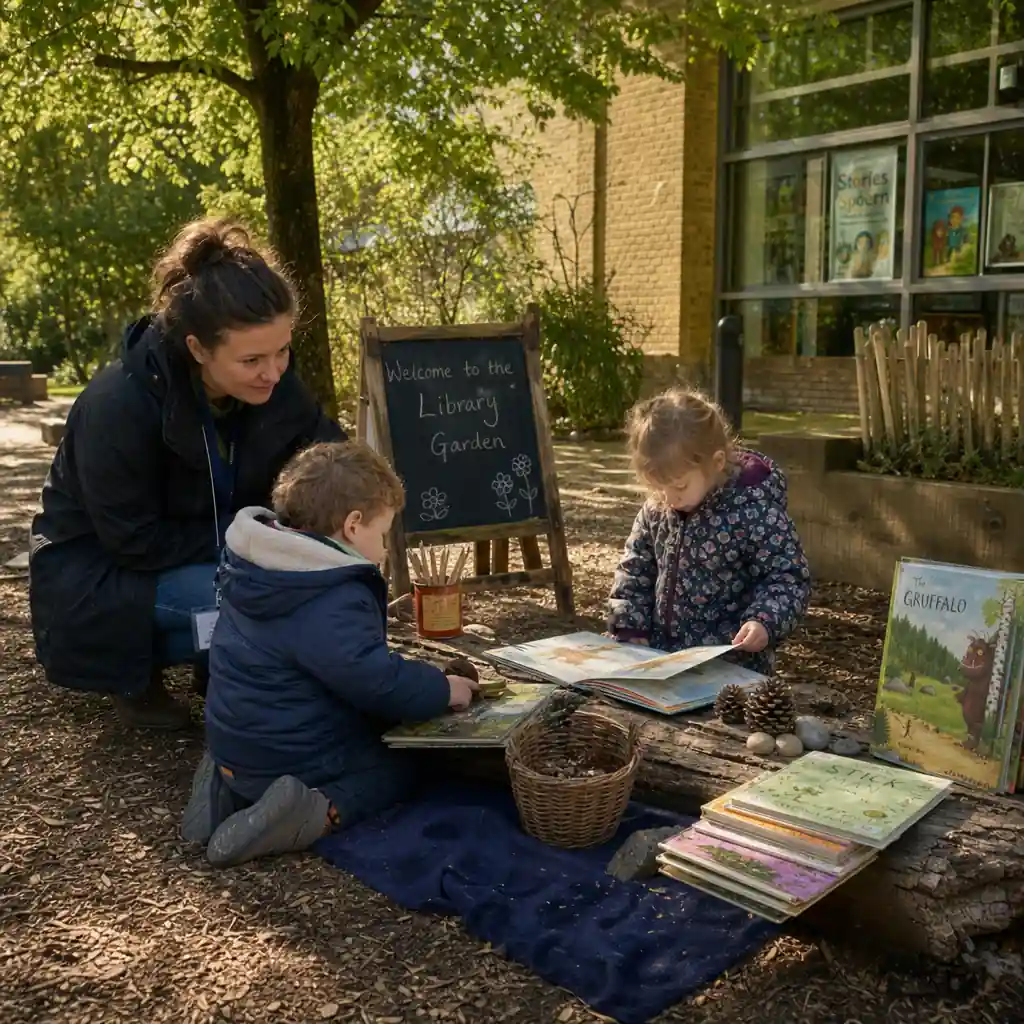
In an outdoor or nature-integrated space, relocate the session to a library garden, courtyard, or to a quiet corner by a window with natural light and visible outdoor views. Materials such as a small basket of natural items (leaves, pinecones, smooth stones), simple wooden page markers and cloth story-sacks replace plastic props; familiar library books are laid out on a low log or blanket rather than a table. Materials are arranged openly so children can choose and handle items alongside books.
The adult observes from close by, checking safety and liaising with staff, then steps back to offer brief, responsive language prompts or single-word cues (e.g. “look,” “turn,” “soft”) rather than directing. Children choose books, handle natural markers, take turns passing instruments or toys, and may move between quiet individual browsing and small shared moments; the adult notices and comments minimally, supports waiting or sharing when needed, and intervenes only for safety or to scaffold brief conversations.
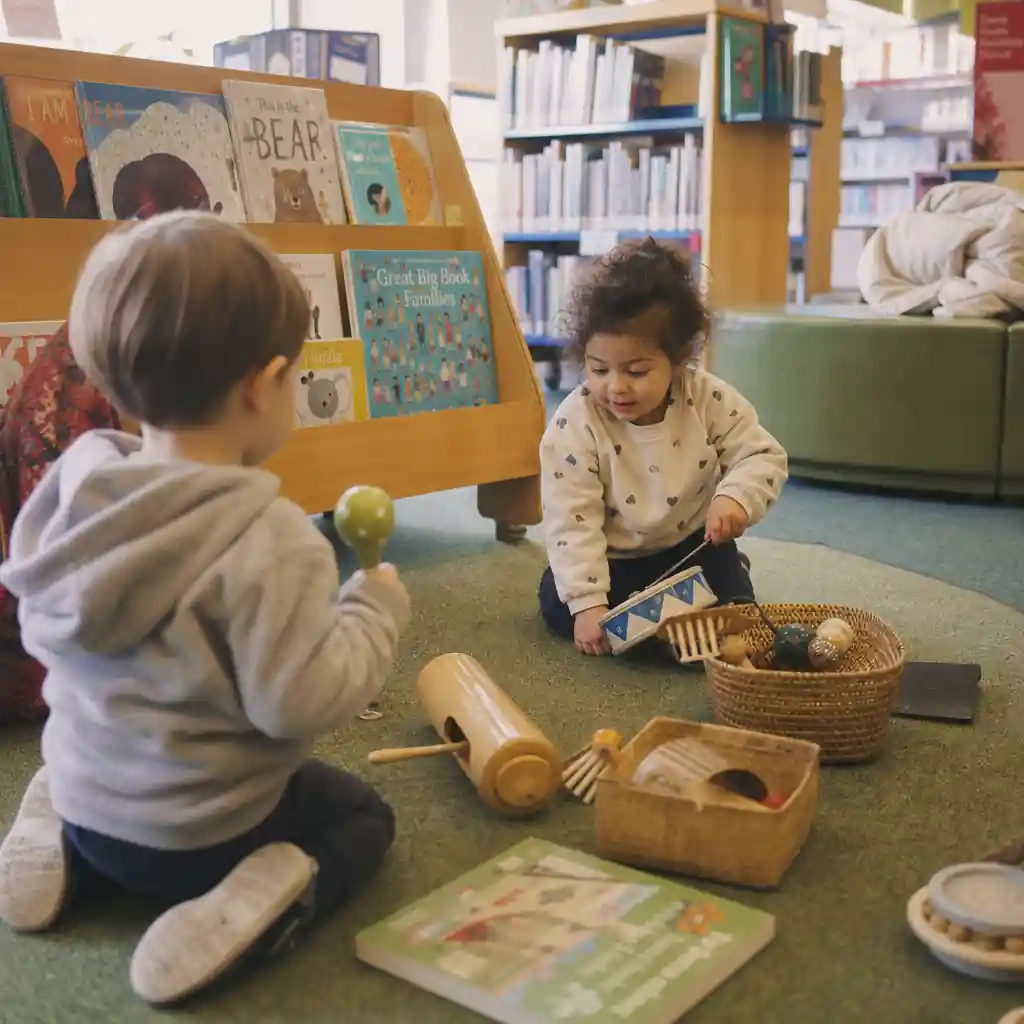
Arrive and settle so the library becomes an invitation rather than a led activity: choose a consistent drop-off point, leave shelving and play areas accessible (staff-permitted) and spread a few mixed-height low trays or mats where books, simple instruments and shared toys sit within reach. Replace preset lists with a small interest card collection the child may carry; visual cue cards for “quiet voice” or “walking feet” are available but not enforced. The layout and open placement of materials guide movement, choice and social clustering while keeping routines and safety visible.
The adult steps back as observer and co-researcher, using commentary such as “I can see you’re looking at…” or “You’re trying to find…” and occasional prompts like “What happens if…?” rather than instructions. The child may choose to browse, pause for a sound from an instrument, negotiate sharing or create a self-led reading spot; the adult follows these shifts and adds vocabulary to extend thinking. Embed observation by noting moments of focused handling of print, listening behaviour, turn-taking negotiations and emerging confidence in the community setting.

A quiet corner of the library is chosen; a neutral cotton cloth marks a small base on the floor or a low table so the wider space stays uncluttered. The materials are arranged simply: a woven basket with three to five sturdy picture books linked to current interests, a wooden bookmark, and a small cotton bag for essentials kept at the edge. Only natural items are offered; if permitted, a single seed-filled wooden shaker replaces plastic instruments. Two small wool felt tokens serve as calm cues for quiet voice and walking feet.
The adult demonstrates slow walking, gentle page turning, and returning a book to the basket, using minimal language and soft gestures; they remain nearby, observing and attending to library expectations and safety. The child chooses a book, settles on the cloth, looks through pictures, and replaces it before selecting again, sometimes sharing space by placing a book beside a peer or waiting briefly. If the shaker is available, the adult models one soft sound, then rests it; the child returns to browsing, repeating this calm rhythm before folding the cloth and tidying.