Exploring a lime jelly dinosaur swamp with small and large dinosaur figures
Sensory Play
Small world play
Understanding the World
Communication and Language
Children explore a tray of lime jelly with small and large dinosaur figures, noticing wobble, coolness and the marks left behind. The experience can invite pressing, mashing and moving dinosaurs through changing textures, with space for children’s own swamp ideas. Adults keep the materials minimal and edible-focused, modelling simple descriptive language and watching for sensory comfort, turn-taking needs and safe handling.
Children explore a tray of lime jelly as a “swamp” for small and large dinosaur figures. The jelly’s wobble, coolness and resistance can invite pressing, mashing and moving the dinosaurs through the surface. The open-ended setup can support sustained attention as children notice marks, tracks and changes in texture. Adults can keep the experience calm and spacious, with a clear focus on safe, edible sensory play.
Step-by-Step Guidance
1. Prepare lime jelly in advance and allow it to fully set in a container that can be tipped out cleanly.
2. Choose a shallow tray with raised sides and place it on a wipe-clean surface at child height.
3. Tip the set jelly into the tray. Decide whether to leave it as a single piece or gently ruffle it to create extra texture, keeping the tray space open and uncluttered.
4. Place a small selection of small and large dinosaur figures into the jelly. If adding any extra “swamp” items, keep them few, large enough to handle safely, and appropriate for an edible activity.
5. Invite children to explore in their own way. Allow pressing, mashing, poking and moving dinosaurs through the jelly, without directing a storyline.
6. Model simple descriptive language linked to what children are doing, such as naming the texture, temperature, wobble, and the marks left behind.
7. Support children to manage boundaries: keeping jelly in the tray, choosing where to stand or sit, and taking turns with dinosaurs if needed.
8. Notice when interest reduces. Offer a clear ending routine such as wiping hands, removing dinosaurs for washing, and clearing the tray.
Learning Objectives
Children may explore sensory properties such as temperature, texture and movement through hands-on play (Physical Development). Children may use words, sounds or gestures to share what they notice and to request resources or support (Communication and Language). Children may begin to represent ideas through small world play, linking dinosaurs to a swamp-like habitat (Understanding the World).
Adult Role
Stay emotionally attuned by watching for hesitation, sensory overload, or excitement that tips into throwing or smearing, and respond with calm limits and reassurance. Model language that matches children’s actions, using short phrases that name what is happening (for example, “cold jelly”, “big push”, “wobbly”, “tracks”), and repeat key words to support understanding. Scaffold only when needed: offer a dinosaur, steady the tray, or show a gentle press, then step back to let children lead the exploration. Observe closely for how children vary pressure, switch between dinosaurs, and communicate needs, and use this to decide whether to simplify the space or add a little more challenge. Maintain safety by supervising continuously, keeping the activity edible-focused, and removing any item that becomes a hazard or is mouthed in an unsafe way.
Observation Cues
Reaches in with fingertips or whole hand, pauses, and repeats a preferred action such as pressing or scooping. Moves dinosaurs through the jelly and watches the tracks or wobble, returning to the same pathway. Uses descriptive language or sounds such as “cold”, “wobbly”, “sticky”, “squish”, or dinosaur noises. Switches between small and large dinosaurs and adjusts pressure or grip. Seeks adult support for turn-taking, boundaries, or to manage discomfort with the texture.
Time & Space
10–25 minutes, plus preparation time for the jelly to set.
A wipe-clean table or floor area with enough room for a shallow tray and 2–4 children to access from the sides, plus nearby handwashing.
Materials
Safety
Age adaptations
Budding Adventurers
Provide both small and large dinosaurs and leave some open tray space so children can create their own routes through the jelly. Offer a limited number of optional “swamp” additions only if they are safe for an edible activity and do not crowd the tray. Encourage children to compare what happens when they use a small dinosaur versus a large one, without turning it into a test. Use language that supports early concepts such as big/small, fast/slow, and deep/shallow marks.
Curious Investigators
Increase the variety of dinosaurs (still kept minimal) and invite children to notice and describe changes they make to the jelly surface, such as tracks, holes, and flattened areas. Support children to develop a simple shared play idea, for example deciding where the “swamp edge” is, while keeping the activity edible-focused and uncluttered. Extend vocabulary with words like “wobble”, “slippery”, “squash”, and “sink”, and encourage children to explain what they think is happening when the jelly changes shape.
Confident Discoverers
Offer a slightly larger tray and a balanced mix of small and large dinosaurs, with clear limits on how many extra items are available so children must make choices. Encourage children to plan a simple layout for their swamp space, such as leaving a clear area for moving dinosaurs and a textured area for mashing, without prescribing a storyline. Support children to compare effects (for example, different pressures or different dinosaur sizes) and to use more precise descriptive language. Invite children to help with responsibility routines such as sorting dinosaurs for washing and wiping the surface with adult supervision.
EYFS Links
Communication and Language: Children may use words, sounds and gestures to describe sensory experiences and to share ideas during small world play, supported by adults modelling clear, relevant vocabulary. Physical Development: Handling slippery jelly and moving dinosaurs through resistance can support hand strength, coordination and controlled movements, with adults helping children regulate pressure and manage boundaries. Understanding the World: Dinosaur play can prompt children to connect animals to environments and to notice cause and effect as the jelly changes shape, wobbles and shows tracks.
Ethos adaptations

Set a single shallow tray with a measured block of fully set lime jelly placed to one side, and limit figures to one small and one large dinosaur arranged left-to-right on a low mat so the sequence is clear. Remove extra “swamp” items and keep cloths and a handwashing station within easy reach. This simplifies the scene to one clear investigation: pressing, moving and making tracks through the jelly to notice texture, temperature and resistance.
Show the sequence once: place a dinosaur on the jelly, press to make a track, lift and set the next figure, all with slow, minimal words, then step back out of the play space. Use brief safety prompts only and avoid questions or step-by-step talk. Observe for steady pressure control, repeated track-making, moments of sustained concentration, changes in language or gestures used to request materials, and any self-correction in how the child moves the figures.
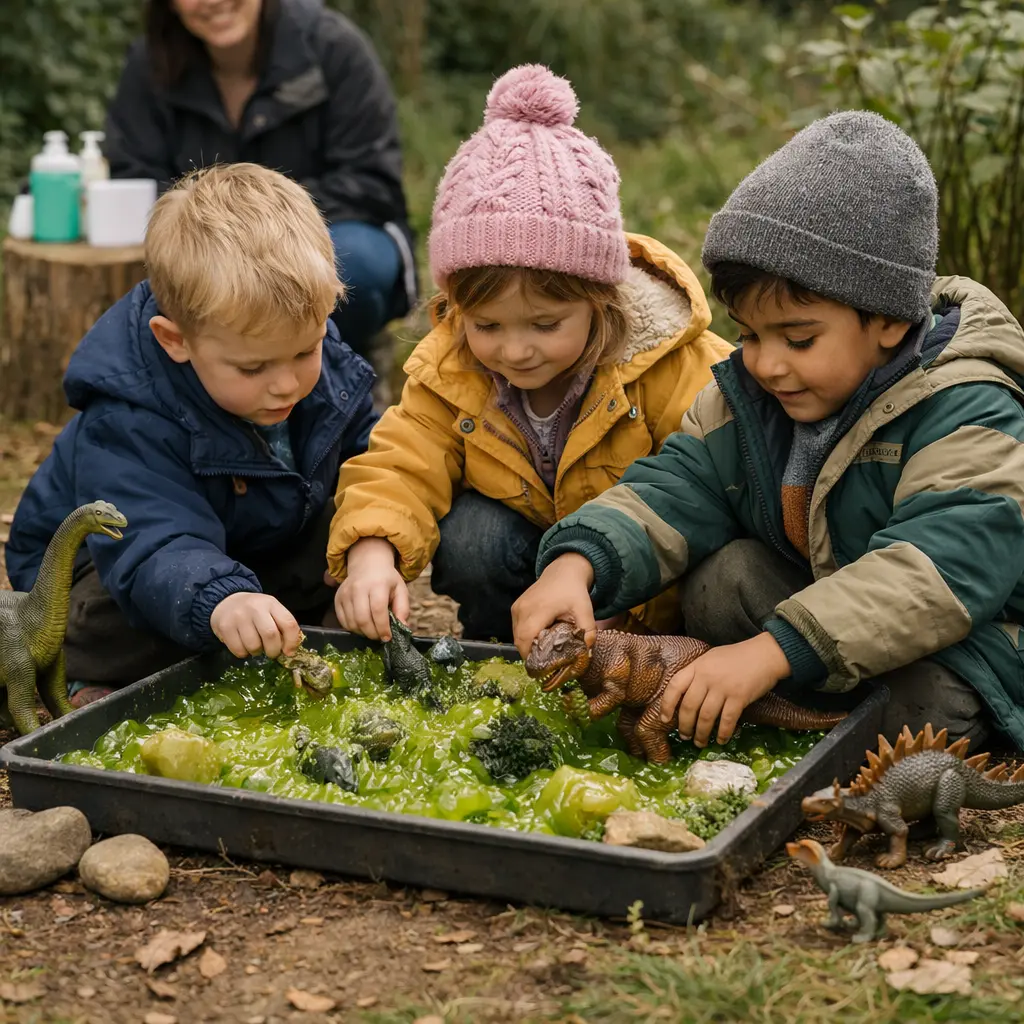
In a shaded outdoor spot on grass or a firm patio beside plants, the tray is placed directly on the ground so children can kneel or squat around it. Lime jelly is tipped into the shallow tray in uneven mounds to create varied depth and wobble. Small and large dinosaur figures are set nearby within reach, with any optional edible-safe “swamp” additions kept minimal and clean. The natural light, breeze and changing temperature add variation to texture, with the adult checking the ground for tripping hazards and keeping handwashing close.
The adult observes at the edge, offering brief, responsive words about sensory properties and habitat only when children seek connection or pause. The adult steadies the tray if needed, manages spacing, and supports simple boundaries and handwashing while allowing repetition and return. Children choose figures, press and drag through the jelly’s resistance, compare tracks and sizes, create sounds or gestures, and request more space, tools from the set, or help, shaping their own small-world “swamp” play.
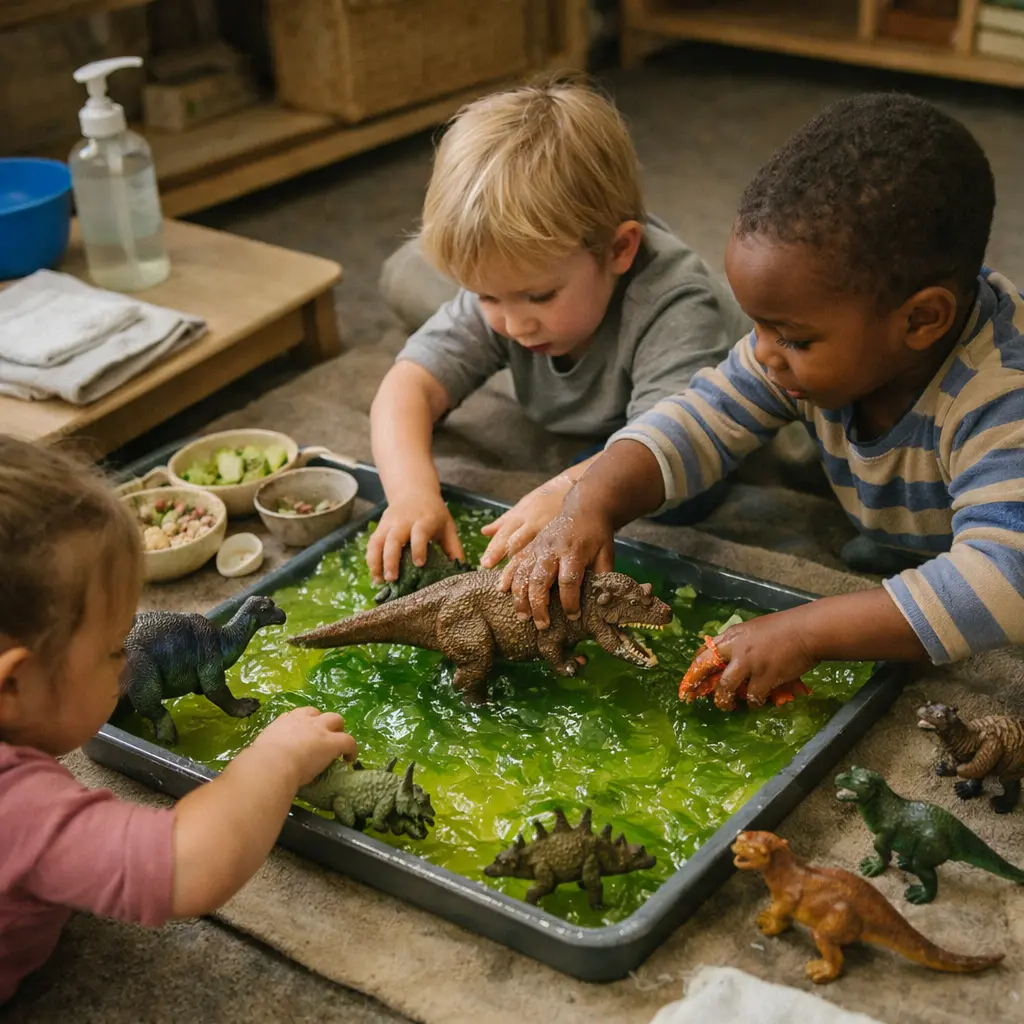
Place a single shallow tray of fully set lime jelly at child height with clear space on all sides. Set small and large dinosaur figures loosely along the tray edges, not posed, so children choose where and how to begin. Keep the edible-safe “swamp” additions together at one corner for self-selection, leaving most of the jelly surface open. Handwashing access and cleaning cloths are visible and reachable to support autonomy. These materials function as loose parts; the jelly, mixed figure sizes, and optional additions permit pressing, burying, freeing, track-making, or leaving untouched.
The adult steps back as observer and co-learner, using light-touch commentary: “I can see your big dinosaur sinking,” “You’re trying to pull this one through the sticky bit,” “What happens if you press gently here?” Children may steer play toward size contrasts, habitat stories, or cause-and-effect testing. The adult notices grip changes, pressure control, temperature words, gestures for more space or resources, peer exchanges around tracks, and returns to repeated actions, documenting these moments within the flow.
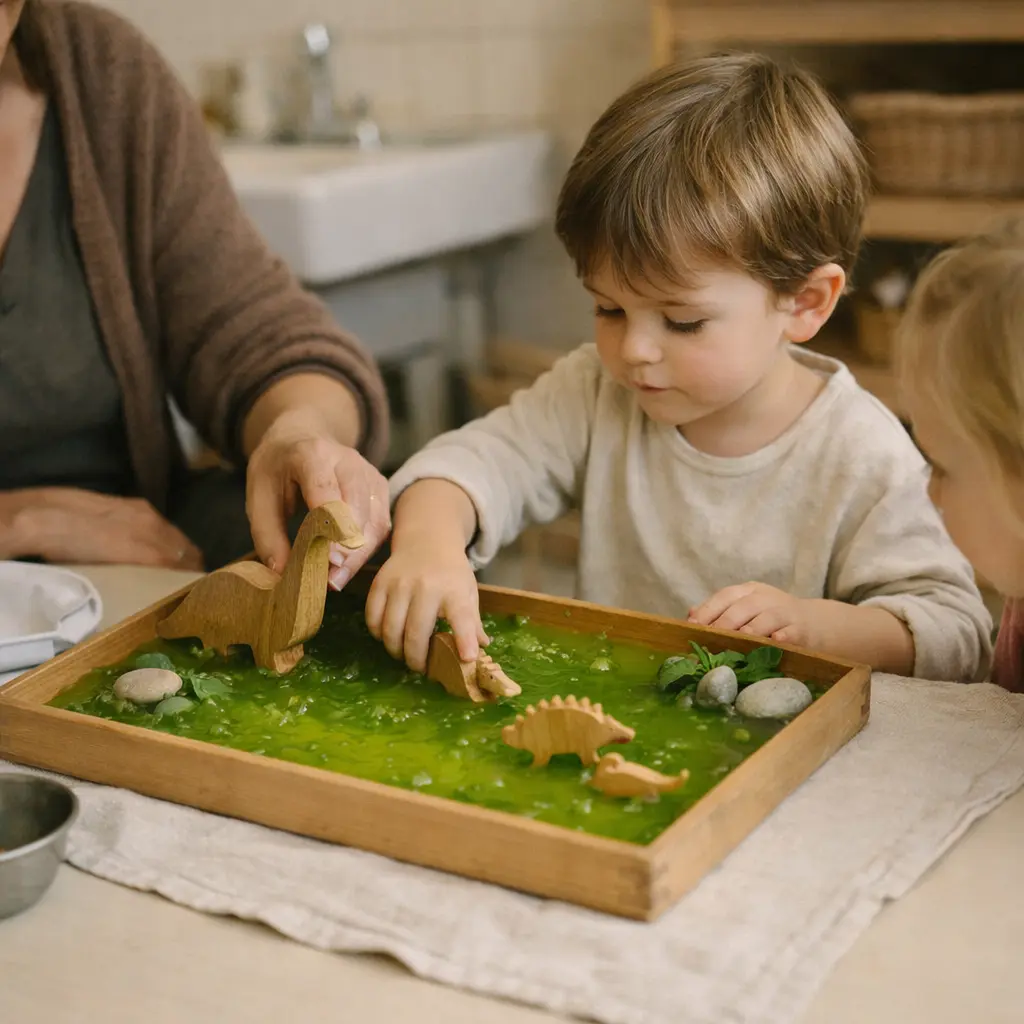
A shallow wooden or enamel tray with fully set lime jelly is placed on a plain cotton cloth to define a calm working area, with handwashing access and cleaning cloths at the edge. Only a small selection of figures in two sizes is offered, favouring solid wooden pieces for weight and warmth; any optional edible-safe additions are kept minimal and removable to avoid crowding. The space is uncluttered, materials are neutral in tone, and numbers at the tray are limited so children can notice temperature, texture, movement, and visible tracks.
The adult quietly models one slow press and a steady glide of a figure through the jelly, then remains nearby, watchful and unhurried, using minimal language and stepping in only for safety or to support edible handling. The child returns to pressing, mashing, and drawing paths at their own pace, repeating sequences and comparing small and large figures; the adult may offer a simple word when the child indicates interest, and helps maintain a gentle rhythm of exploration and tidy.