Dressing babies and teddies in winter clothing to build self-help skills (12–24 months)
Winter
Dressing
A brief glimpse of a calm, open-ended dressing activity where a child helps clothe a teddy in winter attire. See how the setup invites choice, supports fine motor practice, and fosters early independence, with space to observe language, persistence, and interaction. The full activity includes detailed adaptations, step-by-step guidance, and ethos-specific approaches.
Children practice dressing a baby or teddy in child-sized winter clothing. The activity supports physical development and growing self-confidence as they handle clothing fasteners, place items correctly, and follow simple dressing sequences. It is designed to be calm and open-ended, encouraging repeated, independent attempts that build self-help skills and self-esteem.
Step-by-Step Guidance
1) Set up a small dressing station with the teddy on a low chair or mat and clothing items arranged in a tray. 2) Introduce the teddy and invite the child to help dress it, naming each clothing item. 3) Demonstrate a single step (e.g., guiding an arm into a sleeve) using clear, slow actions. 4) Encourage the child to attempt the next step, offering hand-over-hand support as needed. 5) Gradually reduce prompts as the child gains confidence with each fastener. 6) Rotate clothing items to practice different fasteners and layers. 7) Pause to talk about weather and why the clothing is needed. 8) Finish with a simple reflection, inviting the child to describe what they did and how they feel.
Learning Objectives
This activity supports the development of Personal, Social and Emotional Development (independence, self-confidence, self-regulation), Physical Development (fine motor control and finger dexterity through fastening and manipulating clothing), and Communication and Language (describing clothing, naming actions and expressing preferences). It also introduces Understanding the World by discussing weather and appropriate clothing choices.
Adult Role
Be calmly present and warm, modelling simple dressing language and gestures. Provide scaffolding only when needed, then step back to let the child attempt steps independently. Use concrete prompts (e.g., ‘arms in’, ‘zip up’), support safe handling of small fasteners, and maintain a patient, steady pace. Watch for safety, ensure clothing fits, and keep the teddy securely seated during dressing.
Observation Cues
1) Child chooses a clothing item and names it. 2) Child places arms into sleeves and aligns the item for putting on. 3) Child uses a simple fastener (Velcro, large button, zipper) with guidance or independently. 4) Child completes the dressing sequence with increasing ease and persistence. 5) Child talks about what they are doing or asks for help if needed. 6) Child shows enjoyment or pride when the teddy is dressed.
Time & Space
Approximately 15–25 minutes per session, depending on age and interest
A small, quiet area with a flat surface for the teddy and dressing station; enough space for the child to sit or kneel comfortably and move without obstruction
Materials
Safety
Age adaptations
Budding Adventurers
The child attempts multiple dressing steps with intermittent assistance. Introduce a teddy or baby doll dressed in a simple outfit to practice sequencing (arm in sleeve, leg in trouser, coat on). Use more varied clothing with easy fasteners and encourage verbal participation (“coat on, zip up”). Support independence while staying within a manageable sequence length.
Curious Investigators
The child dresses with moderate support and begins completing simple sequences more independently. Offer a wider range of clothing items, including items with two-step fasteners. Prompt the child to talk through what they are doing and to choose items based on weather cues. The adult encourages problem-solving and fluent communication about clothing choices.
Confident Discoverers
The child completes the dressing sequence with minimal prompts and can independently select appropriate items after a weather discussion. They may help dress the teddy in more complex outfits (multi-layered clothing, mixed fasteners). The adult steps back to observe, supports problem-solving, and engages the child in reflective discussion about why each item was chosen.
EYFS Links
Prime areas: Personal, Social and Emotional Development (independence, self-esteem, turn-taking); Physical Development (fine motor control and hand-eye coordination through dressing actions). Specific areas: Literacy and Communication (describing actions, vocabulary for clothing), Understanding the World (weather appropriate clothing), Expressive Arts and Design (imaginative play with the teddy). The activity supports repeated, meaningful interaction with familiar routines that underpin early independence and confidence.
Ethos adaptations
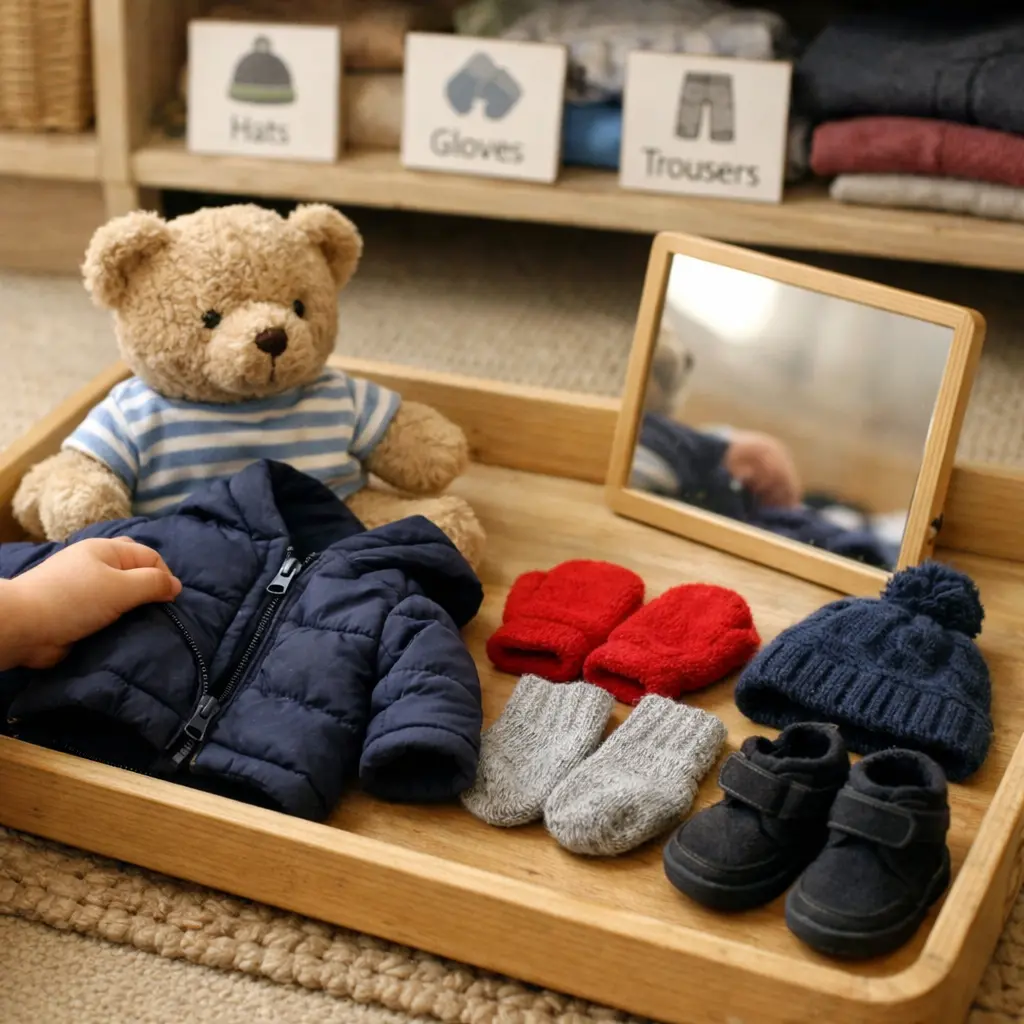
Set out one doll and a single, ordered set of winter items on a low tray or small dressing mat: hat, coat with one chosen fastener type (Velcro or large zipper), trousers, socks. Remove extra toys and limit clothing to one size and one fastener style so the child sees a clear sequence. Place a child-height mirror beside the tray and label or picture-cue each item in order; everything is reachable and returned to its place to make success visible and repeatable.
Show the full dressing sequence once as a slow, controlled demonstration, then step back to let the child work. Keep language brief and practical (short safety reminders only), avoid prompting or questions, and resist taking over. Observe whether the child repeats actions, shows steady hand control when fastening, follows the sequence, and how long they sustain attention, noting where they hesitate so future setups isolate that step.
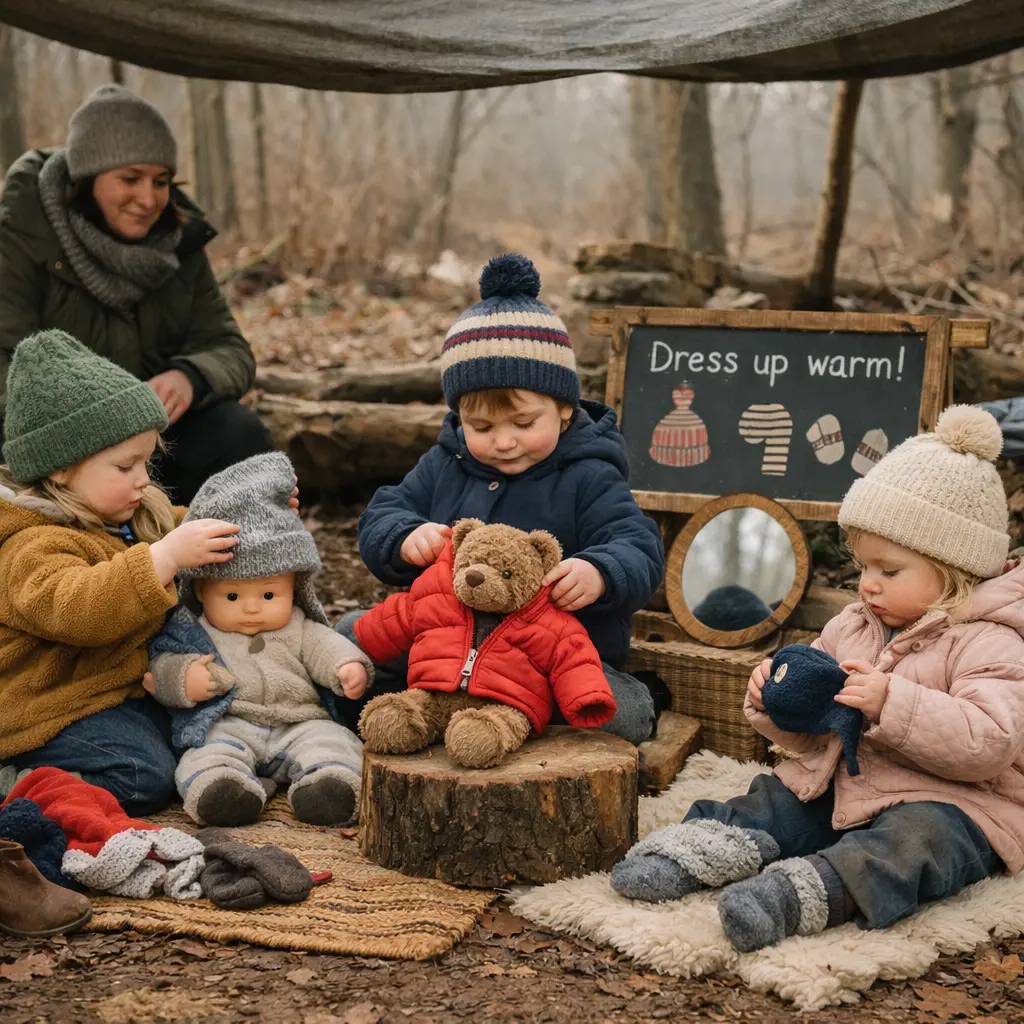
In an outdoor or nature-integrated space, the dressing area is moved onto a mat beside low logs and a sheltered spot on grass. Materials are replaced with natural-fibre child-sized winter clothes (wool hats, chunky wool scarves, thick socks) and a coat with oversized wooden toggles or wide Velcro; wooden or fabric fasteners are chosen over small plastic bits. Materials are arranged in open baskets with a bark-framed mirror and a few leaves or pinecones as weather props rather than a fixed display.
The adult observes from a short distance, checking safety and offering minimal, responsive prompts or a quick single demonstration before stepping back. Children choose their teddy or doll, practise pulling on layers, exploring toggles, zips and Velcro at their own pace, and may use the log seat and mirror to try on items repeatedly. The adult intervenes only for supervision or brief language prompts, naming items or repeating a word when children request help.
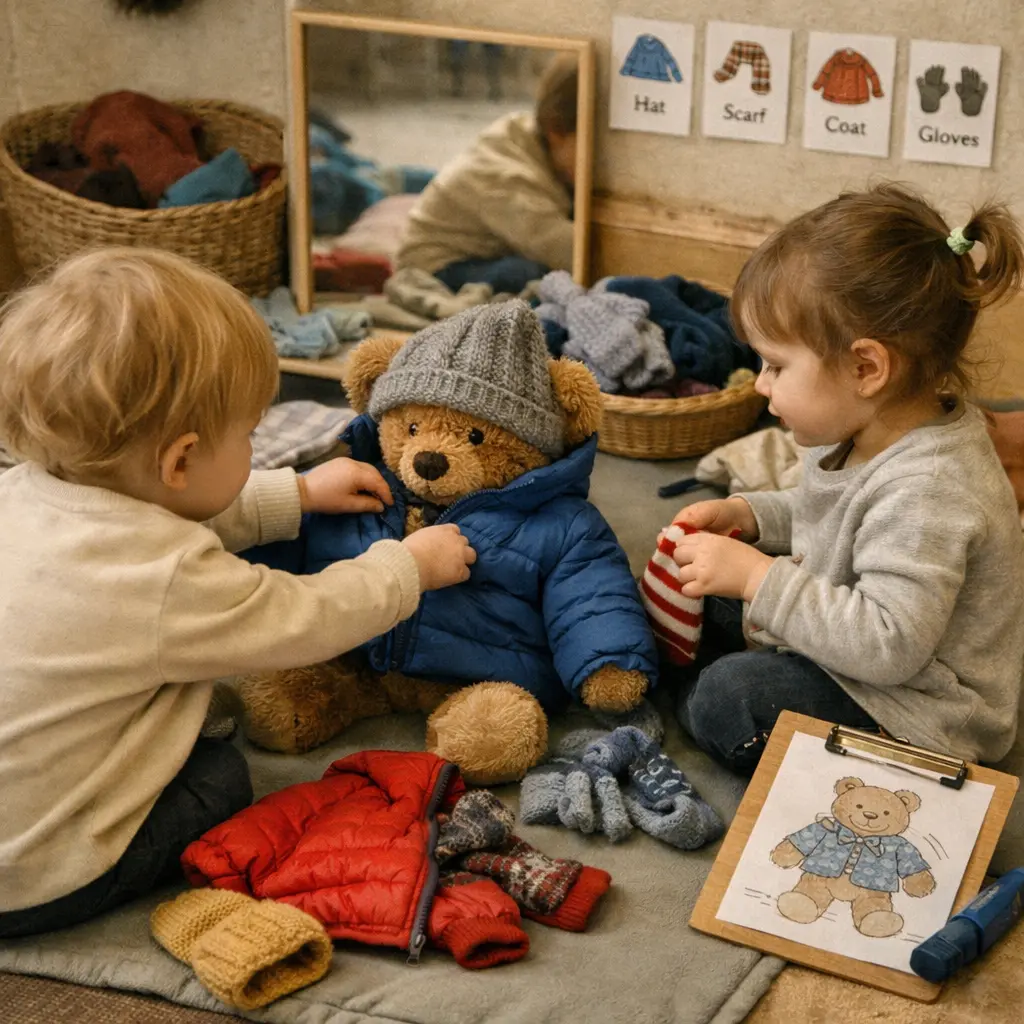
Ethos adaptation — The dressing area is arranged as a low, open dressing station with baskets of varied child-sized winter clothing and multiple dolls placed within easy reach so children select materials themselves. Materials are presented as loose parts: mismatched gloves, elasticated hats, coats with different fasteners, scarves and socks inviting exploration rather than a single prescribed outfit. Picture labels sit at child height as invitations, and the mirror and mat are positioned to allow simultaneous independent approaches and safe movement around the space.
The adult steps back as observer and co-researcher, using commentary such as "I can see you exploring the zipper" or "You’re trying to get the mitten on" and open prompts like "What happens if you turn the jacket this way?" The child may invent sequences, pause, repeat or combine clothes for imaginative play; fine-motor practice, decision-making and vocabulary emerge naturally. Observation notes focus on persistence, bimanual coordination, turn-taking and descriptive language used, embedded in the flow rather than added as a separate task.

A quiet corner is defined with a plain wool mat and a low wooden bench, holding two soft figures only: a cloth baby or wool teddy. The materials are arranged simply in shallow wooden trays: cotton or wool layers (vest, jumper), soft trousers, a wool coat, knitted hat, wool socks, and mittens with cotton ties; fasteners are wooden buttons with cotton loops and smooth metal zips. A small polished metal mirror is fixed at child height; no labels or picture cues are used.
The adult demonstrates a single, unhurried dressing of one figure, showing hands working one button and a gentle zip pull, using minimal words and pausing for watching. Remaining close and observant, the adult intervenes only for safety or to quietly model steadiness. The child returns to dressing and undressing, feeling textures, trying fasteners, checking the mirror, and choosing items that suit cold weather, repeating at their own pace and folding pieces back onto the trays to close.