Cutting snowflakes from paper and counting beads (3–4 years)
Winter
Reggio Emilia
Creative arts and design
Snowflake folding and counting beads begin, focusing on symmetry and motor skills; deeper ethos adaptations and documentation are available in the full version.
Children explore symmetry and fine motor skills by folding and cutting paper to create snowflakes. After producing several snowflakes, they extend the activity by counting snowflakes or counting beads to compare quantities. The session supports early maths, concentration, and expressive language as children describe patterns and compare groups.
Step-by-Step Guidance
1. Set up individual work trays with a square sheet of paper, a pair of child-safe scissors, and a few counting manipulatives. 2. Demonstrate folding a square in half, then in quarters, showing where to place cuts to create a symmetrical snowflake. 3. Invite the child to pick a sheet, fold it, and make one or two simple cuts along the folded edge. 4. Help the child gently open the snowflake to reveal symmetry; discuss the mirrored shapes. 5. Lay out counting beads or pebbles and number cards; invite the child to count the snowflakes and place the corresponding number of beads on a mat or next to each snowflake. 6. Encourage a comparison discussion: “Which snowflake has more beads? Which has less? Are any the same?” 7. If time allows, repeat with a second snowflake to practice consistency and symmetry. 8. Display the finished snowflakes in a designated area or on a wall grid. 9. Clean up together and reflect on what was challenging and what was enjoyed. 10. Extend by creating a small “Snowflake Book” where each page shows one snowflake and its count.
Learning Objectives
This activity provides opportunities for fine motor development and hand–eye coordination through cutting and folding (Physical Development). Children may begin describing symmetry and patterns (Communication and Language). They may develop early counting, one-to-one correspondence, and simple quantity comparisons (Mathematics). It also offers expressive play and design as children decorate and discuss their snowflakes (Expressive Arts and Design).
Adult Role
Provide safe, calm guidance and language throughout. Demonstrate safe scissor use and folding technique, then step back to observe and prompt with brief cues like ‘Where will you fold next?’ or ‘What shape do you think will appear here?’ Offer mathematical language for counting and comparing quantities, and support turn-taking and sharing of materials. Monitor safety, ensure beads or small items are age-appropriate, and adapt prompts to individual needs. Record brief observations to support playful progression and EYFS links.
Observation Cues
- Child folds paper with deliberate creases and begins to plan where to cut.
- Snowflake opens with clear symmetry; child identifies mirrored cuts.
- Child counts beads or pebbles while placing them on number cards or mats.
- Child uses number language (more, less, same) during the counting extension.
- Child describes their snowflake design or explains choices to a peer or adult.
- Child shares materials and collaborates or asks for help when needed.
Time & Space
40–60 minutes
Tabletop workspace per child plus a nearby floor-area for laying out finished snowflakes; a quiet corner or small group area suitable for focused activity.
Materials
Safety
Age adaptations
EYFS Links
This activity engages several EYFS areas: Physical Development (fine motor control and hand strength through cutting and folding); Mathematics (counting, one-to-one correspondence, more/less, and quantity comparison); Expressive Arts and Design (creative making and discussing designs); Communication and Language (describing patterns, symmetry, and counting language); Understanding the World (exploring seasonal symbols and the natural world through snowflakes). It supports active, play-based learning with opportunities for adult-supported, child-led exploration.
Ethos adaptations

Set up two low trays so each child has a defined workspace: Tray A holds one pre-folded square, one child-safe pair of scissors, one pencil and a small mat; Tray B holds a small pile of beads (maximum six) and one counting mat. Remove extra paper and decorative materials so the focus is on one clear sequence: unfold-fold-cut → place finished snowflake on mat → move to beads tray to count. Arrange items left-to-right in order of use so the child can complete the steps independently and see immediate visual outcomes (fold lines, hole patterns).
Introduce the activity with a single, slow, silent demonstration showing the fold and one cut, then step back and limit language to brief safety reminders or a single prompt to move trays when ready. Avoid asking questions or giving step-by-step help; instead watch for fine motor control (scissor grip, controlled cuts), repetition and sustained focus, and accurate one-to-one counting of beads. Offer the next tray or a second sheet only when the child signals readiness, and note precision, sequencing errors, or moments of concentration for planning future invitations.
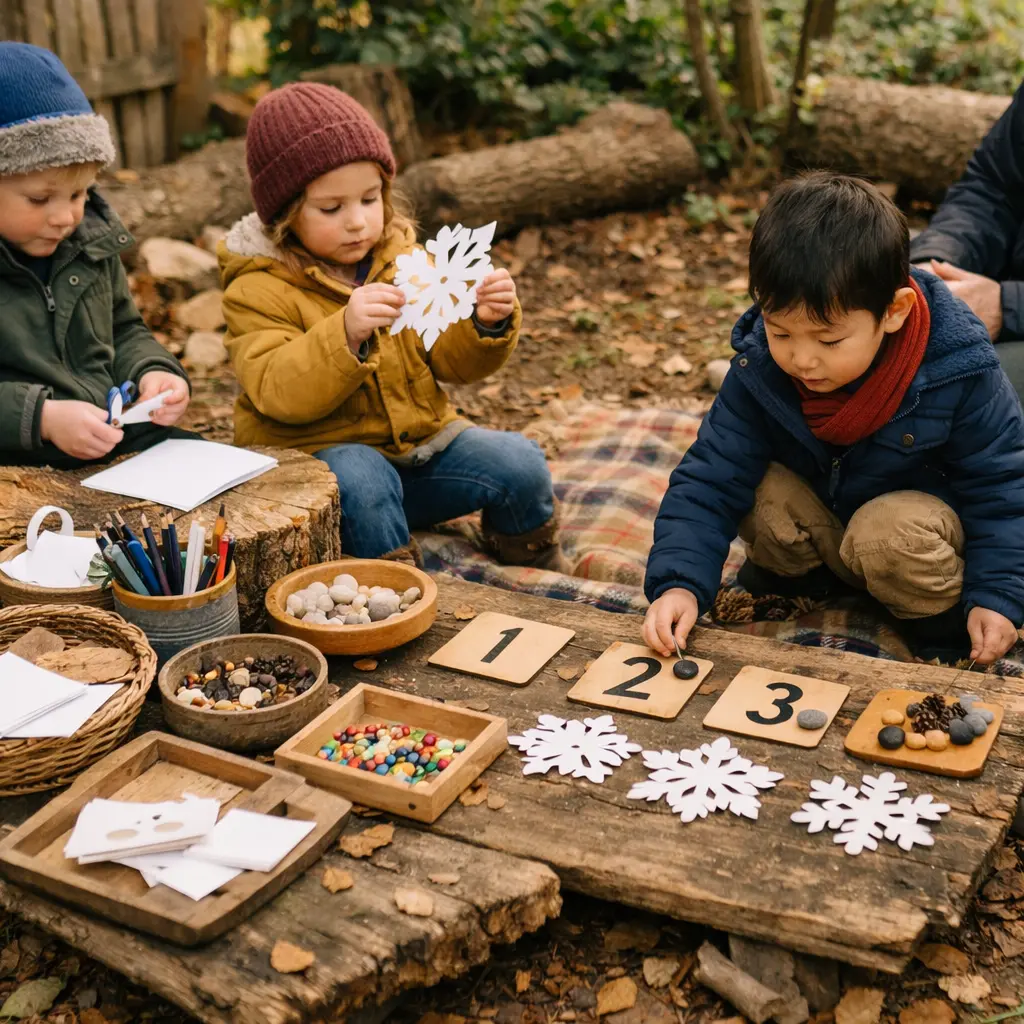
In an outdoor or nature-integrated space, the activity moves to a sheltered garden patch or paved courtyard with blankets, a stump or low table and a scattering of leaves and safe uneven surfaces. Materials such as square recycled paper, clean birch bark strips or large flat leaves, blunt-tipped scissors, pencils and natural counters (pebbles, pinecones, large beads or buttons) are provided in an open-ended way rather than pre-arranged; small trays hold pieces to contain mess and wind.
The adult observes from close by, checks scissors and anchors, models one simple fold and cut then steps back to offer minimal, responsive prompts or a single-word cue when needed. Children choose how to fold, cut and display snowflakes, compare and count using natural counters or trays, move between making and counting at their own pace, and may rearrange groups to explore more/less while the adult intervenes only to manage safety.
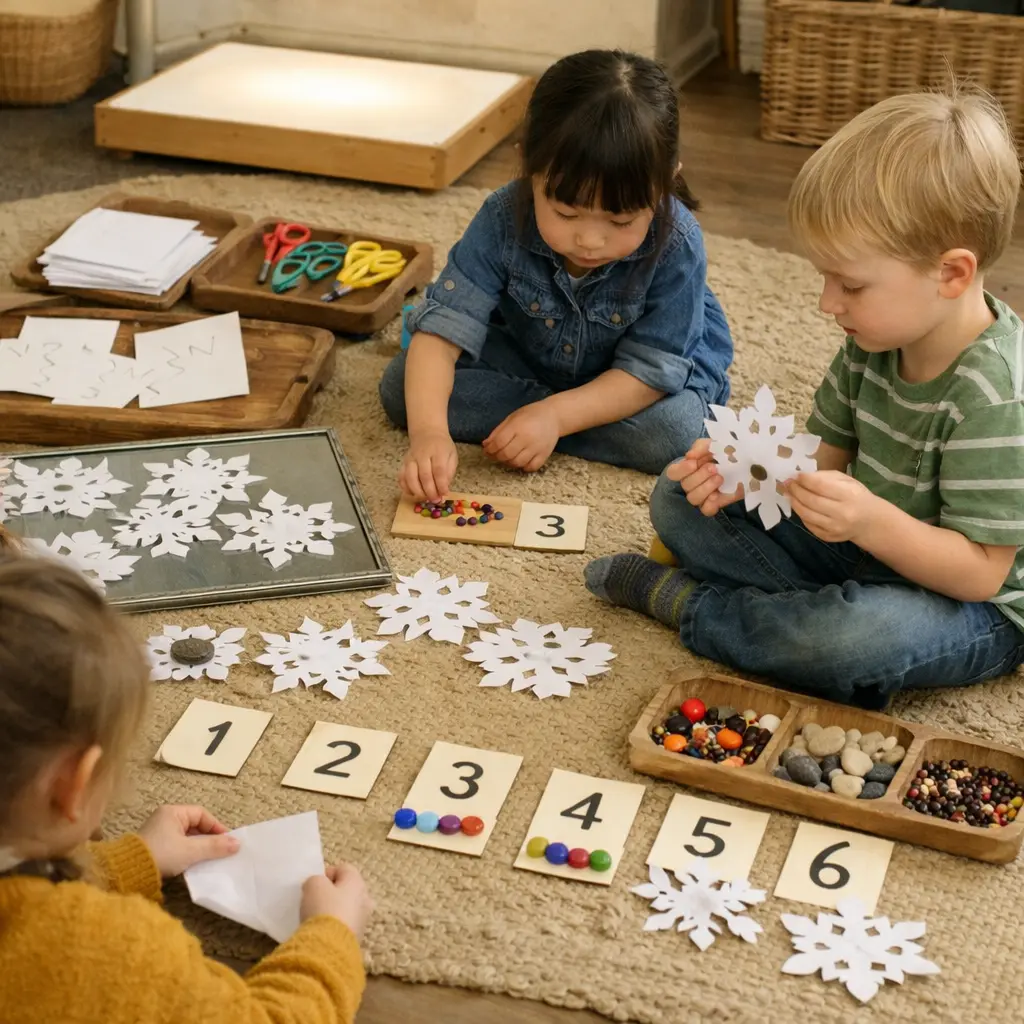
Arrange low tables or floor trays so folding, cutting and loose parts sit within reach and can be used across the space: stacks of square paper, trays of blunt scissors, mixed-size beads/buttons/pebbles, fabric scraps, and small mirrors or a light surface. Remove single-use templates and place varied papers and optional folding guides where children choose them. Materials are grouped to invite combination (decorating, threading, pairing) and left available so the child may return, repeat or abandon a snowflake at will.
The adult steps back as observer and co-researcher, using commentary: "I can see you folding another way," "You’re trying to make a pattern," or "What happens if you try a bigger bead?" The child may select folding styles, decide how many beads to pair with each snowflake, or invent matching systems. Observation notes are embedded in flow: watch grip changes during cutting, verbal descriptions of symmetry, one-to-one counting gestures, strategies for comparing quantities, and moments of sustained concentration.
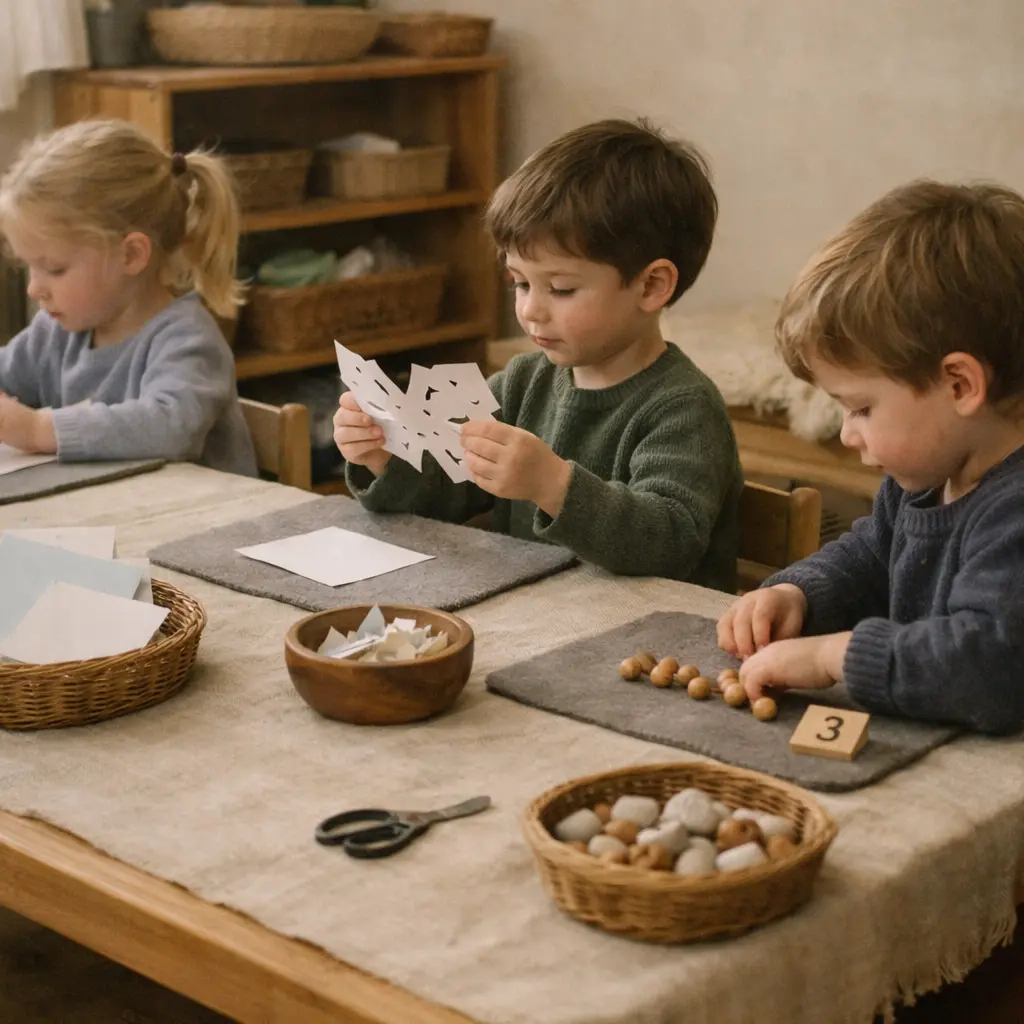
A quiet table is prepared with a neutral cloth and individual wool-felt mats to define each workspace; offcuts are gathered into a small wooden bowl to keep the area clear. The materials are arranged simply: squares of plain white or softly tinted recycled paper in a wicker basket, child-safe metal scissors, a graphite pencil or beeswax block crayon for optional marks, and a second basket with smooth wooden beads or river pebbles plus a few wooden number tiles for gentle reference.
The adult demonstrates a slow fold and a safe scissor grip, then makes a few calm snips without commentary, remaining nearby and observant. The child explores folding and cutting at their own pace, opening the paper to notice symmetry, returning to repeat folds and vary where they snip. For counting, the child sets snowflakes or individual beads onto the mat, touching one at a time to match numbers, placing two small groups side by side to compare; the adult quietly names actions or supports safety when needed.