Drawing winter story characters with mark making materials to develop grip and early literacy (3-4 years)
Winter
Mark making
Literacy
Nature/rainbows and weather
Children choose a favourite winter story character and begin mark making with a range of tools. The opening invites discussion of characters and events, and supports grip and expressive design. An optional extension invites older children to draft a storyboard or short narrative on paper and consider turning it into a small book. The full setup and adaptations are explored in the complete activity guide.
Children choose a favourite winter story character and represent them through mark making on paper using pencils, crayons and other tools. The activity supports grip, control and expressive design while strengthening early literacy as children talk about characters and events from their stories. For older children, there is an optional extension to draft a storyboard or short narrative on A3 or A4 and bind it into a simple book.
Step-by-Step Guidance
1. Prepare a calm, well-lit table with mats and paper. 2. Offer a small selection of mark-making tools and papers, plus a winter storybook or two for inspiration. 3. Read a short excerpt from a favourite winter story to invite recall of characters. 4. Invite each child to choose a character and begin drawing on their paper. 5. Support younger children with hand-over-hand grip and model how to hold a pencil. 6. If older children are ready, invite them to add a simple caption or begin a storyboard page. 7. When all pages are drawn, provide an option to bind into a simple book using staples or rings. 8. Invite children to share a sentence about their character with a peer. 9. Clear away materials and tidy the area.
Learning Objectives
Expressive Arts and Design: children explore line, shape and texture as they represent characters. Literacy and Communication and Language: children talk about characters and events from their stories and may add simple captions. Physical Development: children develop fine motor control and grip through purposeful mark making. Personal, Social and Emotional Development: children choose materials and persevere with a task, building confidence in their own ideas.
Adult Role
Be present and attuned to each child's needs, modelling clear language and descriptive talk about characters. Provide light physical support to establish a stable grip when needed, then gradually step back as children gain confidence. Scaffold writing or captioning only if the child shows readiness. Observe use of tools and keep children safe, managing drying times for glues and inks. Facilitate sharing and peer feedback during a short reflection.
Observation Cues
Notices the grip and control of drawing tools and the evolution of line quality; Hears children naming characters, colours and story moments; Sees children refer to the familiar story to guide drawing or describe actions; Observes some children attempt sequencing or storyboard ideas; Observes sharing and turn-taking when tools are moved between children.
Time & Space
45-75 minutes
Indoor table space for each child or small group; accessible floor space for spreading papers; nearby water and drying area; room for displaying finished work.
Materials
Safety
Age adaptations
Budding Adventurers
Environment uses large sheets placed on wall or floor; chunky mark-making tools (thick crayons, broad markers); adult supports with hand-over-hand grip to establish initial marks; language focus on naming simple shapes and characters; simple, safe writing prompts or labels introduced with heavy support; observations track emerging hand control and willingness to experiment with different textures.
Curious Investigators
Smaller sheet size (A4) and simple storyboard templates alongside drawing; encourage children to narrate a simple sequence or event from the story; provide a caption prompt or simple sentence starters; offer a choice of both pencils and crayons to explore line variety; allow collaborative pair work or small group sharing. Observations focus on question-asking, storytelling links and early writing attempts.
Confident Discoverers
A4 paper or small booklet pages with a simple binding; introduce basic caption writing or simple storytelling sentences; encourage independent tool selection and documentation of a short narrative or dialogue; optional extension to create a multi-page storybook with stitched or stapled binding; focus on precision, detail, and coherent sequencing of events.
EYFS Links
Prime areas engaged include Communication and Language (talking about characters, events and colours), Physical Development (fine motor grip and control), and Personal, Social and Emotional Development (choosing materials, turn-taking, and sharing). Specific areas engaged include Literacy (beginning to connect marks with words or captions) and Expressive Arts and Design (exploration of media and materials, representing ideas). The activity supports independent exploration within a structured, story-informed context.
Ethos adaptations

Prepare the table as individual trays: one sheet of A4 or A3, one pencil (thin) and one crayon (thicker) placed in a fixed position, a small pot for used tools and a sample winter character sketch as the only prompt. Remove the rest of the material so the child focuses on line, shape and grip; keep scissors and book-binding supplies in a separate tray for the older-child extension so they are a distinct, optional step rather than mixed with mark making.
Show the child a single, slow demonstration of how to hold each tool and make a simple character line, then step back and use minimal language. Observe how the child repeats strokes, changes pressure, positions the paper and returns tools to their places; note precision, grip adjustments and sustained focus and only offer a short, practical prompt if the child clearly stops from frustration.
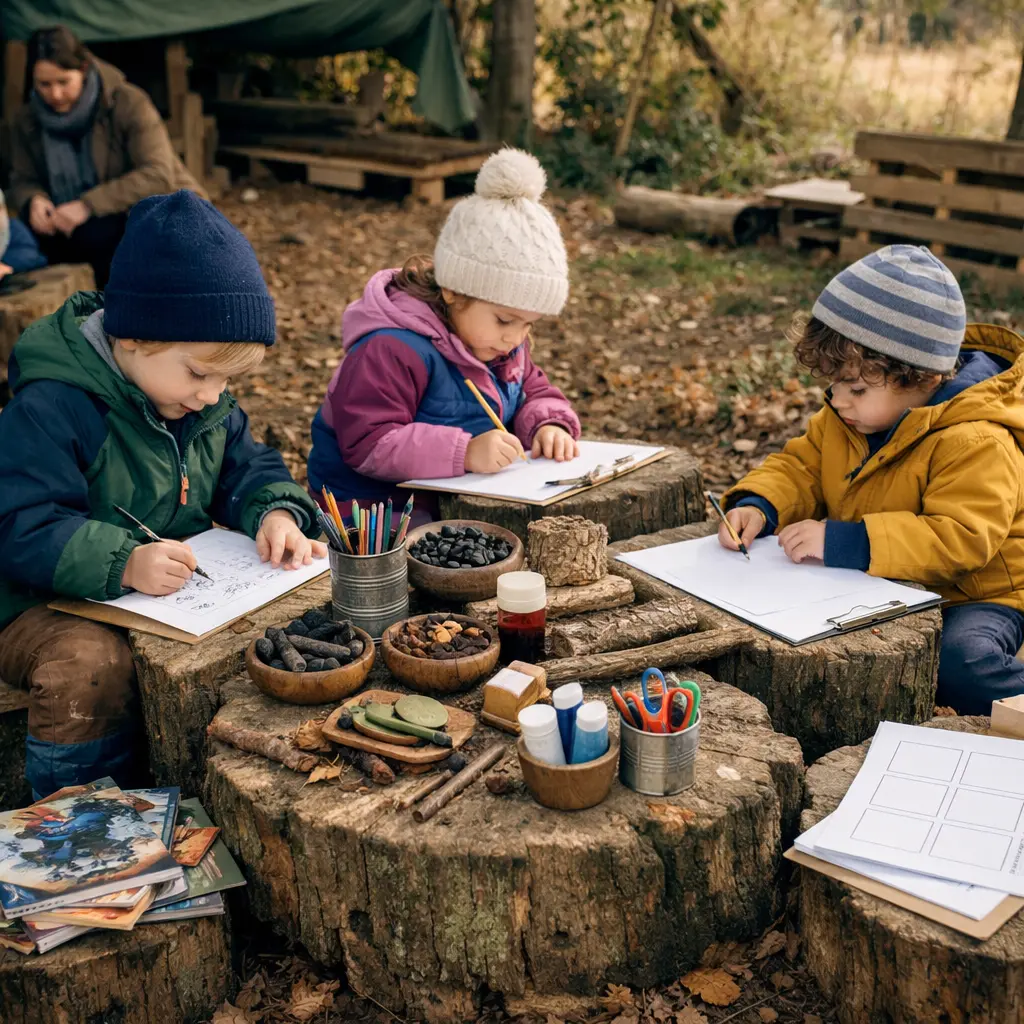
In an outdoor or nature-integrated space, move the mark-making session to a sheltered garden, courtyard or nearby green area where children sit on logs, tree stumps or low benches and use clipboards or paper anchored on natural surfaces. Materials are arranged as open-ended natural and real alternatives — charcoal sticks, twig crayons, bark and leaf rubbings, mud or berry inks and recycled paper — alongside a small selection of pencils and crayons to preserve fine-motor grip practice.
The adult observes from nearby, offering minimal, responsive prompts and modelling grip or mark-making techniques only when asked while supervising safe use of scissors and glue. Children choose a favourite winter character, explore mixing natural marks with conventional tools, talk about events as they work, and may sequence simple frames into a loose storyboard at their own pace without a fixed finished product.

Arrange the space so papers of different sizes lie flat across low tables and a tray of loose parts (fabric scraps, pinecones, buttons, ribbon) sits within reach beside jars of pencils, crayons, oil pastels and markers. Storybooks are open on stands nearby; optional binding materials are in a labeled basket the child can choose. Scissors and glue remain accessible with adult supervision; nothing is presented as a single finished-task kit so the child may combine mark making, collage and found materials to represent a winter character.
The adult stays nearby as observer and co-researcher, using commentary such as "I can see you are trying..." or "What happens if you press harder here?" rather than giving instructions. The child may select scale, materials and sequence, move between drawing and collaging, and decide whether to add captions or bind pages. The adult notices grip changes, repeated marks, emerging narrative language and cooperative exchanges, recording brief observations in the moment rather than directing outcomes.

Steiner (Waldorf) Adaptation
The workspace is simplified to a single neutral cloth on a low table or tray with only A3 or A4 paper and a very small selection of natural mark‑making tools: wood‑cased pencils, muted wood‑pigment coloured pencils, beeswax crayons and willow charcoal. Only a small number of sheets and tools are provided at once; scissors and binding are kept pre-cut or prepared by the adult. Cotton aprons and a pot of water for brush cleaning sit to one side for safety and tidying.
The adult demonstrates a calm, single mark or holding grip once, then steps back to remain quiet and observant, using minimal language unless for safety. The child returns to repeated mark making at their own pace, choosing from the limited tools and pauses as needed; the adult intervenes only to model a steady hand, prompt a gentle transition to tidy, or to carry out supervised cutting/binding, preserving child-led exploration of character and narrative.