Creating story sacks from household teddies and toys to reenact stories or invent new ones
Literacy
Role-play
Creative arts and design
Traditional stories
An abridged look at creating story sacks with household items to spark imagination. It hints at setup principles and ethos-focused variations without revealing full step-by-step guidance.
This activity invites children to assemble story sacks using teddies and toys from around the home or setting. They use the items to reenact a familiar tale or to invent a new story, supporting imagination and expressive language. Adults provide gentle prompts and space for collaboration, so children practise narrative thinking, turn taking and problem solving as they play.
Step-by-Step Guidance
1. Prepare 2–4 story sacks on a low shelf, each containing a small set of familiar items. 2. Invite a child to choose a sack and spread items on a mat. 3. Model one-sentence opening for a story using one item, then invite the child to continue. 4. Support with open prompts but step back to let the child lead; add new props only if needed to extend the story. 5. Encourage turn-taking and collaboration when more than one child is present. 6. After play, tidy away and invite reflection or drawing a quick scene from the story. 7. For younger children, keep sessions shorter and emphasize sensing and naming rather than complex plots.
Learning Objectives
This activity supports early literacy and Communication and Language as children name characters, settings and actions. It encourages Expressive Arts and Design through imaginative play and role play, and Personal, Social and Emotional Development as children share, take turns and cooperate. Children may begin to sequence events, describe narratives and ask questions, building confidence in storytelling.
Adult Role
Be emotionally present and attentive, narrating items and actions with clear, simple language. Model turn-taking and joint attention, naming characters and settings as children handle materials. Scaffold by posing gentle questions but step back to let children lead. Observe for engagement, safety, and evolving language, and respond with appropriate extensions or simplifications. Ensure inclusive language and actively supervise to keep play safe.
Observation Cues
Children name characters and describe what happens using concrete terms. Children recreate a scene from a known story or invent a new sequence with the sacks. Peers contribute ideas and negotiate roles during play. Language becomes more detailed as they describe settings, motivations and outcomes. Play persists across a session and reappears with new objects or reconfigurations.
Time & Space
15–30 minutes typical, shorter for younger children and longer for older children
Indoor carpeted area or cleared floor space; low shelf or tray for sacks; optional outdoor covered area with a soft ground surface
Materials
Safety
Age adaptations
Budding Adventurers
Offer 3 sacks with a handful of items that can be moved and combined; prompt with simple questions like who is in your story and where does it happen. Allow longer handling time and a basic narrative sequence, with adult repeating and expanding a few phrases. Expect 15–20 minutes of engaged play with opportunities for parallel or shared storytelling.
Curious Investigators
Provide 3–4 sacks with a larger set of props; encourage children to plan a short sequence and narrate events. Use open-ended questions to extend thinking and invite peer collaboration. Sessions may last 20–25 minutes, with opportunities to pause and revisit sacks for different outcomes.
Confident Discoverers
Set up 4–5 sacks with varied props and allow small groups to co-create a multi-scene story. Invite children to take roles, negotiate ideas, and record a simple story frame or diagram. Sessions of 25–30 minutes support more complex plots, role balance, and sustained concentration.
EYFS Links
Supports Communication and Language through conversation and narrative play; develops Literacy as children retell stories and describe events; fosters Expressive Arts and Design via role-play and storytelling with textured materials; promotes Personal, Social and Emotional Development through turn-taking, sharing, collaboration, and caring for props; touches on Understanding the World when using household objects and discussing real-world items
Ethos adaptations

Place one small story sack on a low tray or marked mat for each child and reduce the contents to three purposeful items: a main character toy, a single setting cue (a scrap of fabric or natural object) and one prop. Add a simple three-frame picture card that shows beginning, middle and end and keep extra scarves and toys out of reach. Arrange sacks in order and label each with a picture so children can choose and return a sack independently, keeping the focus on sequencing a short narrative.
Show the sequence once with a slow, silent demonstration: take a sack, lay out the three items left-to-right, and tell a one-sentence beginning–middle–end, then step back. Use minimal language after the demo, offering only brief safety prompts and one-word cues if needed, and avoid questioning. Observe who repeats the sequence, how children place items in order, their use of past/present tense and turn-taking, and note signs of concentration or abandonment rather than directing the play.

In an outdoor or nature-integrated space, set the activity in a sheltered corner of the garden or local green space with logs to sit on, a low table of tree slices or a blanket on grass, and nearby natural loose parts. Materials such as cloth story sacks, household teddies and toys are joined by natural props—sticks for wands, leaves and pinecones for scene-making, stones for character markers, scarves and fabric scraps for costumes—arranged openly rather than in fixed kits so children can select and combine items freely.
The adult observes from a short distance, checking anchors and managing any minor risks while using minimal, responsive language and occasional brief questions. Children choose roles, gather props, sequence and reenact familiar tales or invent new ones, taking turns and negotiating props; Materials are arranged for easy access so children may revisit stories, change characters and follow their own pacing while the adult steps in only to support safety or offer a single prompt.
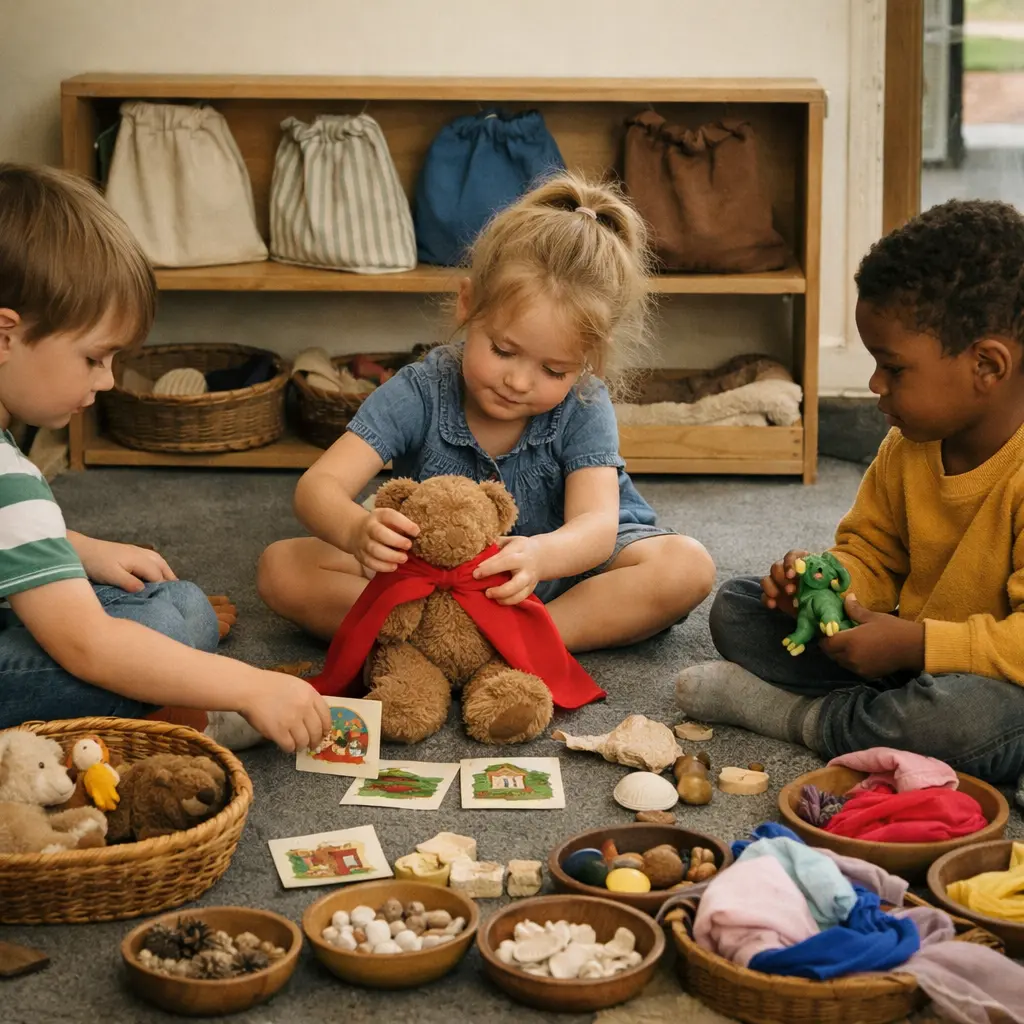
Ethos adaptation: arrange a low shelf or open tray area where 2–4 cloth sacks and loose materials are always reachable, each sack visible but unfilled so children choose contents. Group fabrics, natural objects, toys and simple picture cards in small bowls rather than preassembled kits so materials invite combinations and multiple uses. Leave gaps: no labelled story order, no required costume set, and space for children to bring their own household teddies or found objects to redefine the sacks’ purpose.
The adult steps back as observer and co‑researcher, offering commentary not instruction — for example, "I can see you’re sorting characters," "You’re trying a new voice," or "What happens if the shell becomes the crown?" The child may select, sequence, abandon or rework a sack narrative, invite peers, or use objects in novel roles; the adult notices language turns, sequencing attempts, negotiation and problem solving and records these moments as they naturally emerge.

Steiner (Waldorf) Adaptation
A small, clearly marked cloth area on a low table or floor tray is prepared; only two or three cloth story sacks and a maximum of three toys are presented to keep the surface uncluttered. Teddies and figures are swapped for natural-fibre or wooden versions where available, costumes are cotton or wool scraps, and props are simple natural objects (wooden buttons, pinecones, shells). Picture prompts and labels are muted paper, folded and placed to the side so the play space remains calm and contained.
The adult demonstrates quietly by placing a toy in a sack and modelling a short, soft narrative line or a simple movement, then steps back to observe without directive language. The adult remains close for safety, offering brief modelling of turn-taking or handling only when needed; the child returns to reenacting or inventing stories at their own pace, repeating sequences, naming characters and settings, and collaborating with peers through sustained, child-led play.