Creating spring mud kitchen recipes with petals, herbs and water in an outdoor mud area
Sensory Play
Communication and Language
Children explore a mud kitchen by combining mud, water and spring finds such as petals, leaves and herbs to create pretend seasonal recipes. Adults provide a manageable set of tools and a clear place for ingredients, supporting children to notice changes in texture, colour and smell. Children may name dishes, share servings and build simple role play around cooking and serving, with adults watching for turn-taking and safe handling of small natural items.
Children use a mud kitchen space to combine mud, water and spring finds such as petals, leaves and herbs to make pretend seasonal recipes. The experience supports open-ended sensory exploration and imaginative thinking, with children choosing what to collect, mix and name. Adults can keep the focus on safe handling of natural materials and on noticing changes in texture, smell and colour as children experiment.
Step-by-Step Guidance
1. Prepare the space by checking the mud kitchen is stable, surfaces are wipeable, and there is a clear boundary for where mud stays.
2. Set out a small selection of bowls, spoons and serving plates so children can see choices without crowding.
3. Provide a water container that children can manage, and place it where spills are acceptable.
4. Invite children to collect spring items that are already fallen or can be safely picked, using baskets or tubs.
5. Present the idea of “spring recipes” in simple terms and leave the content open, so children decide what to make and what to call it.
6. Allow children to combine mud and water in their own way, adding petals, leaves and herbs as ingredients.
7. Support children to notice changes by pausing near their mixtures and commenting on what you can see and smell.
8. Offer extra containers or a clear space for “serving” when children begin to share food, set up a café, or create scenes.
9. Keep the area workable by swapping out overly muddy tools, refreshing water if needed, and providing a place for finished creations.
10. Close the activity with a simple tidy routine: return tools, tip leftover mixtures into an agreed spot, and support handwashing.
Learning Objectives
Children may explore early science ideas through Understanding the world by noticing how water changes mud and how different natural items affect colour, smell and texture. Children may develop Communication and language as they describe ingredients, make up recipe names and explain what they are making. Children may strengthen Physical development through scooping, pouring, stirring and carrying items around the outdoor area.
Adult Role
Stay emotionally attuned by noticing when children want company, when they want space, and when play is becoming frustrating due to spills or crowded tools. Model language that matches what children are doing, using ingredient words and sensory descriptions, and repeat children’s invented recipe names to value their ideas. Scaffold lightly by offering one suggestion at a time (an extra bowl, a smaller scoop, a place to put finished dishes) and step back when children are absorbed in mixing or role play. Observe in action by watching how children choose materials, adjust mixtures, and include others, and use this to decide whether to add vocabulary, reduce competition for tools, or simplify the environment. Hold safety responsibility by checking natural items, supervising water and tool use, and keeping mud play within agreed boundaries.
Observation Cues
Names or categorises items as ingredients (petal, leaf, herb, water, mud). Uses sensory words (wet, sticky, gritty, smooth, strong smell, bright colour). Adjusts mixtures by adding more water or more mud and checks the change. Sustains pretend play by naming a dish or assigning roles (cook, server, customer). Shares tools or negotiates turn-taking around a popular bowl or surface. Notices seasonal details (new leaves, blossom, fresh scents) and links them to their creations.
Time & Space
20–60 minutes, depending on children’s interest and access to materials.
Outdoor area with a mud kitchen or sturdy table, access to mud/soil and water, and a clear boundary for messy play.
Materials
Safety
Age adaptations
Budding Adventurers
Add small trays for “serving” and a clear spot for finished dishes to reduce tipping and crowding. Provide a wider range of natural ingredients, including petals, and encourage children to sort by type if they choose. Adult supports imaginative play by reflecting children’s ideas (soup, cake, salad) and helps with simple problem-solving such as thickening a mixture or carrying a full bowl safely.
Curious Investigators
Introduce a simple visual menu board with pictures of spring ingredients, leaving space for children’s own recipe names. Offer measuring cups or scoops of different sizes to invite comparison without requiring accuracy. Adult prompts noticing (What changed when you added water? Which herb smells strongest?) and supports collaborative play by helping children agree roles and share the workspace.
Confident Discoverers
Provide a wider tool set including a small sieve or colander for separating stones or leaf pieces, and a designated “ingredient station” for collected items. Invite children to create themed spring recipes (blossom tea, herb stew) and to represent them with marks or symbols on a board if they choose. Adult supports sustained shared thinking by asking open questions about choices and encouraging children to explain their process to others, without turning it into a lesson.
EYFS Links
Communication and language: Children may use new words for natural materials and actions, and practise explaining what they are making to others. Physical development: Scooping, pouring, stirring and carrying can support hand strength, coordination and control in a meaningful context. Understanding the world: Children may notice seasonal changes and explore simple material changes as mud becomes wetter or drier and as herbs and petals add colour and scent. Personal, social and emotional development: Shared access to tools and space can support turn-taking, negotiating roles and managing feelings when play ideas differ.
Ethos adaptations
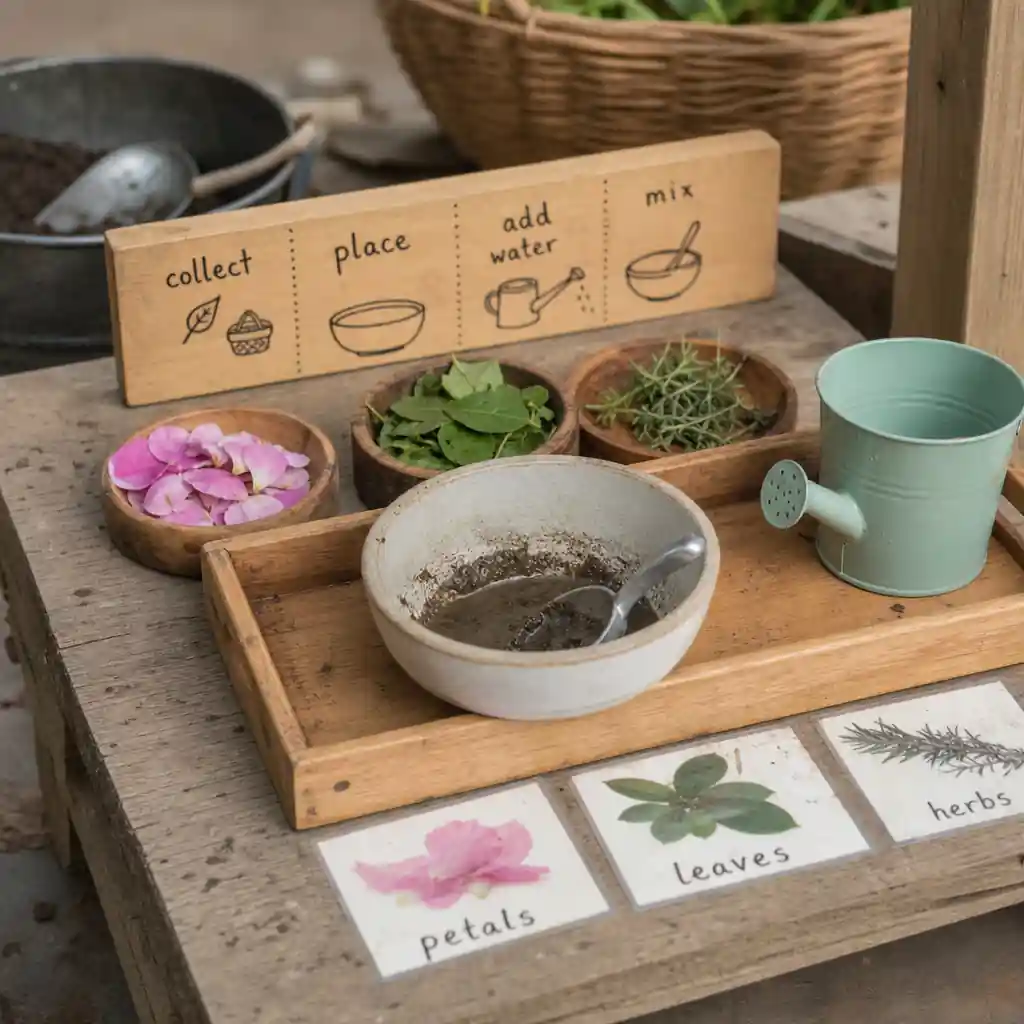
Set out one low tray and one mixing bowl, one spoon, one small watering can and a limited selection of three types of natural items (petals, a leaf type, one herb) placed in separate, labelled bowls. Leave picture cards for naming nearby and remove extra pots and tools so the clear sequence is: collect → place on tray → add water → mix. This reduction and ordering makes the key focus — how adding water changes mud texture, smell and colour — obvious and reachable for each child.
Give a single, slow demonstration: show collecting one item, add a measured pour to the bowl to reach a visible line, stir once, and name one word (wet/dry/smudgy). Then step back, use only brief safety reminders, and avoid prompting during play. Observe for repeated pouring or stirring, careful control of movements, and new descriptive words or recipe names the child uses, noting moments of sustained concentration or self-correction rather than directing next steps.
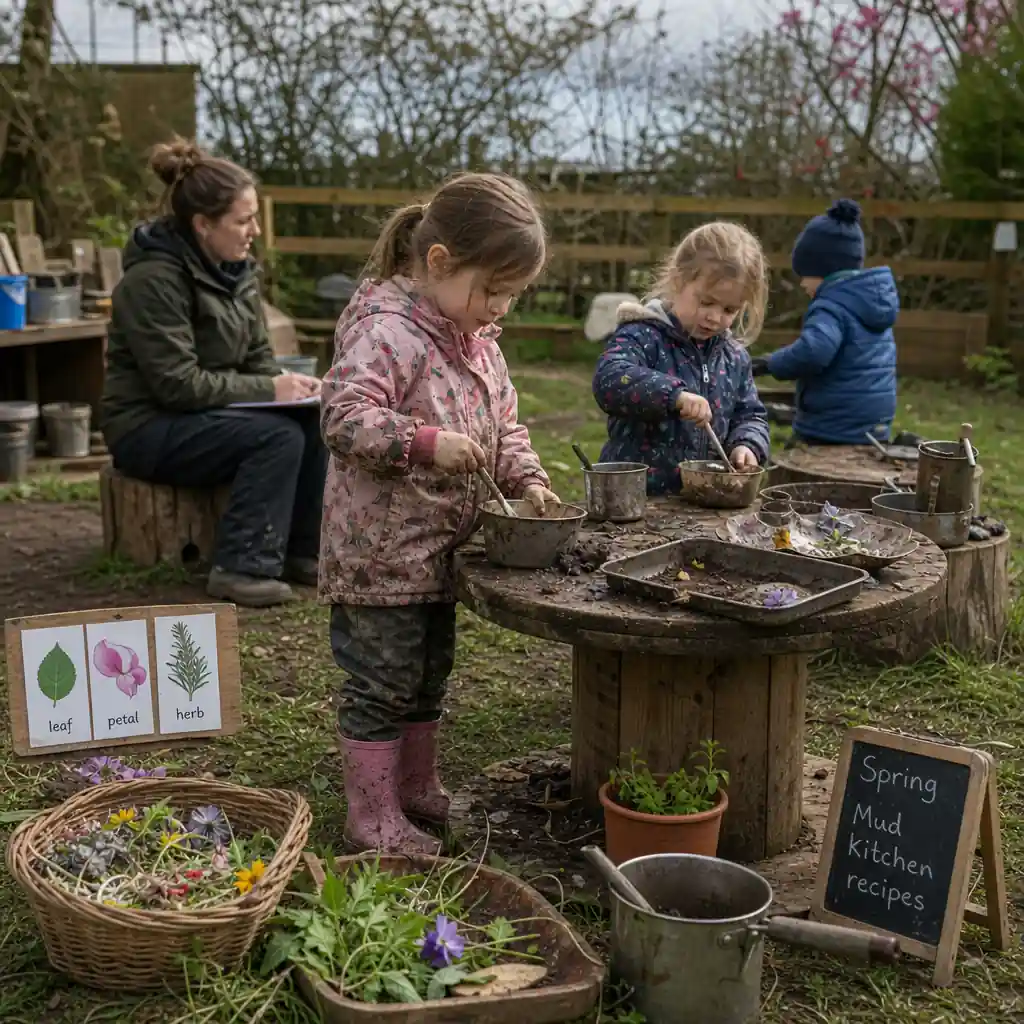
In an outdoor or nature-integrated space, move the mud kitchen into a grassy patch or garden bed with a low table or tree-stump work surface and nearby uneven surfaces for challenge. Materials such as real petals, leaves, herbs, stones and water are provided in open-ended baskets rather than pre-measured sets; metal or wooden spoons, old pots, scoops and child-safe bowls sit ready for exploration. Materials are arranged for free choice and sensory discovery; children may collect and add seasonal finds at their own pace without a fixed recipe.
The adult observes from nearby, checking anchors, water containers and tool safety, offering brief, practical prompts or single-word descriptions only when needed. Children choose roles, scoop, pour, stir and carry, testing wetter and drier mixes, smelling and naming ingredients and inventing recipe names as they play. The adult responds with short observations, models calm handling and handwashing, and records or repeats children’s words when invited, stepping in promptly if a higher level of supervision or assistance is required.

Arrange the outdoor mud kitchen as an inviting, self-serve atelier: low surfaces grouped into discovery zones (mixing, collecting, tasting-pretend) with trays of loose parts placed where children can reach and replenish them. Replace single-use kits with varied open-ended materials — bowls, spoons, ladles, fabric scraps, shells, wood pieces, petals, leaves and herbs — displayed in small baskets so the child may combine, mound, sieve, and reconfigure ingredients without a prescribed result. Keep water accessible in refillable jugs rather than handed-out measures.
The adult steps back as observer and co-researcher, using brief comments such as "I can see the mud is darker where you added water" or "What happens if you stir more slowly?" rather than giving instructions. The child may decide recipes, roles, and when to pause or return; shared tools invite negotiation and turn-taking. Observation cues—changes in texture, repeated stirring patterns, naming exchanges, and social problem-solving—are noted naturally as part of play, supporting EYFS goals in language, physical skills and understanding the world.

Steiner (Waldorf) Adaptation The materials are arranged on a single neutral cloth beside the low mud table or in shallow wooden trays to create a calm, contained workspace. Only small quantities of mud, a watering can, wooden bowls, metal spoons, natural-fibre scoops and baskets of seasonal petals, leaves and herbs are provided; bright plastics and extra tools are removed. A single washable cloth for hand wiping and a discreet labelled card for common finds sit at the edge for occasional naming support.
The adult demonstrates quiet, slow scooping, pouring and stirring at the table, modelling safe handling without verbal step-by-step instruction and remaining close and observant. The child returns to their chosen mixes in an open-ended flow (setup → exploration → tidy), repeating actions as desired, naming recipes aloud if they wish; the adult intervenes only for safety, to steady a movement or to record a child’s recipe name on a clipboard.