Creating mini beast habitats in small sensory trays using natural fillers and recycled tubes
Sensory Play
Children explore a small-world mini beast habitat inside a shallow tray filled with a chosen sensory base, using recycled tubes and small boxes as shelters and tunnels. Adults offer a limited set of materials and model simple habitat vocabulary, staying close to support children who are unsure about textures. Practitioners can watch for how children organise spaces, repeat building ideas, and use mini beasts to represent hiding, travelling, or resting.
Children explore a small-world mini beast habitat built inside shallow trays filled with a chosen sensory base such as sand, mud, or lentils. Recycled tubes and small boxes become shelters, tunnels, and “homes” that children can arrange and re-arrange. The experience supports imaginative play alongside careful noticing of textures, spaces, and how mini beasts might move and hide. Adults can keep the play open-ended and responsive, following children’s ideas about habitats and creatures.
Step-by-Step Guidance
1. Prepare the space: place a wipe-clean mat on the floor or a low table, and set out one tray per group with enough room for children to stand or sit without crowding.
2. Choose one sensory base for each tray (sand, mud, or lentils). Add a shallow layer so children can move it easily without it spilling constantly.
3. Check recycled materials: remove tape, staples, and sharp edges from tubes and boxes. Pre-open boxes so they sit stable and can be used as shelters.
4. Present materials in a simple layout: tray in the centre, mini beasts in a small bowl beside it, and tubes/boxes in a separate pile. Add a scoop and cup within reach.
5. Invite children to explore the tray and select mini beasts. Keep the invitation open, focusing on what they notice about the material and the spaces they can make.
6. Allow children to build habitats by placing tubes and boxes, burying edges, making entrances, and creating pathways. Let children decide whether the habitat is for one creature or many.
7. Join play briefly to model possibilities without taking over, such as making a simple tunnel, clearing an opening, or placing a mini beast to test a space.
8. Support sustained play by offering small adjustments: add one more tube, swap a box size, or provide a second scoop if waiting becomes a barrier.
9. Close the activity with a calm tidy routine: children can return mini beasts to the bowl and place tubes/boxes in a recycling pile. Keep the sensory base contained for later use or dispose of mud safely. Support handwashing.
Learning Objectives
Children may develop sensory awareness and fine motor control as they scoop, pour, press, and place materials (Physical Development). Children may extend language as they name mini beasts, describe textures, and talk about where creatures might live (Communication and Language). Children may explore early understanding of the natural world by considering simple habitat features such as shelter and pathways (Understanding the World).
Adult Role
Stay emotionally attuned by noticing children’s comfort with textures and offering choices without pressure, such as a tool instead of hands or a different tray base. Model language that matches what children are doing, using simple habitat and position words (hide, shelter, tunnel, under, inside, near) and texture words (dry, sticky, smooth, gritty). Scaffold only when needed: stabilise a box that keeps collapsing, show how to clear a blocked tube, or reduce the number of items if a child looks overwhelmed; step back when children are absorbed and problem-solving. Observe in action by watching how children plan spaces, repeat actions, and use mini beasts in pretend play, and note any emerging interests (certain creatures, building tunnels, burying). Hold safety responsibility by supervising closely, keeping lentils away from mouths for younger children, and maintaining clear boundaries for throwing or tipping.
Observation Cues
Chooses a sensory base and shows preferences (avoids, seeks, or tolerates certain textures). Uses fingers or tools to make marks, trenches, piles, or “paths” and returns to repeat a method. Positions tubes/boxes with intention (lining up, stacking, making entrances, covering openings). Moves mini beasts in ways that suggest ideas about hiding, hunting, resting, or travelling. Uses descriptive words or gestures for texture and space (dry/wet, heavy/light, in/out, under/over). Sustains play by adding new elements or changing the habitat when something “doesn’t work”.
Time & Space
20–45 minutes, with flexible entry and exit for children who prefer shorter sensory play.
A wipe-clean floor area or low table space for 1–2 trays, with room for children to sit or stand around without leaning over each other.
Materials
Safety
Age adaptations
Budding Adventurers
Offer a choice between two bases (e.g., sand or lentils) and let children help decide which tray they want to join. Provide a small set of mini beasts and a mix of tubes and two box sizes to encourage comparing spaces. Add a small brush to clear entrances and support early problem-solving when tunnels block. Adult supports turn-taking around favourite items and extends language with simple habitat ideas (home, shelter, path) without directing a storyline.
Curious Investigators
Provide multiple recycled pieces (tubes, half-box “caves”, small box “huts”) and enough mini beasts for shared play. Offer sand or mud for mark-making and building edges, and include a scoop and a small cup for controlled pouring. Adult encourages children to explain their habitat choices (Where can it hide? What does it need?) and notices collaborative planning, negotiation, and changes made after testing spaces with mini beasts.
Confident Discoverers
Offer a wider range of recycled materials, including longer tubes and boxes with cut doorways (edges taped smooth by an adult). Provide a deeper sensory layer for more stable building and allow children to create separate zones (paths, shelters, open areas) within the tray. Adult supports children to represent ideas clearly, such as grouping mini beasts by where they “live” in the habitat, and encourages children to review and refine structures that collapse or block movement.
EYFS Links
Communication and Language: Children may use words and gestures to describe textures, positions, and pretend scenarios, supported by adults modelling clear, relevant vocabulary. Physical Development: Scooping, pouring, pressing, and placing small-world items can support hand strength, coordination, and controlled movements within a defined space. Understanding the World: Building shelters and pathways for mini beasts can support early thinking about living things and simple habitat needs such as hiding places and safe spaces. Expressive Arts and Design: Children may create and adapt a small world, using recycled materials as open-ended props and developing pretend play ideas through arranging and re-arranging.
Ethos adaptations

Set up one shallow tray per child or pair with a single chosen base (sand or lentils or mud) and place only three recycled tubes/boxes and one small scoop and one cup on a small tray so the sequence is clear. Arrange materials left-to-right and put the tray on a low mat so children can reach without help. Remove extra figures and tools to isolate scooping, pouring and fitting shelters so outcomes (overfill, misfit) are visible to the child.
Show the whole sequence once: lift the tray, scoop to the line, place a tube, tuck a mini beast into a shelter, then step back. After the brief demonstration use minimal language and no prompting; offer a short safety reminder only. Observe for steady hand control, repeated attempts at the same action, careful placement of tubes that shows self-correction, and spontaneous naming or problem-solving rather than directing play.
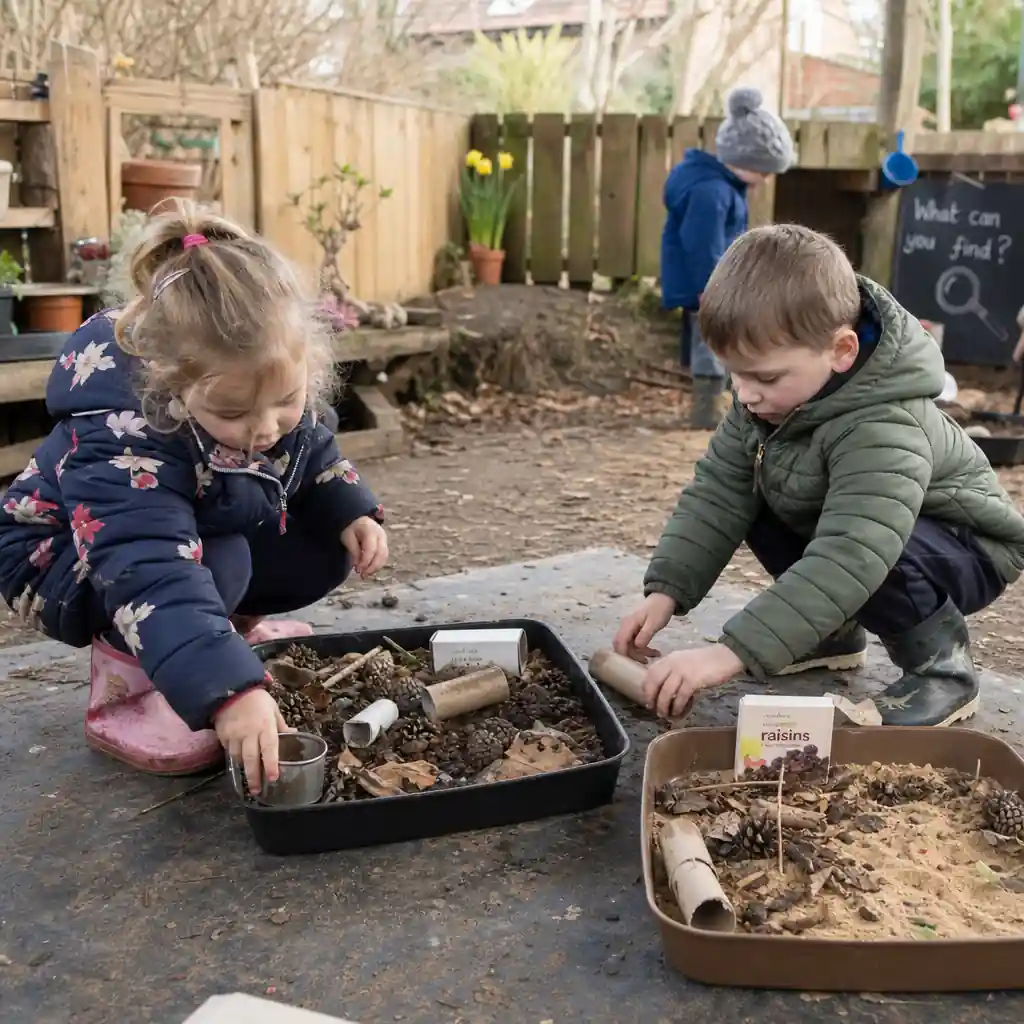
In an outdoor or nature-integrated space, move trays to a sheltered garden patch, courtyard or covered decking where uneven surfaces, stones and plant pots are within reach. Materials such as damp soil, leaf litter, sand or dried peas are provided alongside natural props — bark, pinecones, stones and short lengths of hollow stems — arranged in an open-ended way rather than pre-built scenes; recycled tubes and small boxes can be partially buried, balanced or propped to form tunnels and shelters for natural items instead of only plastic figures.
The adult observes from nearby, checks anchors and hygiene, offers single-word prompts or a brief demonstration when safety or technique is needed, then steps back to allow pace and choice. Children choose materials, scoop, press and reposition shelters, test how gaps and tunnels change movement, and describe textures or imagined creatures aloud while the adult responds with concise observation and supportive questions, maintaining supervision and access to handwashing.
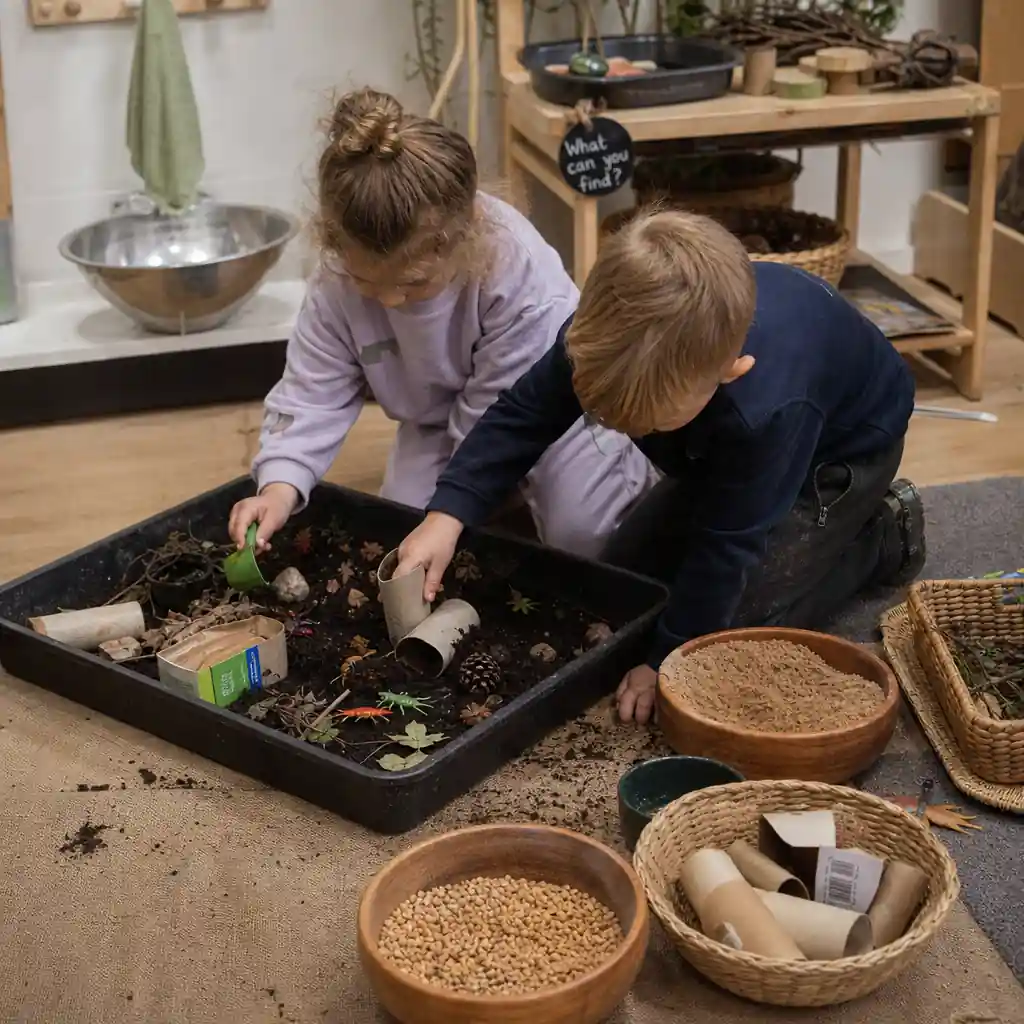
Arrange low trays on low tables or the floor in small clusters so children can move between habitats and see all materials. Offer one sensory base per tray (sand, mud or lentils) in open bowls so children choose and refill; place recycled tubes, small boxes, stones, leaves and loose natural bits in visible baskets rather than pre-made shelters. Keep scoops and cups accessible; remove anything that prescribes a single outcome and keep a mat and handwashing nearby for safety and cleanup.
The adult steps back as observer and co-researcher, using commentary such as “I can see you’re moving the tunnel” or “What happens if the tube tilts?” rather than instructions. The child may invent pathways, test hiding places, abandon and return to constructions or combine materials in unexpected ways; the adult notices sustained focus, language bursts, problem-solving with tubes, and fine-motor patterns and records these moments within play rather than interrupting it.

A calm corner is prepared with a neutral cotton cloth under one or two shallow wooden or enamel trays, each holding a single base: clean sand, mud, or dried lentils. Only a small number of items are provided: cardboard tubes and small boxes, a few pieces of bark, smooth stones, dry leaves, and a handful of simple wooden or wool-felt mini‑beast shapes. Tools are natural and quiet in the hand—a small wooden scoop, a metal cup, and a natural‑bristle brush. Handwashing is set nearby.
The adult demonstrates once, slowly scooping, pressing a hollow, and setting a tube to form a shelter, then steps back and watches. Language stays sparse and specific, offering a word for a texture or creature only when useful, while attending to hygiene and safe handling. The child returns to scooping, pouring, and pressing, arranging paths and hiding places, repeating and adjusting at their own pace. A simple rhythm holds: set out, unhurried play, then shared tidy into baskets.