Creating marbled Easter egg prints using shaving foam and paint on a tray (2–4 years)
Easter
Sensory Play
At the table, the adult steadies the tray while two children lean in to look at the paint sitting on the foam. One child takes a straw and drags the tip through the colours, then pauses to watch the lines widen and fade. The other child chooses an egg-shaped card, presses it down with flat hands, and lifts it slowly; a soft mound of foam clings to the edge before sliding back into the tray. The adult places a cardboard tube on the table within reach and says, “Slow hands,” as the child turns the card to find a clear place to scrape.
Children explore colour and pattern by making marbled prints on egg-shaped card using a foamy, paint-swirled surface. The process invites experimentation with swirling, pressing, lifting and noticing how designs transfer. Adults can keep the experience open-ended, focusing on what children notice and choose rather than aiming for identical results.
Step-by-Step Guidance
1. Prepare the space: cover the table, set out aprons, and choose a tray position where children can reach without leaning across others.
2. Pre-cut egg shapes from card and place them in a dry stack beside the tray so children can select one at a time.
3. Add a layer of shaving foam to the tray (adult sprays), keeping it shallow enough that children can see the surface and not sink hands deeply.
4. Dot small amounts of acrylic paint onto the foam in a few places. Keep colours limited at first to reduce muddy mixing.
5. Offer a straw to each child and show how to swirl the paint through the foam by moving the straw tip across the surface (no blowing). Place used straws in a separate pot.
6. Invite children to make their own swirls. Step back so they can decide where to swirl and when to stop.
7. When a child is ready, they place an egg-shaped card onto the foam surface and press lightly with flat hands.
8. The child lifts the card straight up. Hold it over the tray for a moment so excess foam can fall back.
9. Support the child to scrape off foam using a cardboard tube: one steady pass across the card, then a second pass if needed. Place the tube back on a designated spot.
10. Lay the print flat to dry. Offer another egg shape if the child wants to repeat, or leave the tray available for further swirling.
11. Close the activity with a simple tidy: wipe the tray edges, collect straws, and wash hands together.
Learning Objectives
Physical Development: children can practise controlled hand movements as they swirl, press, lift and scrape materials. Expressive Arts and Design: children can explore colour mixing, pattern and print effects through an open-ended process. Communication and Language: children may use words to describe what they see, feel and change as they work.
Adult Role
Stay emotionally attuned to children’s sensory responses, offering choice about touching foam versus using tools, and allowing a child to pause or watch. Model simple, descriptive language such as “swirl”, “press”, “lift”, “scrape”, “more paint”, “lighter”, “darker”, and reflect what you see without judging the result. Scaffold only when needed for safety and control of materials (spraying foam, managing paint amounts, and supporting careful scraping), then step back so children can make decisions about colour placement and pattern-making. Observe in the moment for signs of concentration, avoidance, repetition, and emerging talk about cause and effect, and adjust the pace or offer a fresh card when the child signals readiness. Maintain close supervision around straws and paint, and keep the workspace organised so children can work without crowding.
Observation Cues
Does the child choose to swirl gently or vigorously, and do they change their approach after seeing the effect? Does the child talk about colours, lines, swirls or “hidden” patterns when the card lifts? Can the child coordinate two actions (holding the card steady while scraping, or pressing then lifting carefully)? Does the child tolerate the feel/smell of foam, or do they avoid touch and prefer tools? Does the child repeat the process to test a new colour choice or swirl direction?
Time & Space
15–30 minutes, plus drying time.
Table-based activity with a washable surface and a nearby handwashing point; drying space for multiple card prints.
Materials
Safety
Age adaptations
Budding Adventurers
If shaving foam is used, keep paint to two colours and offer a short, clear demonstration of swirling with the straw tip (no blowing). Provide thicker, larger egg shapes for easier gripping and scraping, and allow children to use the cardboard tube with two hands. Adults stay close to support lifting and scraping, and offer the option to switch to a sensory bag if the child avoids foam.
Curious Investigators
Offer three or four paint colours and invite children to decide where to place dots before swirling. Children can experiment with different swirl directions and compare prints side by side as they dry. Adults can introduce vocabulary like “lines”, “curves”, “spiral”, “lighter/darker”, and support children to scrape with one steady pass to reveal the pattern clearly.
Confident Discoverers
Children can take more responsibility for planning: choosing a limited palette, deciding when to stop swirling, and selecting how many prints to make. Offer a choice of egg sizes and card colours, and encourage children to notice how pressure and scraping angle change the final look. Adults can support children to describe their process in simple sequences (“First I dotted… then I swirled… then I pressed…”) without turning it into a performance task.
EYFS Links
Expressive Arts and Design: children explore colour, pattern and print effects through an open-ended marbling process, making choices about materials and noticing visual changes. Physical Development: swirling, pressing, lifting and scraping give repeated practice of hand control and coordinated movements in a meaningful context. Communication and Language: adults’ descriptive talk and children’s own comments about what they see and do can build vocabulary for actions, textures and visual features.
Ethos adaptations

Materials are reduced and ordered on one tray: one shallow foam tray, a small palette with two paint colours, one straw, one cardboard tube scraper, and a small stack of egg-shaped cards. The adult defines a single work space with a mat, places the tray at the top edge, and sets a clear “finished” spot for wet prints so the child can move items without crossing over the foam. The adult decides to offer one card at a time, to keep spare tools and extra colours out of reach, and to mark where the straw and scraper are returned so the child can reset the work independently.
The adult gives one slow, precise demonstration with minimal words, then sits slightly back and keeps hands off unless needed. The adult decides to intervene only for safety (straw use, paint amounts, wiping slips), to pause the activity if the child brings the straw to their mouth, and to wait a few seconds before offering help so the child has time to try again. The adult watches for concentration, careful control in pressing and lifting, and self-correction (choosing less paint after muddy mixing, adjusting pressure after a blurred print), and responds by quietly refreshing the card stack, smoothing the foam surface when it becomes overworked, and returning tools to their marked places rather than directing the next choice.
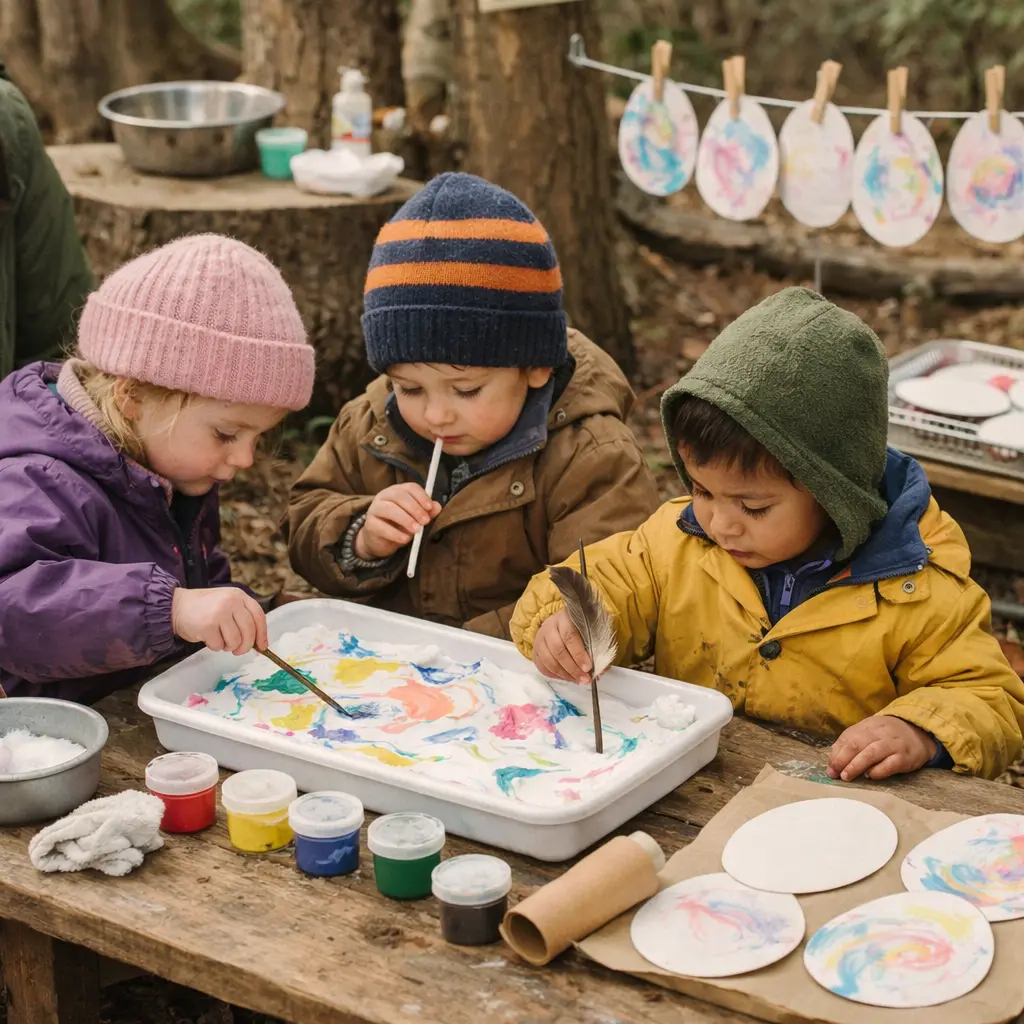
The activity is set up outdoors on a low, stable surface with a washable tray and a drying line or rack nearby. Alongside the foam tray, provide a small selection of natural “mark-makers” for swirling such as smooth sticks or feathers, and use egg-shaped card that can be pegged up to dry in the breeze. Paint is offered in small pots with lids so children can move between making, pausing, and returning without the adult holding the flow.
The adult stays close to manage risk (wind, spills, children moving with tools) and uses brief, responsive comments rather than directing a method. Children choose whether to swirl with a straw, stick or feather, and may test how weather changes the process (foam drying faster, paint moving differently). The adult notices how children adapt to conditions, negotiate space outdoors, and decide when a print feels “finished” for them.

Set low trays at child height with clear space around each. The adult adds small puddles of shaving foam to trays in view, then places closed paint pots and droppers/sticks/straws for moving colour within reach, plus egg-shaped cards in a basket and the scraper, wipes, and warm soapy water nearby. Paint is dotted in small amounts onto foam as children arrive, so each tray looks different. Children can choose any tray, card, tool, press depth, and whether to scrape or layer new prints.
The adult stays at the side as co-learner, using descriptive talk rather than steps: “I can see the blue stretching,” “You’re trying a light press,” “What happens if the card meets the foamy edge?” Children may swirl with straw tips or tubes, press part of an egg or many times, compare scraped/unscraped textures, or return to alter a drying print. The adult notices grip shifts, wrist rotation, sequencing (“press–lift–look”), colour vocabulary, cause–effect comments, and peer exchanges.
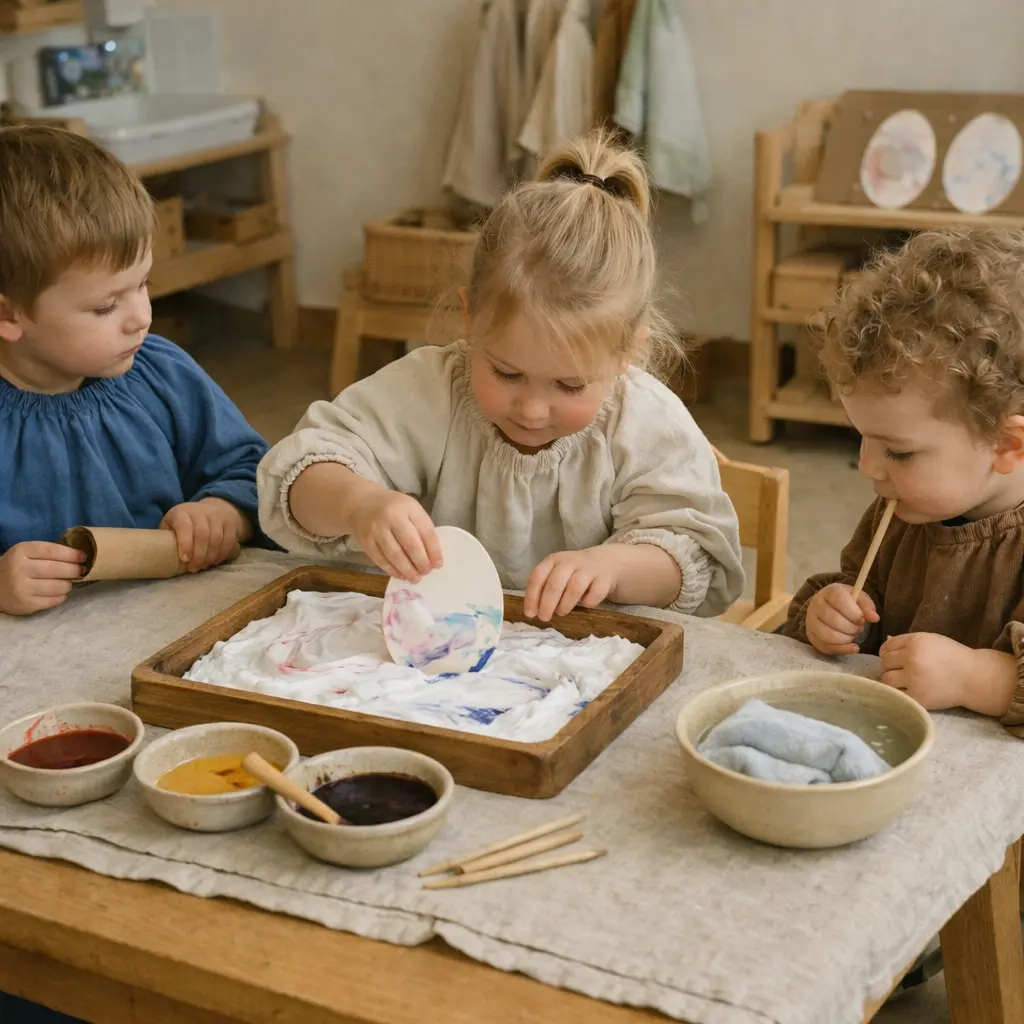
A calm table is prepared with a neutral cotton cloth and a shallow wooden or enamel tray holding a cool cornflour size. Only a few natural colours are set out in small ceramic dishes (for example, beetroot, blueberry, or turmeric infusions), alongside short wooden sticks for swirling and small bamboo spoons or soft natural-bristle brushes for dropping colour. Egg-shaped prints are cut from thick, plain recycled card or cotton watercolour paper. Cotton smocks, a bowl of warm water with cloths, and a simple wooden drying board sit at the edge.
The adult demonstrates once, slowly, showing a quiet sequence of dropping a little colour, making a gentle swirl, pressing the card, lifting, and scraping excess size with a wooden scraper, using minimal words and pausing so children can watch. The child returns at their own pace, choosing one or two colours, repeating the swirl–press–lift–scrape pattern as often as they wish, watching how the print changes each time. The adult remains nearby for safety, replenishing materials and observing, with calm tidying folded into the close.