Creating ice cream shop role play with scented playdough and simple serving tools
Sensory Play
Children explore scented playdough through an ice cream shop theme, shaping “flavours” and combining colours in their own ways. Adults offer a small set of serving tools and containers to support scooping, filling, and presenting, with space for children to take on roles such as customer or server. Practitioners can watch for how children describe smells and textures, manage turn-taking around tools, and persist with an idea when the dough changes shape.
Children explore scented playdough through an ice cream shop role play, shaping and combining colours to represent scoops, swirls, and toppings. The experience invites repeated squeezing, rolling, pinching, and pressing, with plenty of room for children to follow their own ideas. Adults can support by offering a calm serving context and simple language for describing what children notice as they manipulate the dough.
Step-by-Step Guidance
1. Prepare the space: place a wipe-clean mat or large tray on a low table or floor area, with enough elbow room for sharing without crowding.
2. Set out materials in a clear layout: one bowl/tray per dough colour, cones/cups in a small stack, and a limited set of tools in the middle to reduce overwhelm.
3. Introduce the context briefly: name the area as an ice cream shop and show the key items without demonstrating a finished product.
4. Offer a simple invitation: encourage children to choose a colour and explore the smell and feel in their hands, noticing how it changes when squeezed or warmed.
5. Support tool use: place a scoop or spoon near each child and model safe handling once, focusing on how to lift and release dough rather than making a “perfect” scoop.
6. Allow child-led making: children create scoops, swirls, or mixed flavours; some may prefer filling cups, others may line up cones or make “toppings” with cutters.
7. Add role play as it emerges: follow children’s lead with serving, buying, or taking orders, keeping language simple and responsive to what they are doing.
8. Extend gently: offer prompts that invite thinking without directing, such as noticing size differences, combining colours, or choosing a scent for a pretend customer.
9. Support sharing and turn-taking: if tools become a pinch point, add duplicates or introduce a simple “tool parking spot” on the tray for swapping.
10. Close the activity: give a short warning that play is ending, invite children to place dough back into bowls, and wipe hands and surfaces together as part of the routine.
Learning Objectives
Children may develop fine motor control as they manipulate playdough into different forms and handle simple serving tools. Within Communication and Language, children may build vocabulary for describing smells, textures, quantities, and pretend roles in an ice cream shop context. Within Personal, Social and Emotional Development, children may practise turn-taking and negotiating roles as they share materials and ideas.
Adult Role
Stay emotionally attuned by noticing children’s comfort with scents, textures, and social closeness, and offer space or a quieter spot if a child seems overwhelmed. Model language that matches what children are doing, naming actions (press, roll, scoop), sensory words (soft, sticky, strong smell), and role play terms (cone, scoop, customer) without over-questioning. Scaffold when a child is stuck with a tool, a social conflict, or a plan that is not working, and step back when they are absorbed in repeating a successful action. Observe how children choose materials, persist with shaping, and communicate needs, using these observations to decide whether to simplify the set-up, add duplicates, or introduce a new word. Hold responsibility for safe tool use, hygiene, and allergy-aware practice, including monitoring mouthing and keeping small items out of reach where needed.
Observation Cues
Reaches for particular colours or scents and shows preferences through repeated choices.
Uses different hand actions (pinch, roll, press, pat) to change the dough’s shape.
Attempts to represent an idea (scoop, cone, topping) and adjusts when it does not match their plan.
Uses words, sounds, or gestures to request items, offer servings, or assign roles.
Shows awareness of quantity by asking for more/less or comparing sizes of “scoops”.
Time & Space
15–40 minutes, depending on children’s interest and tolerance for sensory play.
A wipe-clean table or floor mat area with a defined boundary for materials, plus nearby access to handwashing or wipes.
Materials
Safety
Age adaptations
Budding Adventurers
Provide 2–3 colours and introduce cones alongside cups, plus one or two cutters for “toppings.” Children may enjoy mixing colours to make “new flavours,” so offer a small “mixing bowl” to contain this choice. Adults can support simple role play routines (serve, pay, take away) and help children notice quantity by comparing scoop sizes without insisting on matching sets.
Curious Investigators
Add a wider range of tools (scoop, rolling pin, blunt knife) and a small tray labelled as a “toppings station” to organise choices. Children may begin to plan multi-step creations (two scoops, topping, special order), so adults can support by reflecting the plan back and offering vocabulary for describing combinations and changes in texture when dough is worked. Encourage children to solve social problems by suggesting swaps, shared tool rules, or making a simple queue if the shop role play becomes busy.
Confident Discoverers
Introduce a simple menu card with pictures (not prices unless children add them) and offer a wider palette of dough colours for “flavours.” Provide a designated “order pad” area with paper and chunky pencils for children who choose to record orders, and a separate “kitchen” tray for mixing experiments. Adults can extend mathematical language through child-led comparisons (bigger/smaller, same/different, two scoops) and support more complex negotiation of roles, stepping back when children sustain the play independently.
EYFS Links
Communication and Language: Children may use words, gestures, and pretend roles to request, offer, and describe what they are making, building vocabulary linked to actions, quantities, and sensory experiences.
Physical Development: Manipulating dough and handling scoops/spoons can support hand strength, coordination, and control, alongside safe tool handling routines.
Personal, Social and Emotional Development: Sharing tools and negotiating roles in a shop context can support turn-taking, managing feelings when waiting, and cooperating with peers.
Expressive Arts and Design: Children may represent ideas through pretend “flavours” and “toppings,” experimenting with colour mixing and form to match their imaginative intentions.
Ethos adaptations

Place only 2–3 colours of scented playdough on individual shallow trays, each tray holding one scoop, one child-safe scoop/spoon and one cone or cup. Remove extra cutters and toppings so the task isolates scooping, rolling and pinching; arrange trays on low table spaces with cloths to define each child’s work area and labels showing “scoop” and “cone” order. Limit quantities so overfilling is visible and the correct fit of a scoop into a cone becomes self-evident.
Show the full sequence once: slow, silent demonstration of taking a scoop, shaping it, placing it in a cone, then step back and keep verbal input to brief safety prompts only. Observe repetition and precision in hand movement, how the child corrects scoop size when it won’t sit in the cone, and social strategies for waiting and sharing tools rather than directing their play.
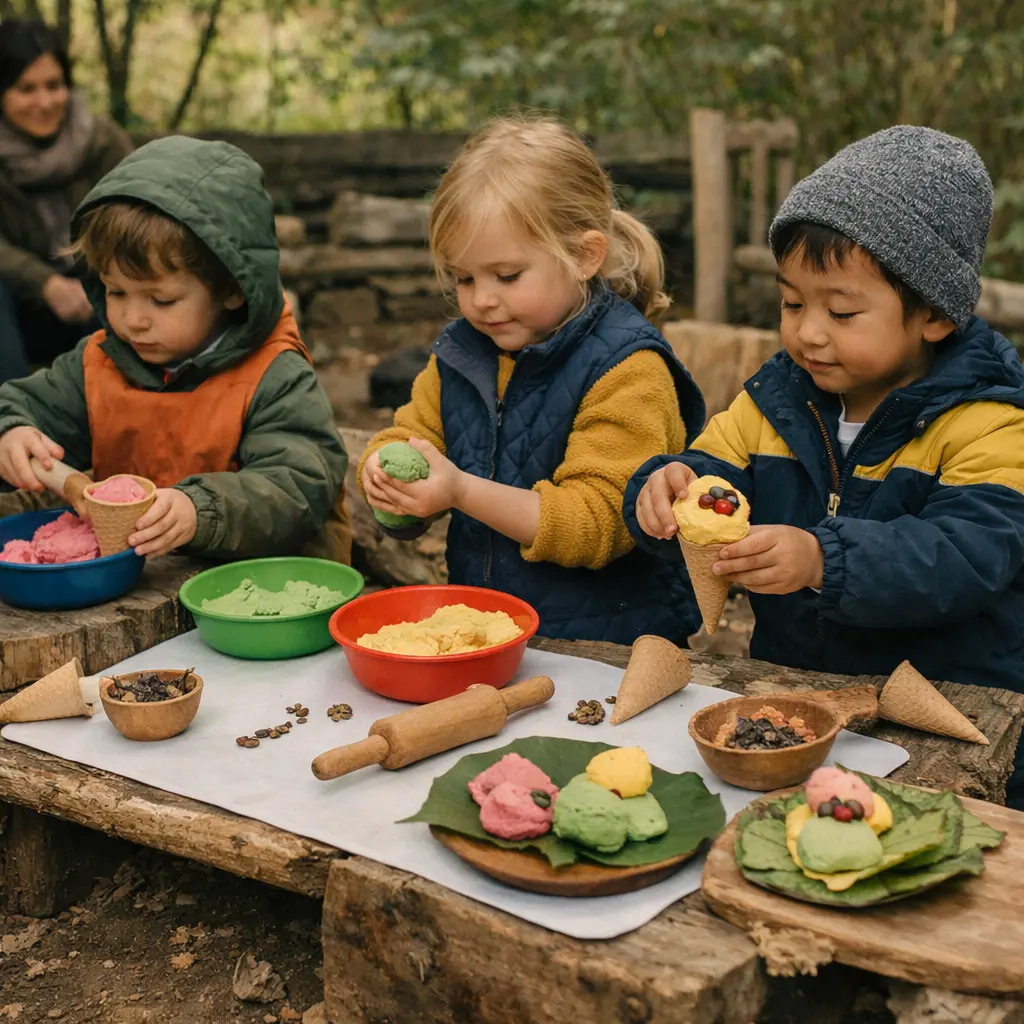
In an outdoor or nature-integrated space such as a sheltered corner of the garden or a grassy clearing, set up low logs or crates as counters and place wipe‑clean mats only where needed; allow patches of uneven ground for carrying trays. Materials are arranged as natural, open‑ended substitutes: simple homemade scented dough (flour/salt/water with grated citrus, mint or vanilla—check allergies), wooden bowls, leaf “plates,” wooden spoons and recycled card cones, and loose toppings like seeds or dried fruit. Children choose materials and place them where they like rather than following a fixed layout.
The adult observes from a short distance, carrying out safety checks, offering minimal, responsive language (single words or short prompts) and stepping in only to manage risk or demonstrate safe tool use. Children may take on server or customer roles, negotiate turns, balance trays across varied surfaces, experiment with scooping, rolling and mixing scents, and adapt recipes over repeated sessions; the adult names sensory words or actions briefly when asked and supports fair sharing without directing the play.

Lay out low tables or floor trays so materials are reachable from all sides and grouped by sensory invitation rather than pre-packed kits: bowls of scented playdough, a separate basket of mixed loose “toppings” (sequins, wooden beads, fabric scraps, natural items checked safe), several empty containers for serving and a couple of neutral light sources or mirrors for reflection. Keep scoops and cutters accessible singly so children choose tools; ensure fragrances and items have been checked for allergies and are replaceable with plain dough if needed.
The adult stays at the edge as observer and co-researcher, commenting with open phrases such as “I can see you’re exploring the smell” or “You’re trying a lot of different scoops—what happens if you press here?” The child may self-assign roles, mix colours and scents, repeat or abandon ideas and invent serving rituals; the adult notices sustained manipulation, new vocabulary about texture or quantity, turn-taking patterns and emerging negotiation, and records or photographs moments that show problem-solving and social exchange.

Use simple, natural-feeling materials and a calm, homelike set-up: muted dough colours, wooden or metal spoons, and cloth napkins, avoiding plastic clutter and busy visuals. Keep the role play gentle and familiar, framing it as serving food in a home or café rather than a fast-paced shop, and offer a small basket for cones/cups to maintain order. Choose mild or natural scents and keep the selection limited to support a settled atmosphere.
Use warm, rhythmic language and unhurried pacing, allowing children to sink into repetitive kneading and serving. Step in softly to model care of materials and courteous exchanges, and step back when children sustain imaginative flow. Observe whether children seek soothing sensory repetition or energetic social play, and respond by simplifying the environment, offering a quieter serving corner, or introducing a short tidy rhythm to close.