Create a multi-sensory colour wheel collage using textured materials in small groups or independently
Sensory Play
Colours
Children explore colour and texture by adding tactile materials to sections of a circular collage, either as a shared group piece or on individual pages. The experience can support careful choosing, sorting, and noticing how different surfaces feel and look side by side. Adults can pay attention to how children match or group colours, how they manage glue and tools, and how they share space when working on one wheel.
Children explore colour through a collage that combines visual and tactile materials. The focus is on noticing differences between colours and textures, and making choices about where materials belong. The activity can be offered as a shared group piece or as individual colour wheels, depending on the children’s interests and space.
Step-by-Step Guidance
1. Prepare the space with a clear table, protective covering, and a defined area for glue. Place sorting trays of textured materials within easy reach.
2. Draw a large circle on paper for a group piece, or provide A4 sheets with a circle already drawn. Use a ruler to divide the circle into sections based on the number of colours you are offering.
3. Mark each section with a simple colour cue (a small coloured dot, swatch, or written colour name for older children) so children can orient themselves without needing constant adult direction.
4. Present the materials by showing a small selection at a time. Keep the rest nearby to reduce overload and support choice-making.
5. Invite children to choose a section and select textured materials that fit that colour. Offer both tearing and cutting options depending on age and confidence.
6. Support children to apply glue in a manageable area and place materials with intention. Encourage pressing and smoothing to help materials stick.
7. For a group wheel, help children agree on how to share sections (one section per child, or shared sections). Keep the focus on collaboration rather than a perfect finish.
8. Pause at natural points to notice colours and textures together. Offer language for what children are already doing and noticing.
9. Provide time for children to revisit sections, add layers, or refine edges if they choose.
10. End by placing the wheel somewhere flat to dry. If appropriate, invite children to look across the whole circle and notice how the colours sit next to each other.
Learning Objectives
Children may develop confidence in exploring and naming colours through hands-on making, linking to Communication and Language. Children may strengthen fine motor control through tearing, pinching, placing and pressing materials, linking to Physical Development. Children may practise making choices and persisting with a self-chosen idea, linking to Personal, Social and Emotional Development. Children may explore materials and represent ideas through collage, linking to Expressive Arts and Design.
Adult Role
Stay emotionally attuned by noticing children’s pace and tolerance for sticky textures, offering reassurance and a calm option to pause or use a tool. Model simple, accurate language for colours and textures, and mirror children’s words without correcting in a way that stops their flow. Scaffold when a child is stuck (for example, offering two material choices, holding paper steady, or suggesting a smaller piece) and step back when they are absorbed in placing and arranging. Observe how children sort, match, and persist, and use those observations to decide whether to simplify the choices or extend the range of colours. Hold responsibility for safe use of glue and scissors, and for keeping small pieces and high-risk materials out of reach of children who mouth objects.
Observation Cues
Notices and comments on colour differences (light/dark, bright/dull) or matches materials to a chosen colour area.
Chooses between textures and shows preferences (smooth, bumpy, soft, scratchy) through touch and language.
Uses controlled finger movements to tear, pinch, roll, place or press materials with increasing accuracy.
Returns to a section to add more, adjust placement, or change their mind about where something belongs.
Works alongside others on a shared wheel by waiting, offering space, or negotiating a section.
Time & Space
15–40 minutes, depending on age, number of sections, and whether the wheel is shared or individual.
Table space for small groups, with a separate drying area that can stay undisturbed. Floor space can work for a large group wheel if the surface is protected and children can reach comfortably.
Materials
Safety
Age adaptations
Budding Adventurers
Offer 4–6 sections and a wider range of textures, including materials that tear in different ways (tissue, corrugated card, fabric). Provide a mix of pre-cut and child-torn pieces so children can choose their level of challenge. Support turn-taking for a shared wheel by offering clear boundaries (one section each) and noticing cooperative behaviours as they emerge.
Curious Investigators
Offer 6–8 sections and invite children to help decide which colours to include. Add an optional sorting stage where children group materials by colour before sticking, using trays with colour swatches. Encourage children to notice shades within a colour (light/dark) and to layer textures, stepping in mainly to support planning, glue control, and collaborative decisions on a group wheel.
Confident Discoverers
Offer 8–12 sections and include more nuanced colour choices (for example, adding pink, purple, grey, or different blues). Provide tools such as child-safe scissors, hole punches, or paper crimpers for children who want to create their own textured pieces. Support children to label sections with colour words or make a simple key, and observe how they justify choices, negotiate shared space, and refine placement for a desired effect.
EYFS Links
Communication and Language: Children may use and hear colour and texture vocabulary in a meaningful context, supported by adults who model words linked to what children are touching and choosing.
Physical Development: Collage supports hand strength and coordination through tearing, pinching, placing, pressing and tool use, with adults adjusting material size and resistance to match children’s control.
Personal, Social and Emotional Development: A shared wheel can support turn-taking, negotiating space, and managing frustration when materials do not stick as expected, with adults helping children find workable strategies.
Expressive Arts and Design: Children explore colour, texture, and composition through selecting and combining materials, making personal decisions about arrangement and layering rather than copying an adult model.
Ethos adaptations

Prepare the activity as single-work spaces: give each child a small tray with a pre-marked circle divided into a few clear colour sections on A4, one glue stick, and a limited selection of textured materials sorted into small bowls by colour. Reduce choices to three or four textures per colour and remove extras from the table so the task isolates colour matching and fine motor placement. Arrange trays within reach on low surfaces so children can carry and return their own materials independently.
Introduce the task with one slow, silent demonstration at a child’s level: place a piece into the correct section, press to stick, then step back. After that, limit language to brief safety reminders and one-word labels if needed; do not prompt choices. Observe whether children repeat placement, show control in tearing or pinching, correct misplacements without adult direction, and sustain concentration, noting fine motor precision and choice-making rather than giving step-by-step help.

In an outdoor or nature-integrated space, move the activity onto a sheltered blanket, low table or tree stumps in a garden or courtyard so children work with uneven surfaces and natural light. Materials such as collected leaves, petals, grasses, bark strips, moss, pebbles and lengths of wool are provided in open-ended trays alongside a small selection of fabric scraps and magazine offcuts; large group sheets and A4 bases remain, with glue pots and spreaders available but less pre-sorted so textures vary and imperfections are welcome.
The adult observes from close by, checking safety and modeling a single tear, press or glue technique, then stepping back to offer only short prompts or single-word descriptors when children ask. Children choose solo or group wheels, sort and place materials by sight and touch, experiment with layering, and take turns with scissors or glue as needed, persisting with self-chosen arrangements rather than aiming for a prescribed finished product while the adult responds with concise observations.
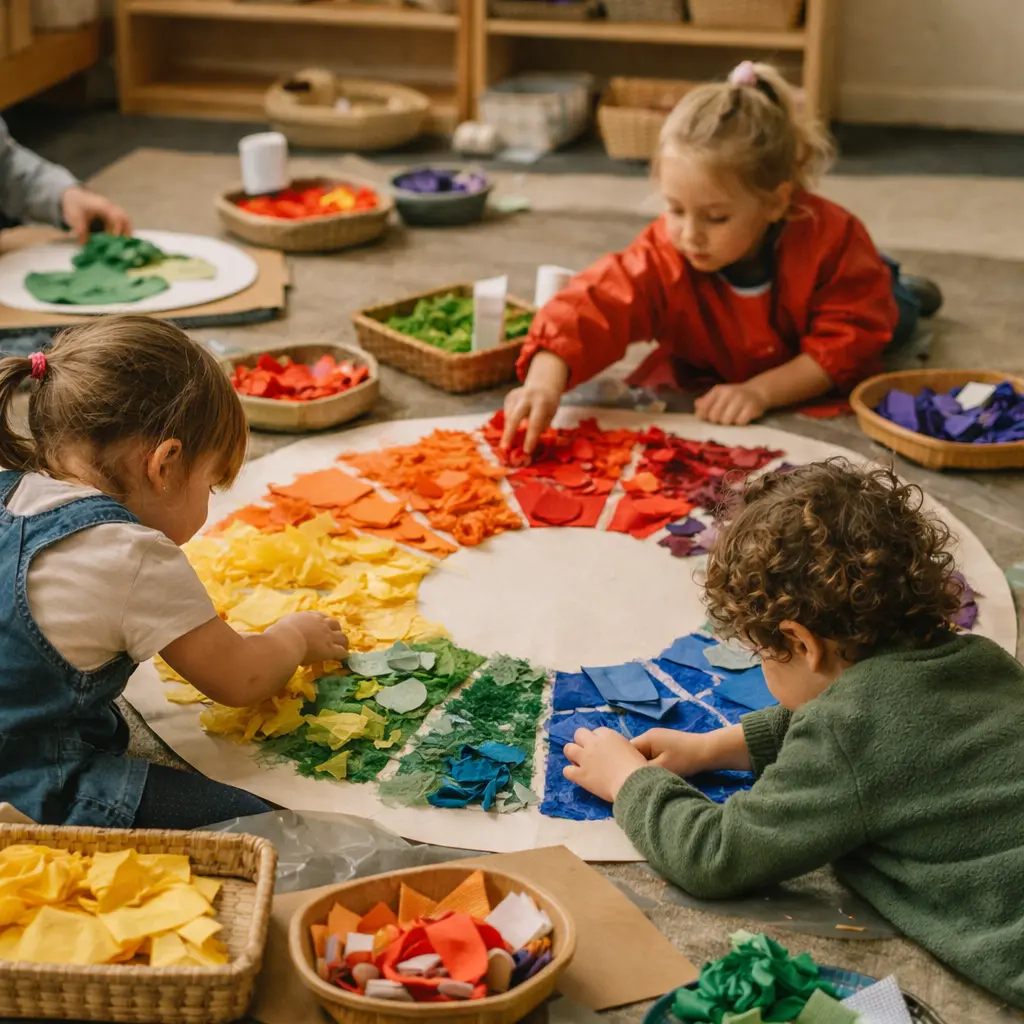
Arrange a low, central surface for a shared wheel and multiple smaller stations for independent wheels so children can approach from any side and choose scale. Replace pre-cut, single-use kits with trays of loose, tactile materials (tissue, fabric scraps, corrugated card, wool, cellophane, sandpaper) and a few simple tools; leave pencil section marks faint or open-ended so the child may define boundaries. Materials are visible, reachable and refillable; space between stations invites movement, collaboration or solitary focus without adult handouts.
The adult steps back as observer and co-researcher, offering commentary such as "I can see you testing that texture" or "You’re trying to make that colour stand out" and asking open invitations like "What happens if you layer these?" The child may choose group negotiation, repeat techniques, or abandon and return to ideas; the adult notices language use, fine-motor control, turn-taking and problem-solving as embedded observation cues, keeping records of moments that link to colour vocabulary, hand skills, persistence and creative choices.

A quiet table is prepared with a plain cotton table covering; the large sheet or A4 paper sits centred with light pencil lines suggesting sections. Materials are arranged in a few small wooden bowls by colour family, choosing soft, earthy or muted tones from wool, natural-fibre fabric scraps, wool felt, ribbon, tissue paper, corrugated card and sandpaper; foam, cellophane and glossy magazine pieces are set aside. Glue sticks or a small pot of PVA with simple spreaders is placed to one side. Only a limited selection is visible; the rest is stored nearby.
The adult demonstrates quietly: tearing a piece, touching glue to the back, and pressing it down with a slow palm, then steps back, observing. Words are minimal and linked to what is handled, with interventions only for safe scissor use and managing glue. The child sorts and returns to chosen sections, feeling textures, naming colours they notice, and deciding where each piece belongs, repeating placements at their own pace. Children may work side by side on a shared wheel or individually, with an unhurried flow of work and a simple tidy at the end.