Crawling over floor cushions with soft obstacles and textured grab points for active crawlers
Sensory Play
Communication and Language
Two children wait at the edge of the cushions while an adult kneels beside the route with one hand resting on a cushion corner to stop it sliding. One child crawls up onto the first cushion and presses their palm onto a small towel, rubbing it once before shifting their knees forward. The second child points at a large soft ball near the far end and makes a short sound; the adult replies, “Ball,” and pauses. The first child leans over the cushion edge, lowers one knee carefully, and then reaches out to tap the ball so it rolls a little way across the rug.
This is a low-level indoor obstacle route made from floor cushions, with soft items and textures placed along the way for children to meet as they crawl. It gives active crawlers a reason to move with purpose, pause, reach, and change direction. Children often return to the same section repeatedly, testing how different surfaces feel and how their bodies manage small climbs and dips.
Step-by-Step Guidance
1. Choose a clear floor area where you can stay close on one side of the route.
2. Place a non-slip mat or rug down if needed, then lay cushions on the floor so they form a short line with small changes in height.
3. Add a few soft toys and soft balls as gentle obstacles, spacing them so a child can crawl around or over them without getting stuck.
4. Place textured materials at a few points where hands naturally land, such as the front edge of a cushion or just beyond a small “dip”, so children can grab as they move.
5. Invite the child to start from one end by positioning yourself at their level and making the route visible. Keep your hands ready but avoid lifting unless needed.
6. As the child crawls, allow pauses. If they stop, wait a moment, then offer one simple cue linked to what they are doing (for example, “over”, “through”, “soft”, “bumpy”).
7. If the child becomes stuck or frustrated, reduce the challenge by widening a gap, removing one obstacle, or turning a cushion so the edge is lower.
8. When the child reaches the end, give them time to explore the objects they found. If they return to the start, keep the route stable so they can repeat and refine their movement.
9. End by clearing the route together where appropriate, naming what you are putting away and keeping the child safely away from any heavy cushions being moved.
Learning Objectives
Physical Development: children may practise crawling, weight-shifting, climbing over low obstacles, and coordinating hands and knees across uneven surfaces. Communication and Language: children may listen to simple, familiar words linked to movement and texture, and may begin to use sounds or words to request “again”, “help”, or name what they notice. Personal, Social and Emotional Development: children may build confidence to try, pause, and try again with an adult close by.
Adult Role
Stay physically close and at the child’s level so you can respond quickly without taking over. Use calm, attuned responses to effort and frustration, such as waiting, offering a steady hand, or naming what you see (“You’re pushing up”, “That feels bumpy”). Model simple movement and texture words in the moment, keeping language short and linked to the child’s focus. Step back when the child is moving steadily, and scaffold only when they are stuck, tired, or showing signs of worry. Observe how the child approaches height changes, how they use hands to test surfaces, and which obstacles they choose to go over versus around. Hold responsibility for safety by checking cushion stability, keeping the route low, and preventing falls or collisions.
Observation Cues
Does the child choose a route or repeatedly return to one cushion or texture?
Do they pause to test a surface with hands before moving their knees forward?
Do they reach for a grab point, pull themselves up, or shift weight to get over a cushion edge?
Do they vocalise or gesture for “help”, “up”, “again”, or point to a preferred object?
Do they show signs of planning, such as looking ahead, turning their body, or reversing out of a tight spot?
Time & Space
10–25 minutes, with children dipping in and out.
A clear indoor floor area large enough for a short cushion route, with an adult able to stay alongside the full length.
Materials
Safety
Age adaptations
Budding Adventurers
Add a simple “stop and go” element by placing a soft toy partway along as a natural pause point, then another at the end to crawl towards. Include a slightly higher cushion to climb over, while keeping the overall height low and stable. The adult models short phrases children can copy (“my turn”, “help please”, “again”) and supports turn-taking if more than one child is using the route. Offer a brief reset between turns so the route stays predictable and safe.
Curious Investigators
Leave the cushions and obstacles available and invite children to help place one or two items, keeping adult control of stability and height. Provide a small selection of textured materials and let children decide where hands might land, then test their ideas by crawling the route themselves. The adult uses descriptive language about position and movement (“next to”, “between”, “over the edge”) and notices children’s problem-solving when a route feels too hard or too easy. Encourage children to suggest one change at a time and observe what difference it makes.
Confident Discoverers
Invite children to plan a route using a limited number of cushions and soft obstacles, with an agreed rule that everything stays low and stable. Add a simple challenge such as carrying a soft toy while crawling, or moving a ball to a “parking spot” at the end without it rolling away. The adult supports children to explain their plan to others and to adjust after testing, using language like “What changed when you moved that cushion?” Observe how children negotiate turns, manage risk, and refine their design.
EYFS Links
Physical Development: children use large muscle movements to crawl, climb over low obstacles, and coordinate hands and knees on uneven surfaces, building control and body awareness through repetition. Communication and Language: adults can model simple, meaningful words linked to what the child is doing and noticing (movement, position, texture), supporting understanding and early expressive attempts. Personal, Social and Emotional Development: children may practise persistence and self-regulation as they pause, try again, and seek support, with the adult providing a calm, predictable presence.
Ethos adaptations
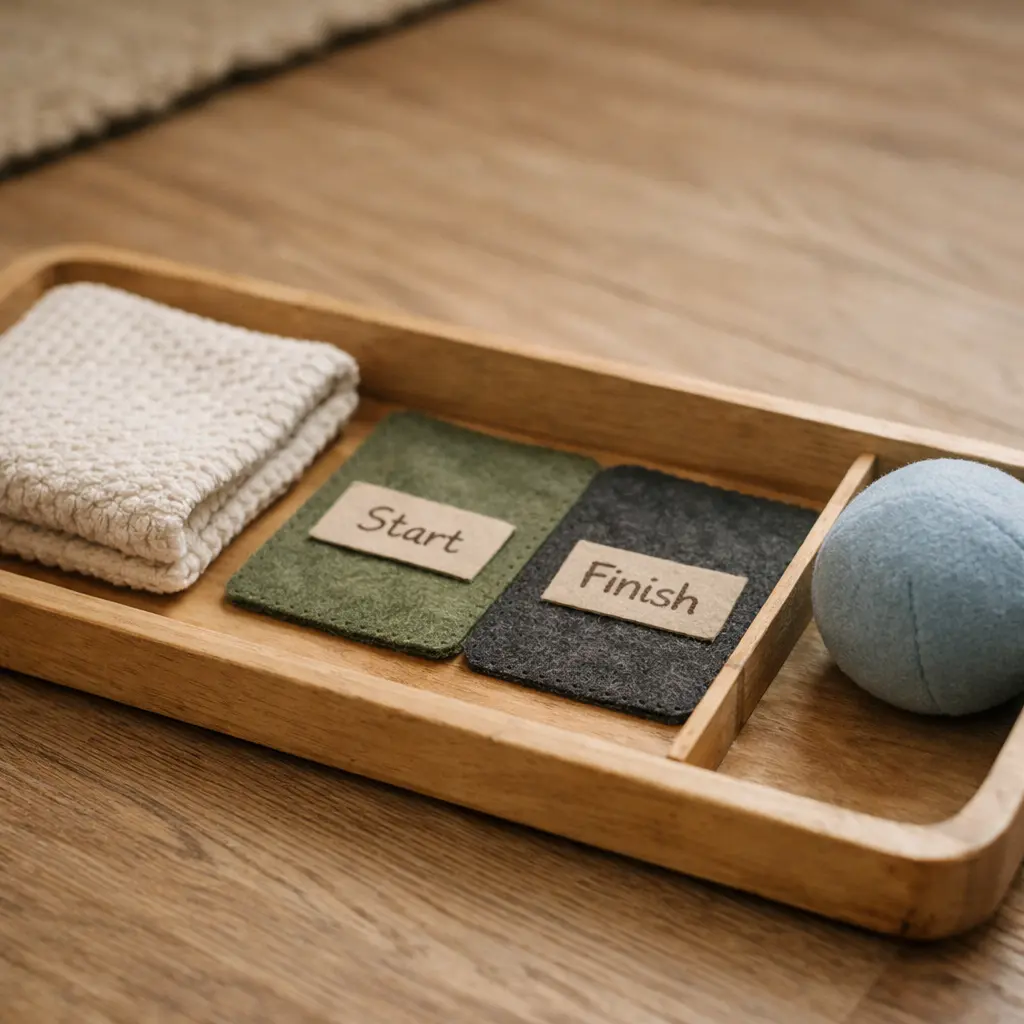
Set out a short, clearly defined route using three to four firm cushions on a non-slip base, with one textured cloth placed in the same position each time as the main touch point. Reduce the choice of objects to one ball at the end and remove extra toys so the child can see what belongs to the activity. Mark a clear start and finish (for example, two small mats) and keep all materials on one low tray to one side so the child can return the cloth and ball and reset the space.
The adult demonstrates the sequence once with slow, precise movements, then sits slightly back and keeps language minimal and consistent (“over”, “touch”, “finish”). The adult decides to intervene only to stabilise a cushion, return the cloth to its exact place if it drifts, or pause the activity if the child begins climbing higher than intended. The adult watches for repetition, careful hand placement, and whether the child notices and corrects a slip or mis-step, and responds with brief factual language (“You moved your hand back”) rather than questions, praise, or extra prompts.
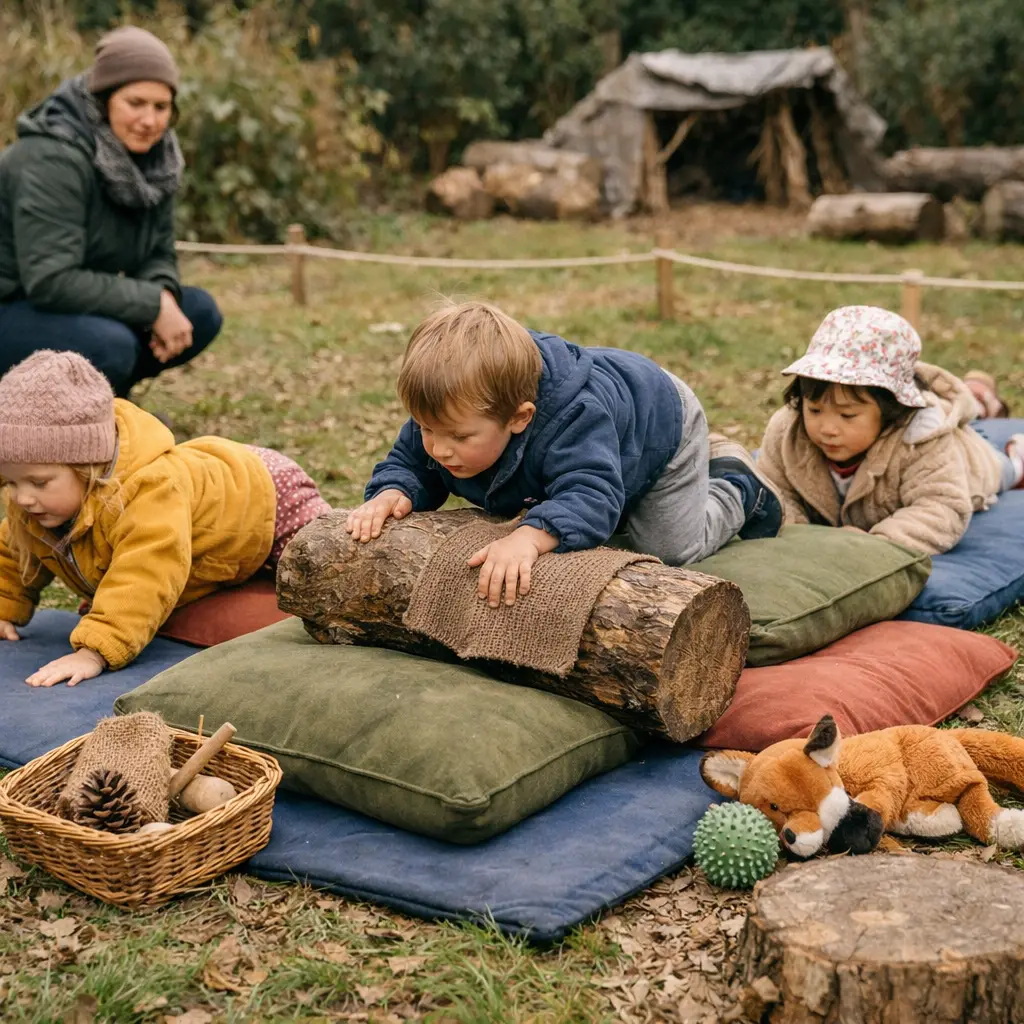
Move the route outdoors onto grass or a firm, flat area of the garden, using low natural features as the main obstacles (for example, a log round, a line of bark pieces, a shallow dip in the ground) and one blanket or mat as a dry base for starting. Offer a small set of natural touch points in a basket (hessian strip, smooth stick, large pine cone) and leave them available for children to place where they want hands to land. Set a clear boundary using cones, a rope line, or a row of sticks, and choose a sheltered spot nearby for pauses and warm-up.
The adult completes a quick dynamic risk check and decides what changes are needed that day (moving the boundary away from slippery leaves, removing sharp twigs, choosing a different patch if there is animal mess). The adult decides where to position their body so they can spot hands and knees on uneven ground while still leaving children space to choose routes. The adult uses short observations (“wet”, “rough”, “wobbly”) and steps in only to steady a log, support a slip, or help a child move a heavy natural piece safely, then steps back again. The adult watches how children test the ground, manage small risks, and decide when to stop and investigate, responding by adjusting the environment rather than directing the child’s choices.
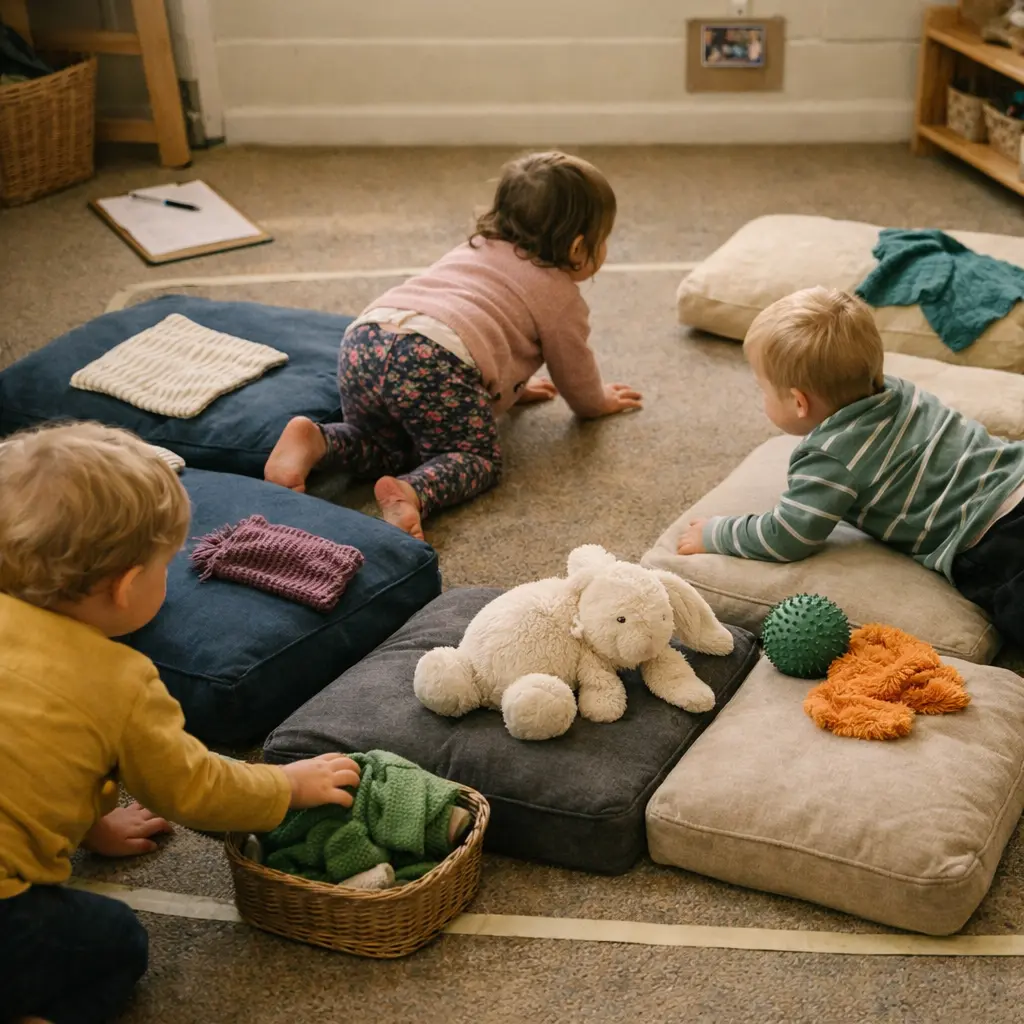
Create a larger invitation space by arranging cushions as two or three separate “islands” with more than one way between them, and leave an open central area for children to pause, meet, and change direction. Place low baskets of textured materials around the edges (cloths, ribbons, textured squares) so children can carry and position them, and add a simple visual boundary (tape line or mat edge) to hold the shared space and reduce collisions. Keep a clipboard and pen nearby for quick notes, and a small spot on the wall or board where a photo or sketch can be added later.
The adult chooses not to demonstrate a single route, and instead starts with one neutral comment that names what is available (“Cushions here, cloths here”). The adult follows children’s ideas as they redesign, using co-researcher language (“I can see you’re making a longer gap. What happens if the cloth goes there?”) rather than correcting. The adult watches for children negotiating space, inviting others to join, and testing theories about “harder” and “easier”, and responds by documenting a child’s layout or words, then offering that back later to extend the shared thinking.
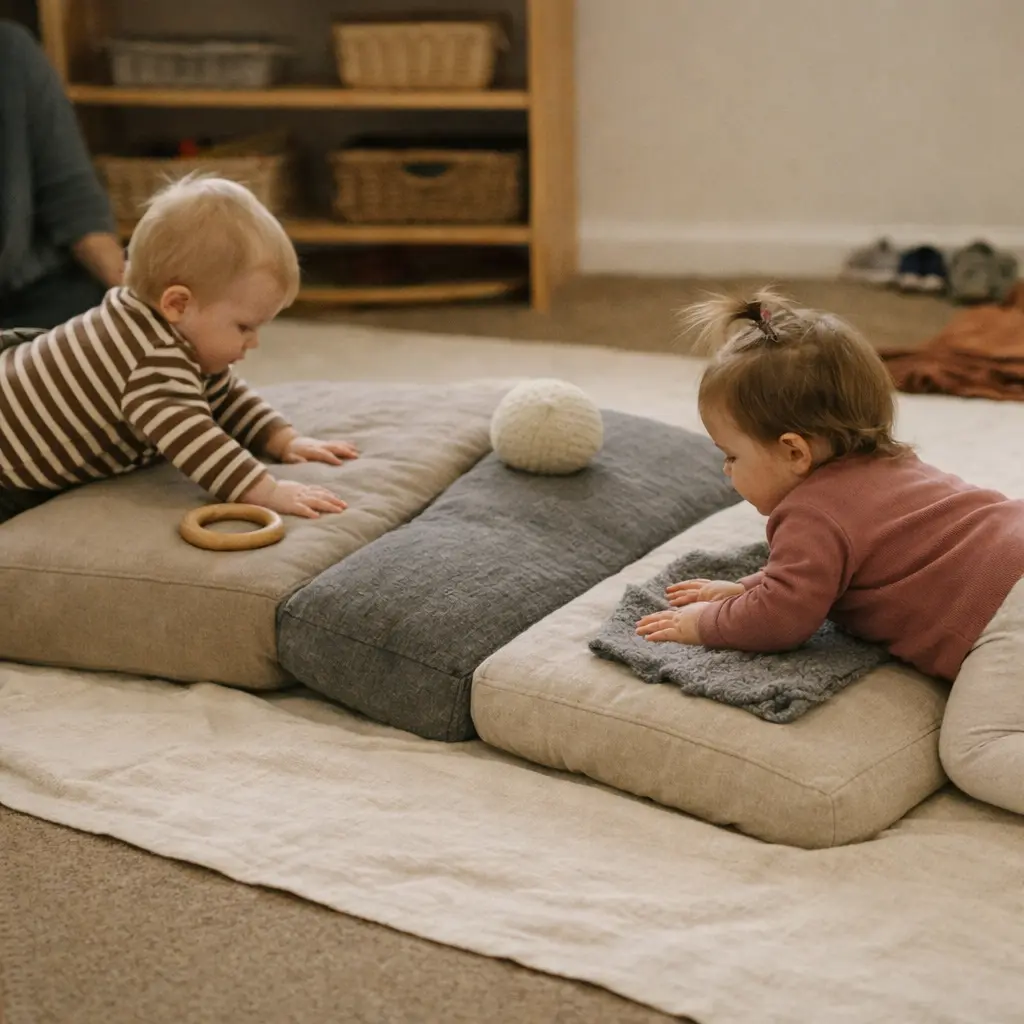
Lay a plain cotton blanket on the floor and place a small number of firm cushions in a gentle rise-and-dip, keeping the space uncluttered and the route low. Provide only two natural touch materials, such as a wool cloth and a smooth wooden ring, placed where hands often land, and keep colours muted and consistent. The adult decides to remove bright or noisy items from the immediate area, and sets a clear edge for shoes, water, and a quiet rest spot.
The adult begins with a quiet, unhurried demonstration of crawling and resting a hand on the wool cloth, then steps back and lets the child return to the movement in their own time. The adult chooses a small set of rhythmic phrases and repeats them without questioning (“over and down”, “soft and firm”), speaking only when it matches the child’s pace. The adult watches for hesitation, faster breathing, or looking back, and decides whether to steady a cushion, offer a hand briefly, or pause the flow for a short rest, then withdraws again so the child can repeat at their own pace.