Colour and shade matching with paint chart strips and dotted pegs for early sorting and problem solving
Colours
Problem solving
This colour-matching provocation pairs dotted wooden pegs with paint-chart strips, inviting children to compare subtle shades and organise their own groupings. Practitioners observe the strategies, vocabulary and hand strength emerging as choices move from broad colour families toward fine-grained discrimination.
Children explore colour matching by pairing dotted pegs to paint chart strips. The close shades on the charts invite careful looking and comparison, not just naming colours. The activity offers a clear purpose for peg squeezing and placing, with space for children to choose how precise they want to be. Adults can notice how children approach tricky decisions when two shades look similar.
Step-by-Step Guidance
1. Prepare the environment: choose a calm, well-lit area so children can see shade differences clearly. Place a small number of paint chart strips on a flat surface with space around each strip.
2. Prepare the materials: add one coloured dot to each peg. Aim for dots that closely match several points on the chart (including similar shades) so children have real decisions to make.
3. Present the invitation: place pegs in a shallow tray beside the charts. Keep the layout uncluttered so children can visually scan.
4. Model briefly: demonstrate opening a peg and placing it on a colour block that looks the closest match. Use simple comparison language such as lighter, darker, closer, same.
5. Step back for child-led matching: allow children to choose a strip, pick pegs, and decide where to clip. Accept approximate matches if the child is working at colour-family level.
6. Support problem solving in the moment: when a child hesitates between two shades, encourage looking back and forth and holding the peg near each shade before choosing. Offer a second peg to test ideas rather than correcting.
7. Extend for children who want more challenge: offer a strip with very close shades, reduce the number of pegs available, or mix pegs from two similar colour families.
8. Close and reset: invite children to unclip and return pegs to the tray, or leave completed strips displayed for later revisiting.
Learning Objectives
Children may develop fine motor control as they open and position pegs with intention. Children may build early thinking skills through sorting, comparing and deciding where a peg belongs, linking to Mathematics. Children may extend colour vocabulary and descriptive language (for example, light, dark, pale, bright), linking to Communication and Language.
Adult Role
Stay emotionally attuned by noticing frustration with stiff pegs or uncertainty with close shades, and respond with calm reassurance and time. Model language that supports thinking, such as closest, similar, lighter, darker, and almost, without turning the activity into a test. Scaffold when a child is stuck by offering a choice of two likely shades, or by suggesting a compare-and-check approach; step back when the child is confidently scanning, choosing, and adjusting independently. Observe how children organise the task (random picking, systematic scanning, grouping by colour family) and use this to decide whether to simplify or increase challenge. Maintain safety by supervising peg use, checking that dots are secure, and keeping small items out of reach of children who mouth objects.
Observation Cues
Chooses a strategy such as matching by closest shade, by general colour family, or by scanning the whole strip before deciding. Adjusts a choice after comparing two similar shades. Uses words or gestures to show comparison, such as pointing between two blocks of colour or saying light/dark. Persists with a difficult peg placement or asks for help with the squeeze. Sorts pegs into groups before matching, or matches one-by-one directly onto the chart.
Time & Space
10–25 minutes, with children returning to it in short bursts.
Small table space or a clear floor mat in a well-lit area, with room to spread several chart strips without overlapping.
Materials
Safety
Age adaptations
Budding Adventurers
Introduce simple gradients with obvious light-to-dark changes and include a couple of “tricky” pegs that sit between two shades. Offer a small mixed set of pegs so children need to sort and select, not just place. The adult supports turn-taking and persistence, and prompts comparison by holding a peg near two shades for the child to choose between.
Curious Investigators
Use longer paint chart strips with closer shades and increase the number of pegs so children need to plan and keep track. Invite children to line pegs up by shade before clipping, or to check their own work by scanning for jumps in the gradient. The adult introduces richer descriptive language (pale, deep, bright, dull) and encourages children to explain their choice without insisting on a single correct answer.
Confident Discoverers
Offer two similar colour families (for example, blue and green) mixed together to increase discrimination demands. Add a self-check option such as a second, identical chart strip kept aside for children to compare against, or invite children to create their own peg-dot set from a chosen strip. The adult supports reasoning with prompts like closest match and what makes you think that, and notices when children revise decisions after re-checking shades.
EYFS Links
Communication and Language: children may use and hear descriptive words for colour and shade, and practise explaining choices when matches are close. Mathematics: children may sort, match, compare and notice patterns across a gradient, building early classification and comparison skills. Physical Development: children may strengthen hand muscles and coordination through repeated peg opening, positioning and releasing with control.
Ethos adaptations
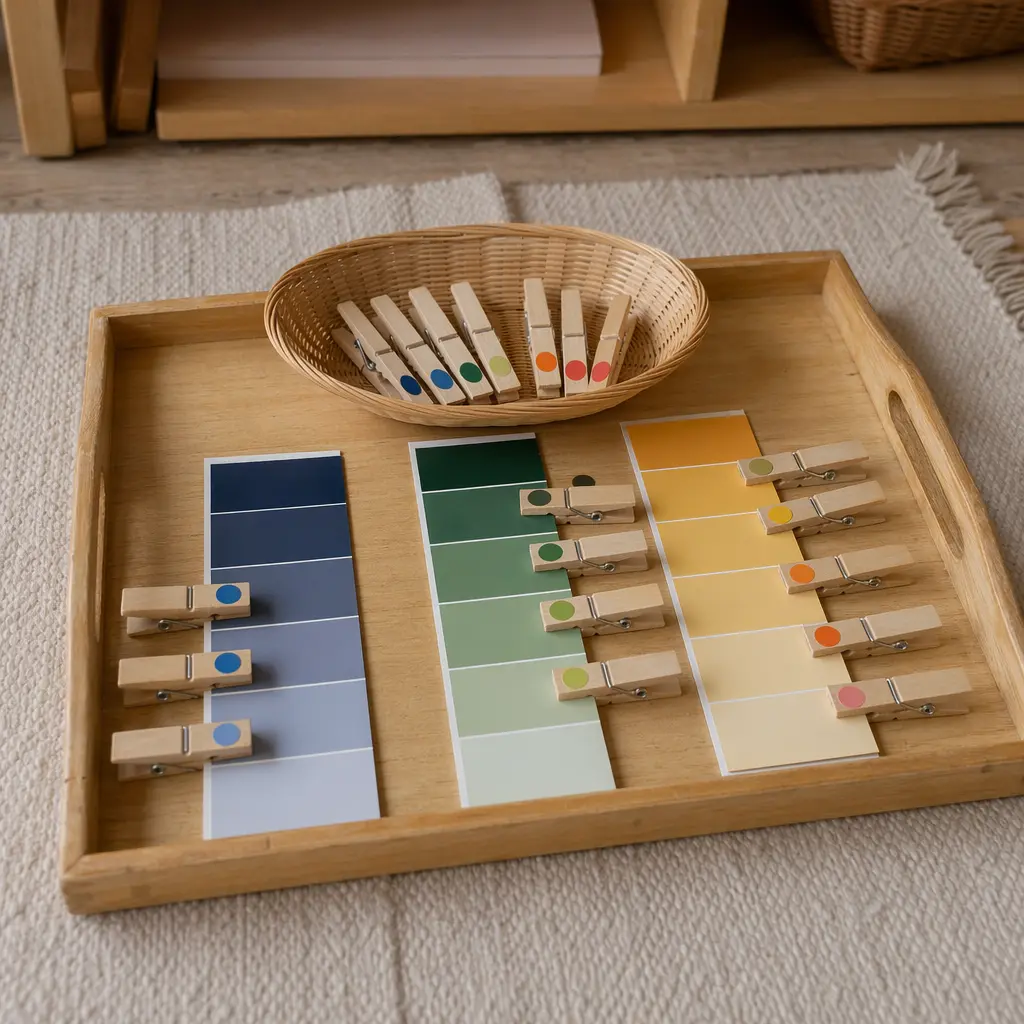
Place three paint chart strips with clear gradients on a small tray, arranged left to right from darkest to lightest, with a work mat the child can reach. Add one shallow basket containing only the matching dotted pegs, one peg per shade; remove extras and keep any blank cards on a separate shelf. Keep the layout consistent—strips below, basket above—so control of error is visible through a visual mismatch, a leftover peg, or an empty space on a strip.
Offer one slow, silent demonstration: take a peg, scan the strip from one end, hover to compare, clip to the closest match, then return hands to rest and replace the basket. Step back and stay quiet, using only brief safety reminders or a single “light/dark” model if invited; do not reposition pegs. Observe grip strength and controlled release, left-to-right scanning, persistence with close shades, spontaneous self-correction when a peg looks wrong, use of comparative words, and signs of deep focus or fatigue.
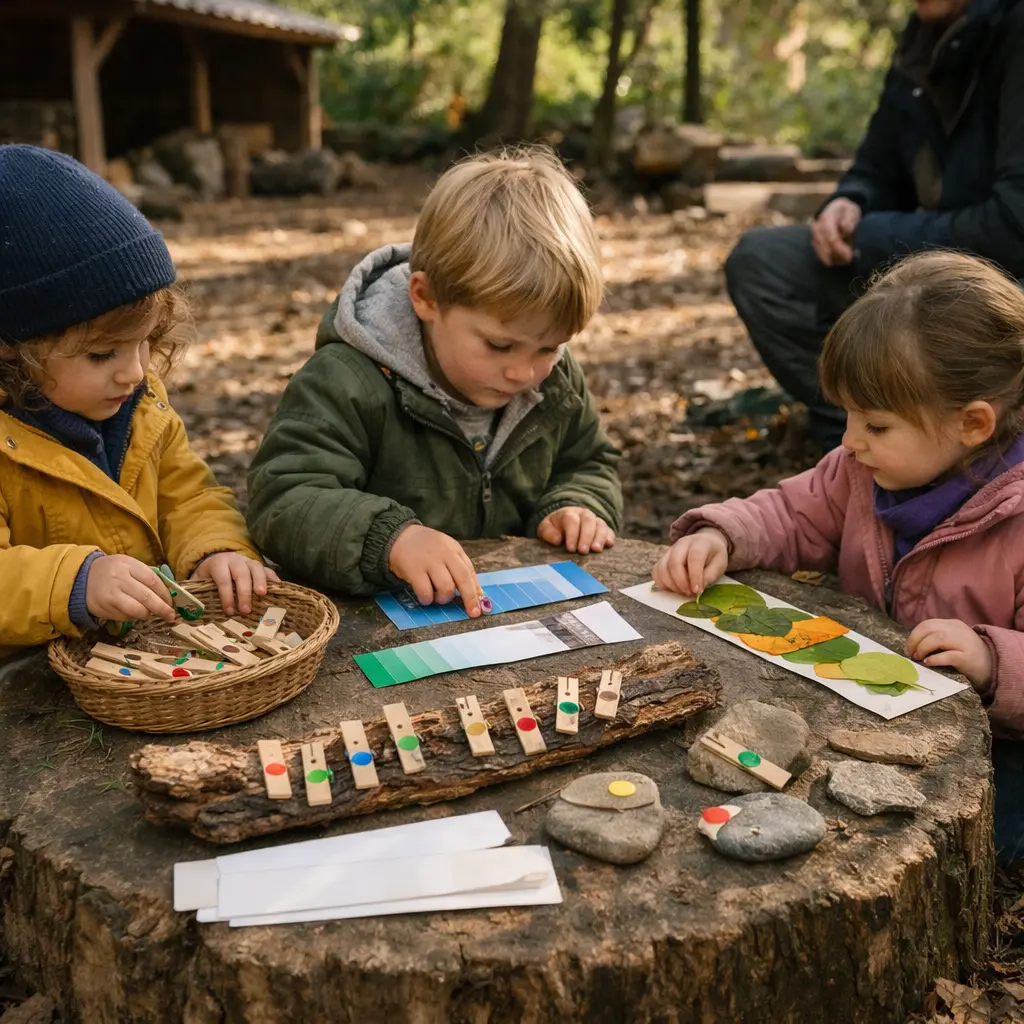
In an outdoor or nature-integrated space, set the activity on a low stump, picnic table or mat under a tree so dappled light and slight slopes change how shades appear. Materials such as paint chart strips, wooden pegs with single-colour dots, and natural alternatives (bark strips, leaf clusters, flat stones) are provided in an open-ended way rather than pre-arranged. Children may move strips onto bark, peg onto stones, or make their own gradient cards from collected leaves to compare close shades.
The adult observes nearby, checking surface safety and peg springs, offering minimal, responsive prompts such as "Which looks closest?" or a single-word descriptor. Children choose their level of precision, repeat placements, trade materials, and test matches at their own pace while the adult steps in only to manage risk or demonstrate a single action on request. Materials are topped up and blank cards offered for children who want to create new colour sets.
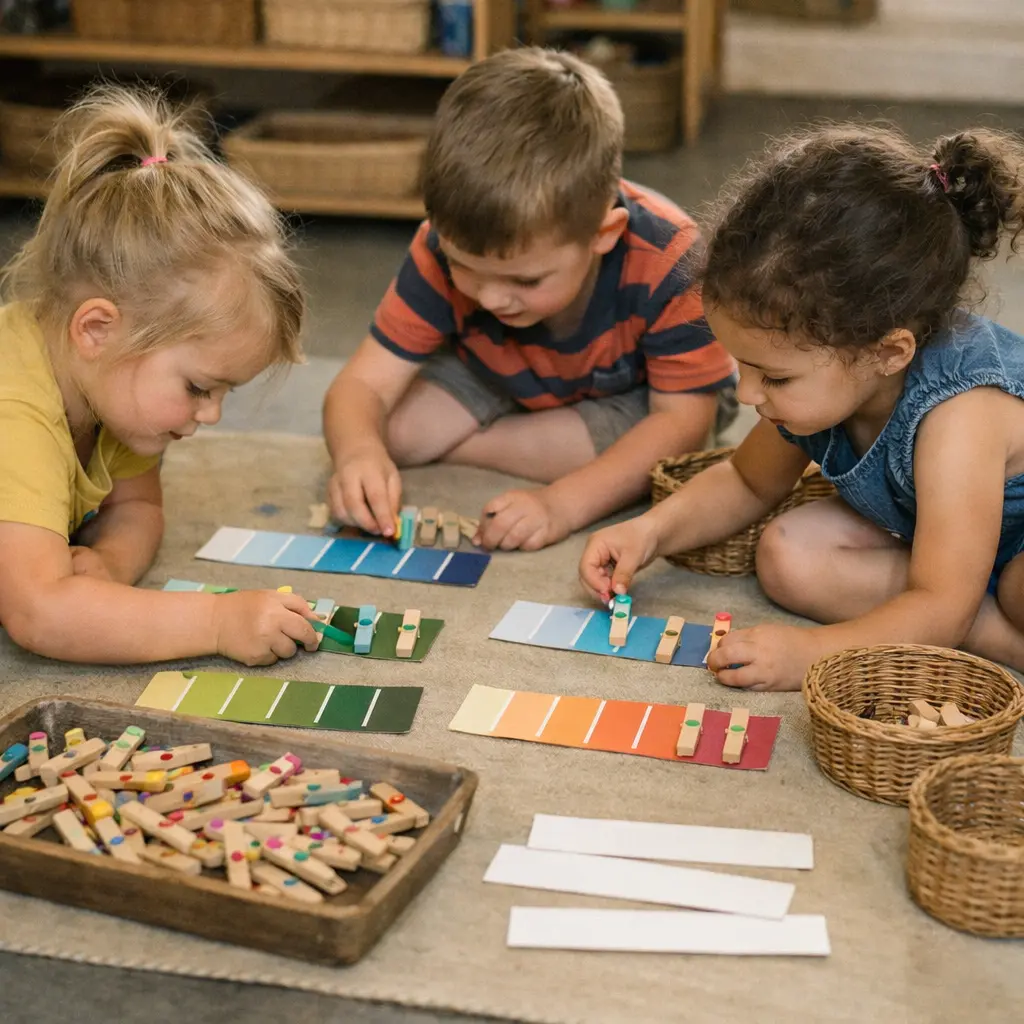
Set paint chart strips on a low table or floor mat with space between gradients, some horizontal, some vertical, and a clear “in‑between” area. Place dotted pegs loose in a shallow tray within reach, with a few empty baskets for the child’s own groupings and optional blank card strips beside them. Avoid pre-pairing or labels so materials don’t signal a single method; the child may sort, layer, reorder, or create new gradients, pause, or return later.
The adult stays nearby as co-learner, offering noticing language: “I can see you’re comparing two very close shades,” “You’re trying to find where this one belongs,” “What happens if this dot sits between these two?” The child may invent categories (light/dark, “nearly the same,” “not sure yet”), design new sets on blank cards, or create patterns. The adult observes grip changes, peg control, strategies for tricky choices, persistence, shared decision-making, and emerging vocabulary linking to Mathematics and Communication and Language.

Set a calm table with a plain cloth and a low wooden tray containing a few shade strips painted on heavy cotton or watercolour card using diluted plant or earth pigments that run from very light to deep. Place a small woven basket of wooden pegs with metal springs beside it; each peg carries a single hand-painted dot mixed to match the gradients. Keep one lidded jar of pigment and a natural-bristle brush with spare blank strips at the edge for quietly adding new strips.
Without giving steps, the adult models once by slowly squeezing a peg and placing it near a close shade, then stays nearby in quiet presence. The child selects, looks closely, tests a position, adjusts or removes, and returns to near matches that feel uncertain, repeating the squeeze-place-release sequence at their own pace. The adult observes hand control, comparison strategies, and any spontaneous colour words, offering a single descriptive term if invited, and intervenes only for safety or to restore the simple order during tidy.