Citrus water tray play with sliced oranges, lemons and limes and pouring tools for ages 1–4
Sensory Play
Communication and Language
A shallow tray of warm water dotted with citrus slices offers a sensory invitation to notice colour, smell and movement. Children may compare the feel of slippery fruit with the weight of a jug, while adults observe emerging vocabulary and hand control. The experience shifts between quiet concentration and lively experimentation according to each child’s chosen approach.
Children explore floating citrus slices in warm water, noticing colour, scent, texture and gentle movement. The open-ended set-up can feel calming or lively, depending on how each child chooses to pour, scoop or simply watch. Adults tune in to children’s focus, whether that is careful pouring, squeezing slices or observing drift patterns.
Step-by-Step Guidance
1. Prepare the space with a water tray on a stable, wipeable surface, with a towel or shallow catch-tray underneath if needed.
2. Fill the tray with a shallow level of warm water so children can reach the bottom easily.
3. Add a small number of citrus slices to the water so they are visible and easy to grasp.
4. Place jugs and cups beside the tray, grouped together so children can choose tools without waiting.
5. Invite children to approach in their own time. Offer a brief, simple demonstration of pouring water from jug to cup and returning the jug to the side.
6. Allow children to explore freely. If a child begins squeezing or mouthing, stay close and observe how they manage the taste and texture.
7. Add or remove a few slices if the tray becomes crowded or if children are throwing or over-stimulated, keeping the focus on manageable sensory exploration.
8. Support a calm ending by slowing your own movements, offering a final pour into the tray, and helping children place tools back beside the water before drying hands.
Learning Objectives
In Physical Development, children may practise hand control through pouring, tipping and grasping wet, slippery items. In Communication and Language, children may build vocabulary linked to sensory experience such as wet, smooth, bumpy, sour, float and sink. In Understanding the World, children may begin to notice simple changes and properties, such as how citrus slices move in water and how smell becomes stronger when the fruit is squeezed.
Adult Role
Stay emotionally attuned by watching for signs of uncertainty (hesitation, pulling away from smell) or sensory seeking (repeated squeezing, mouthing) and respond with calm presence and simple reassurance. Model language that matches what children are doing, using short phrases such as cold water, slippery slice, strong smell, and full cup, without turning it into a quiz. Scaffold only when needed: steady a jug for a child who is frustrated, reduce the water level if splashing escalates, or offer one tool at a time if sharing becomes difficult. Step back when children are repeating actions with focus, and observe how they solve problems like slippery grips, balancing a cup, or tracking floating slices. Hold responsibility for safe use of food items, water depth, and close supervision throughout.
Observation Cues
Reaches for particular fruits repeatedly and shows preference through facial expression or returning to the same item. Adjusts grip or two-handed control to manage slippery slices or heavier jugs. Watches closely as slices drift, cluster, or separate, and changes actions to affect movement. Uses gestures, sounds, or words to label sensations such as smell, taste, cold, wet, or sour. Persists with filling and emptying, showing pauses to check level and reduce spills over time.
Time & Space
10–30 minutes, depending on children’s interest and how many children are waiting to access the tray.
A wipeable floor area or low table with room for 2–4 children to stand or sit around a water tray, plus space for towels and a drying area.
Materials
Safety
Age adaptations
Budding Adventurers
Provide 3–5 citrus slices and both a small and larger jug so children can compare weight and control. Add an extra cup to support sharing and parallel play, and keep the water level shallow enough for quick recovery after spills. Adults can name actions as they happen, such as pour, tip, squeeze, and drip, and notice when children begin combining tools, for example filling a cup to a chosen level or moving slices into a cluster.
Curious Investigators
Offer a wider range of slice sizes (still thick) and include both jugs and several cups so children can set up their own patterns of filling and emptying. Allow children to decide how to organise the tray, including grouping slices by colour or size if that emerges. Adults can extend vocabulary with sensory words and simple comparisons, and observe whether children begin to predict what will happen when they squeeze a slice or pour near floating fruit.
Confident Discoverers
Provide a slightly larger tray area and enough cups for small-group play, keeping the number of slices manageable so the water surface stays visible. Children may begin creating their own self-chosen challenges, such as careful pouring without splashing or moving slices using water flow. Adults can support collaborative problem-solving by reflecting what is happening and helping children negotiate turn-taking with shared jugs, stepping in only when frustration or unsafe splashing appears.
EYFS Links
Physical Development: Children may strengthen hand and wrist control through grasping slippery slices, lifting jugs, and adjusting pour speed to manage spills. Communication and Language: Adults can model sensory and action words in context, supporting children to connect words with what they feel, see and smell. Understanding the World: Children may notice simple properties and changes, such as floating, drifting, and how squeezing releases smell and juice into water. Personal, Social and Emotional Development: Shared access to jugs and cups can create natural opportunities for turn-taking, coping with small frustrations, and returning to a calm state after lively splashing.
Ethos adaptations

Place the shallow bowl on a towel and half-fill with warm water. Put 4–6 thick citrus slices in the bowl. Set one small jug, one larger jug, and one cup on a tray in left-to-right order of use; remove extra cups to reduce choice. Handles face the child, with clear space to return items. This isolates pouring and squeezing. The larger jug stays as source, the small jug for transferring to the cup; overfilling shows at the rim and spills land on the towel. Place at a low table for easy reach.
Offer a slow, silent demo: lift the small jug, support the spout, pour to the cup rim, stop, return; pick up one slice, squeeze over the bowl, release, then step back. Keep language minimal, using a single word only if the child seeks it (wet, sour). Watch for repetition, steadier wrist control, grip on slippery slices, attention to drifting pieces, and self-correction after spills. Note turn-taking with the shared jug and signs of deep focus or fatigue to decide when to pause or end.
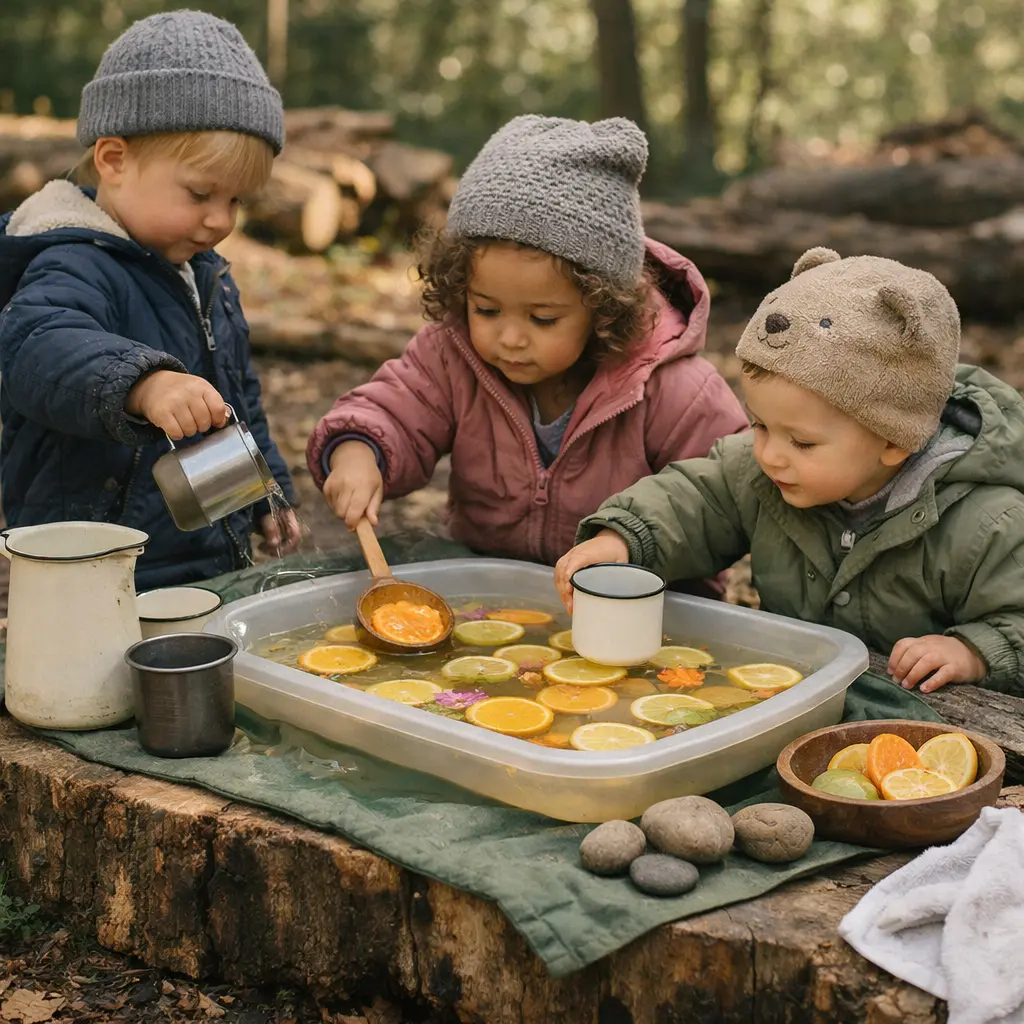
In an outdoor or nature-integrated space, place the shallow water tray on a low log, tree stump or sturdy bench with a waterproof cloth beneath to catch drips. Materials such as thick citrus slices, warm water, wooden ladles or bark scoops, enamel cups and smooth stones are provided in an open-ended way rather than pre-arranged; leaves, petals or small shells may be added for scent and texture and towels are kept close for spills.
The adult observes from nearby, checking temperature and supervising slips while using minimal language and brief, responsive prompts when needed. Children choose roles—pourer, squeezer, scooper or watcher—and may repeat actions, experiment with tilt and grip, compare scents and textures, and take turns as they explore without a fixed outcome; the adult steps in only to manage risk or offer an extra natural tool.
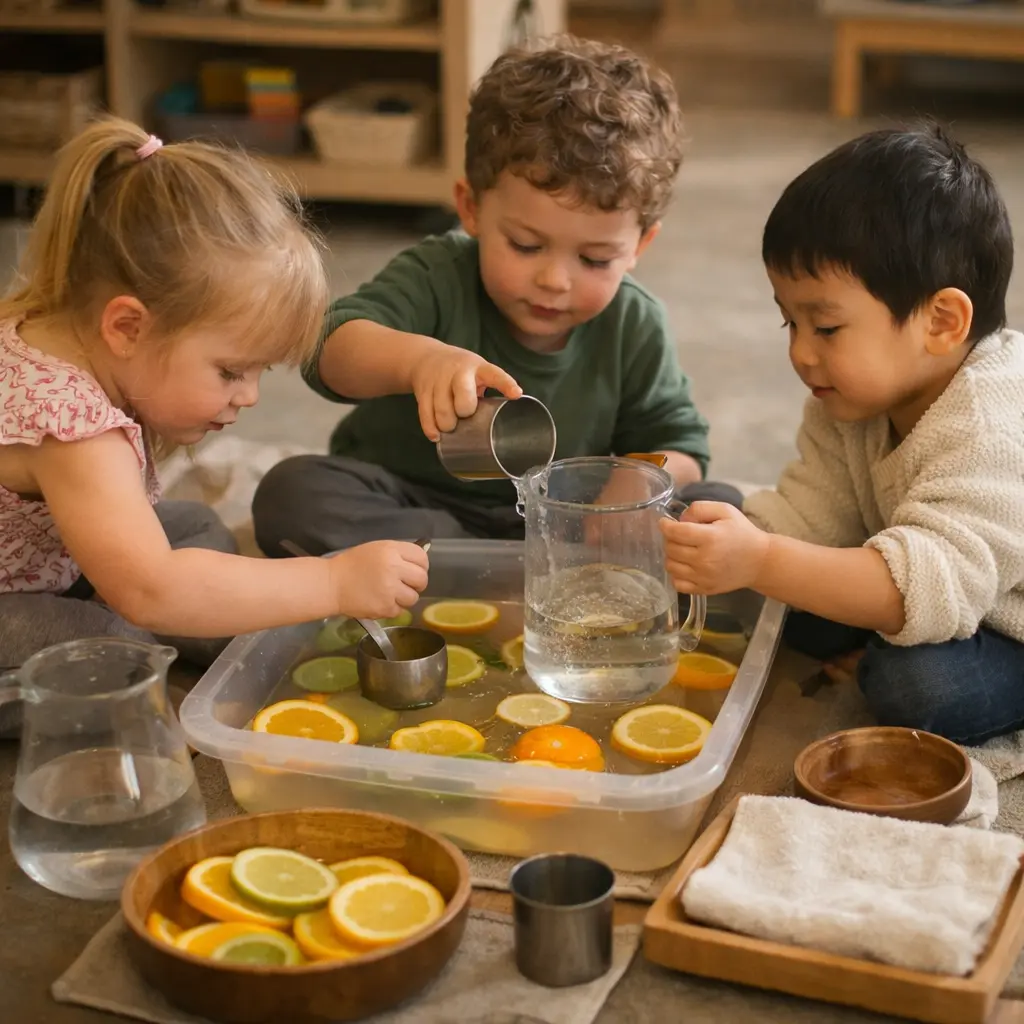
Ethos adaptation: Set the tray on a low, stable surface with two or three loose stations so children can choose where to work and move between areas. Arrange warm water, thick citrus slices, varied open vessels (small and large jugs, sturdy cups), plus neutral loose parts such as fabric, wooden spoons and shallow dishes within easy reach; towels and a shallow drip tray are visible for self- care. Materials are not prepared as a single task but arrayed to invite different uses and rhythms, supporting the same EYFS sensory and motor aims.
The adult steps back as observer and co-researcher, offering commentary rather than directions: “I can see the slice turning as you pour,” “You’re trying to slow the pour,” or “What happens if you squeeze that piece?” The child may choose pouring, squeezing, arranging or simply watching drift; shared access can create turn-taking moments. Observation is embedded in the flow through short notes, photographs or quotes capturing hand control, new vocabulary, problem-solving attempts and patterns of engagement.
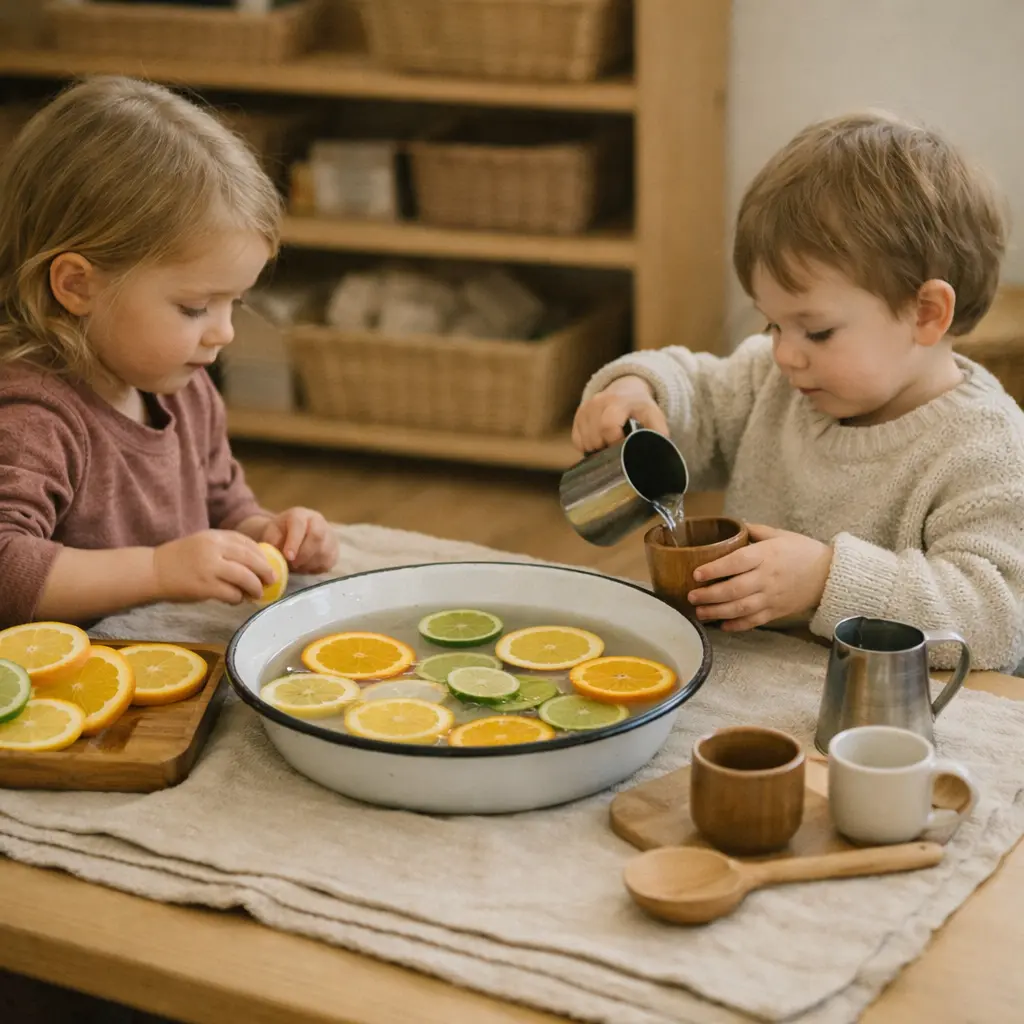
A shallow enamel or stainless-steel bowl is set on a low table or floor within a defined space marked by a neutral cotton cloth, with a folded towel beneath to catch drips. The water is warm and still; thick slices of orange, lemon and lime rest on a wooden tray beside two small metal jugs, two ceramic or wooden cups, and a simple wooden ladle. Only these items are offered to keep the area calm and uncluttered, ready for repeated, unhurried use.
The adult checks the temperature, then demonstrates one slow pour and one gentle squeeze, using few words and a quiet tone, stepping back to observe. The child chooses pace and returns to pouring, scooping, squeezing or watching slices drift and scent deepen, with the adult close for safety and to model steady hands if needed. The rhythm is setup, exploration, then tidy: slices lifted back to the tray, tools placed on the cloth, small cotton cloths used to pat surfaces dry.