Catching rainfall in buckets and measuring the collected amounts during outdoor weather exploration
Autumn
Nature/rainbows and weather
Outdoor exploration
This activity invites children to observe rainfall as it happens and to explore simple measurement by catching rain in buckets. It emphasises outdoor exploration, weather talk, and early numeracy through nonstandard units. The approach remains flexible to weather, with adaptable adaptations for different ages and learning needs.
Children place buckets outside to catch rainfall and then return to observe how much rain has been collected. The activity invites discussion about weather and measurement, using nonstandard units to compare collected amounts. Adults guide safe outdoor practice, support language, and help children notice patterns as rain continues.
Step-by-Step Guidance
1) Set up a sheltered outdoor area with 4–6 evenly spaced buckets on a stable, flat surface; place a waterproof mat under the bucket zone. 2) Ensure children are dressed in appropriate waterproof clothing and have safe, easy-to-use measuring tools. 3) When rain begins, leave the buckets outside for a defined period (e.g., 15–20 minutes) to collect rainfall. 4) After the collection period, retrieve the buckets and pour rainfall into measuring jugs or onto a tray for easy viewing. 5) Use nonstandard units (cups, spoons) to compare amounts between buckets; record observations on clipboards. 6) Gather children to talk about differences, ask simple questions, and celebrate discovery. 7) Clean up and store materials safely; return buckets to storage.
Learning Objectives
This activity supports children in noticing weather phenomena and engaging with practical measurement. Children may begin to compare amounts of water collected, using more/less language and simple nonstandard measurement. It also strengthens communication as children describe what they notice and ask questions. EYFS links: Understanding the World; Mathematics; Communication and Language.
Adult Role
Provide calm, age-appropriate supervision and model descriptive language related to weather and measurement. Scaffold early counting and comparison using concrete, hands-on materials, then gradually step back to let children lead their discussion. Maintain safety by ensuring wet surfaces are controlled and clothing is appropriate. Facilitate peer conversation, extend vocabulary (more/less, heavier, lighter, wetter), and respond to questions with open prompts.
Observation Cues
- Child points to buckets and comments on how much rain has been caught.
- Child uses nonstandard units (cups, hands) to compare amounts between buckets.
- Child volunteers to help retrieve buckets or pour water and shares observations with peers.
- Peers engage in discussion about why some buckets have more rain than others.
- Adult notes safety behaviours (lids on when not actively measuring) and language used to describe weather and amounts.
- Child shows sustained curiosity about weather patterns and asks simple questions (e.g., 'Why is this bucket wetter?').
Time & Space
30–45 minutes total, weather permitting; set-up 5–10 minutes; collection activity 15–20 minutes; discussion and wrap-up 5–10 minutes
Outdoor area with flat, stable ground suitable for placing multiple buckets; sheltered area or overhang to allow rain exposure; clear path for moving between stations; room for children to walk safely around the setup.
Materials
Safety
Age adaptations
Budding Adventurers
Introduce measuring using nonstandard units (cups or small cups) and invite children to compare two buckets. Provide a simple data recording sheet with pictorial cues or stickers for each bucket to support early numeracy and classification. Encourage turn-taking and collaborative talking about which bucket has more water and why.
Curious Investigators
Extend to a basic data collection activity. Children may tally which bucket collected the most rain and begin to verbalise patterns (e.g., 'the west side got more rain'). Use simple questions to prompt explanation and introduce counting sequences up to 5. Provide opportunities to dramatise weather talk with peers, using expressive language.
Confident Discoverers
Children can engage in more formal measurement and representation. They may use multiple nonstandard units to measure each bucket, create a simple tally chart or bar chart with support, and discuss weather patterns or predictions (e.g., 'If it rains more tomorrow, we might get even more in our buckets'). Promote peer-led discussion and independent recording with minimal adult prompts.
EYFS Links
Understanding the World: children observe weather phenomena and outdoor environments; Mathematics: children compare amounts, use nonstandard units, and begin simple data representation; Communication and Language: children describe observations, ask questions, and extend vocabularies related to weather and measurement; Personal, Social and Emotional Development: children collaborate, take turns, and develop resilience in outdoor learning contexts.
Ethos adaptations
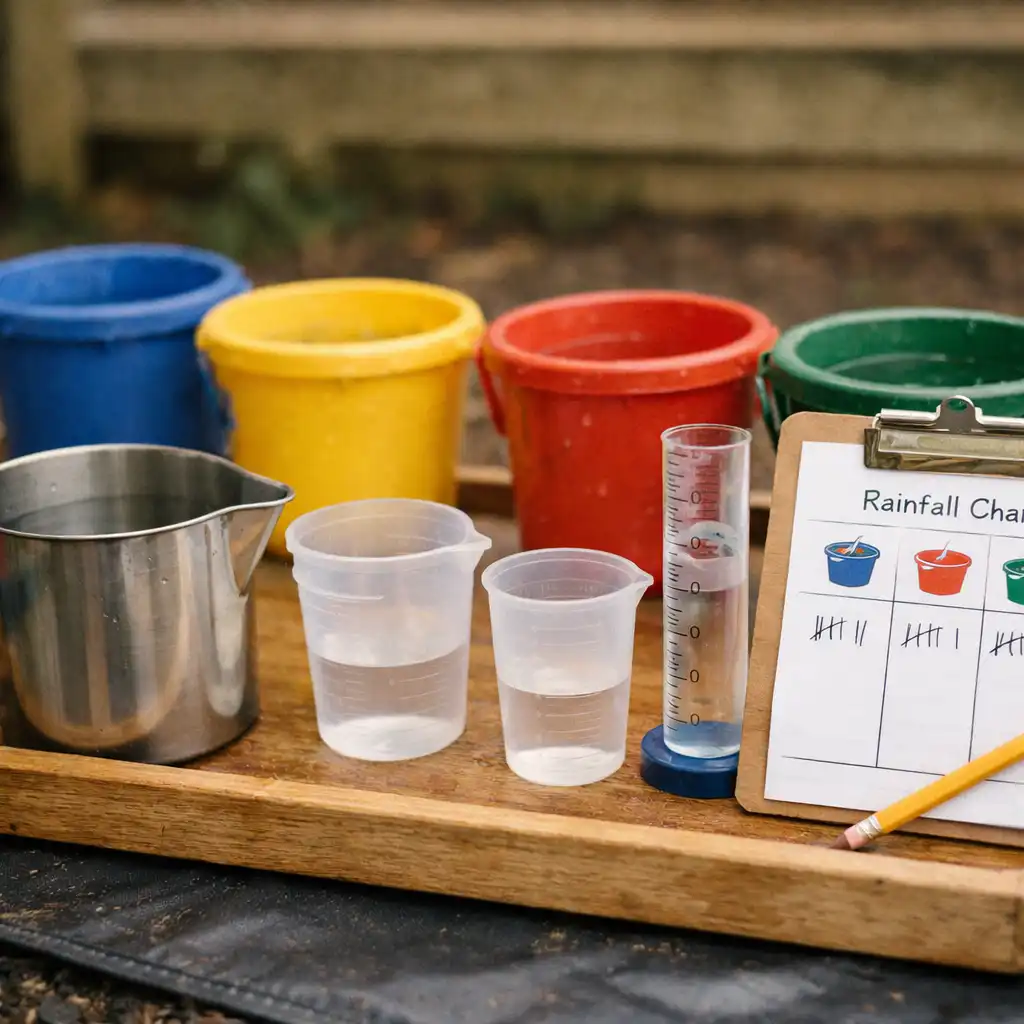
Place four buckets on low marked spots or a shallow tray, each labelled and arranged left-to-right; provide one measuring jug with a single visible fill line and one clipboard with a simple tally sheet per child. Remove extra cups and toys so the sequence (place bucket → wait → pour to line → record) is clear and children can reach, pour and return materials independently.
Show the sequence once with a slow, silent demonstration—place a bucket, set the timer, pour to the fill line and make one mark—then step back and limit language to brief safety reminders only. Watch for repetition, steady pouring that shows self-correction, waiting for the timer, and use of comparative language on the recording sheets rather than directing the child.
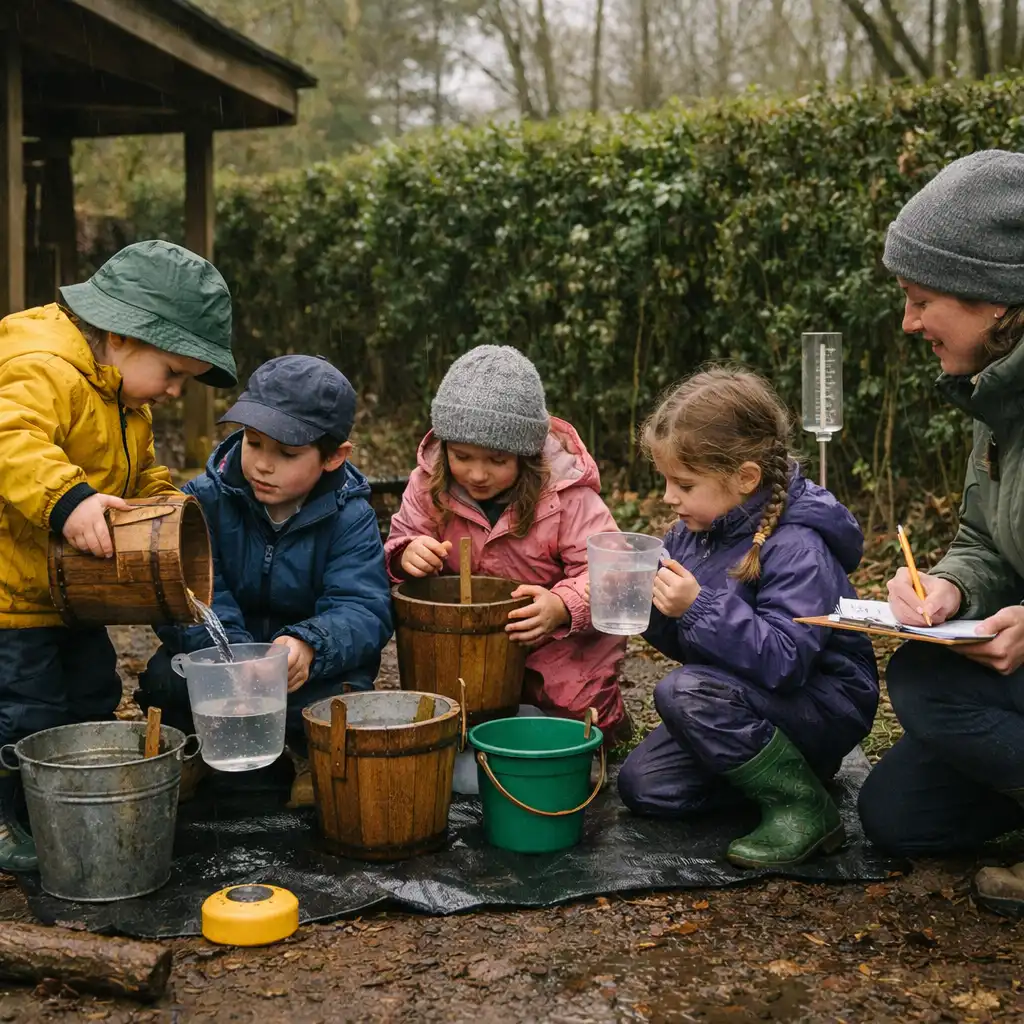
Outdoors in a garden, school yard or patch of green, move the activity onto grass or gentle slopes and replace shiny plastic buckets with open natural receptacles such as shallow plant pots, wooden bowls, terracotta saucers or split sections of log and metal pans positioned on level stones. Materials are arranged loosely with collection containers spaced apart, simple nonstandard measures (cups, jugs, marked sticks) and clipboards brought outside, and some waterproof mats or crates available for sitting but not to create a sterile setup.
The adult observes from close by, naming what they see and asking short, open prompts only when needed while supervising safe use of containers and movement on uneven ground. Children choose where to place receptacles, how to measure using jugs or counted cup fills, and record or tally results themselves, returning to revisit and compare amounts over time as rain falls, with the adult intervening only for safety or to extend a child’s question.
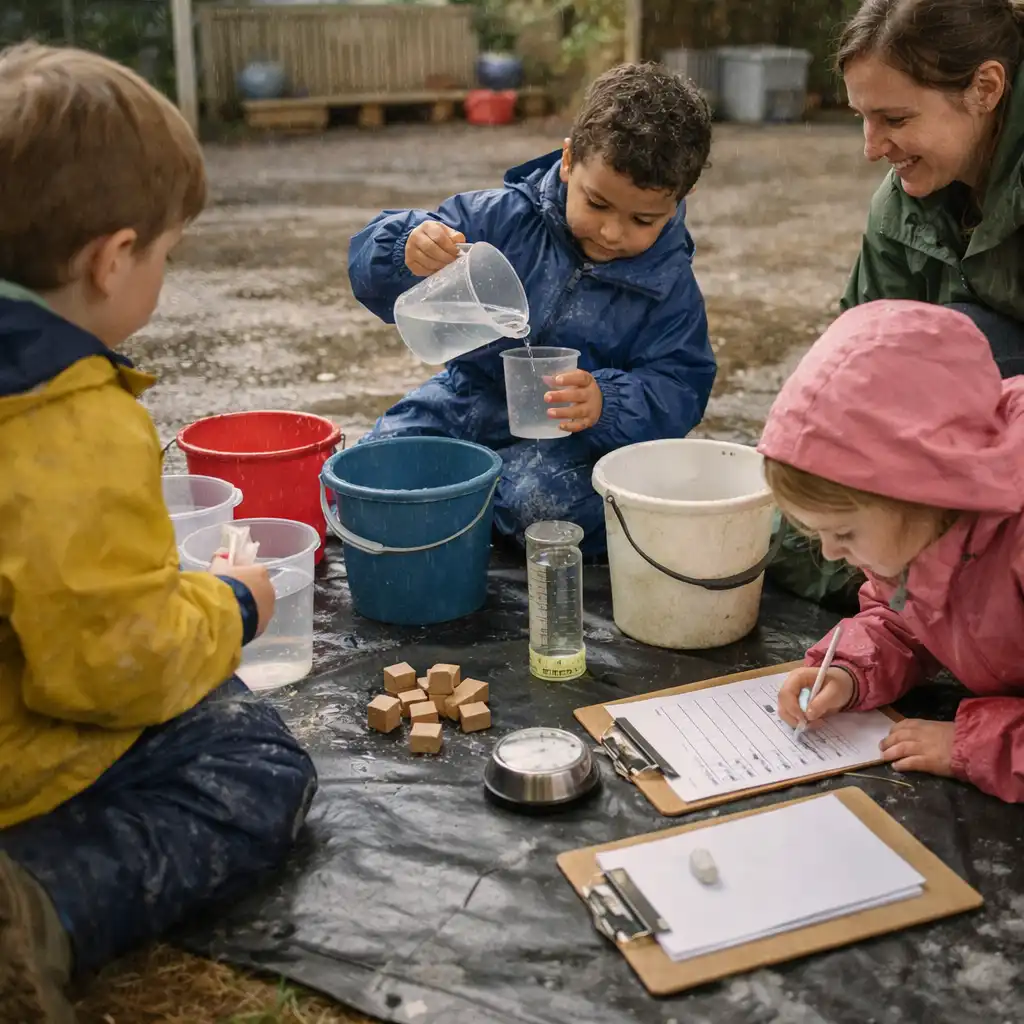
Reggio Emilia ethos adaptation — environment and materials: Arrange buckets and a wider variety of open-ended containers (metal tins, clear jars, wooden scoops, funnels, shells) across several outdoor micro-sites (sheltered ledge, open lawn, near a drain) so children can choose where and how to collect rain. Place clipboards, pencils, simple tally cards and waterproof mats within reach at each site rather than handing them out. Keep measuring jugs but add loose parts (tubes, spoons, nonstandard counters) so measurement can be explored in multiple, child-led ways.
The adult becomes observer and co-researcher, using commentary: "I can see this bucket fills faster," "You’re trying a new container," "What happens if you move the bucket here?" rather than giving instructions. The child may select sites, swap vessels, invent nonstandard units and repeat collections; these choices shape comparisons and language use. Embed observation by noting behaviours (comparing more/less, negotiating turns, counting attempts, persistence in returning after rain) and recording quotes or patterns during natural pauses.

A calm outdoor station is laid out close to the play area: a low wooden tray or bench on a neutral cloth marks the catch-and-measure zone and contains spills. Only a small number of shallow metal pails or simple wooden bowls (no more than four) are provided to collect rain, with one metal measuring cup and a wooden ladle for transferring water into simple paper tally sheets. Waterproof wear and a single ground mat are available; bright or plastic items remain inside.
The adult quietly models placing a pail and later demonstrates one measured pour from pail to cup, using minimal factual language for safety and observation, then steps back to remain a calm anchor. The child returns to the tray at their own pace, repeating pours and comparisons using the single measuring cup and tallying on the clipboard; the adult notes comments and patterns without directing the child’s choices.