Building a simple indoor space den basecamp using sheets, safe sticks and soft lights
Understanding the World
Children explore making a small basecamp space using large fabrics, soft anchors and gentle lighting, adjusting the feel of the area as their play ideas change. Adults support safe choices around stability, entrances and shared use of a small space, keeping higher-risk items managed. The experience often brings rich language about position and size, alongside moments of quiet retreat or imaginative role play.
Children create a small basecamp-style den using large fabrics and simple supports, shaping an enclosed space they can enter and use for play. The experience often invites problem-solving about balance, size and access, alongside shared decision-making. The den can become a calm place for quiet play, storytelling, or small-world setups, depending on what children bring to it.
Step-by-Step Guidance
1. Prepare the space: choose a clear area away from heaters, doorways and heavy foot traffic. Place a rug or mat where the den will sit and remove trip hazards.
2. Pre-check materials: select only smooth, thick sticks/dowels and tape the ends. Test the lights so they stay cool and secure any battery pack inside a zipped pouch or high out of reach.
3. Offer a simple starting point: set out one sheet and a few cushions. Keep clips/pegs with the adult at first so children are not handling pinch points unsupervised.
4. Invite children to decide the basecamp shape: some may want a low cave, others a taller tent. Let children move cushions and choose where the “door” might be.
5. Add supports safely: if children want height, the adult positions the frame option (e.g. airer/table edge) or holds a stick steady while children drape fabric. Pause to let children test what happens when they pull or lean on the sheet.
6. Anchor and adjust: encourage children to notice where the fabric slips and to try different anchoring points with cushions. Use clips only when needed and only where children’s fingers are not near the hinge.
7. Introduce soft lighting: place battery lights so they do not create tangles or trails across walkways. Let children choose whether the den feels better dim or bright.
8. Transition into use: offer a small basket of den items and allow children to decide what the basecamp is for (quiet reading, pretend camping, small-world play). Keep the structure flexible so children can reconfigure it.
9. Close down with children: give a clear warning before tidying. Invite children to remove props, fold fabric, and return cushions, keeping sticks and clips for adult handling.
Learning Objectives
Children may develop confidence in moving, lifting, reaching and positioning materials, supporting Physical Development. They may practise turn-taking, negotiating ideas and using descriptive language as they plan and adjust the space, supporting Communication and Language. Children may also explore simple cause-and-effect and spatial awareness as they notice what makes the structure stable or wobbly, supporting Understanding the World.
Adult Role
Stay emotionally attuned by noticing when the enclosed space feels exciting or overwhelming, and offer a calm option to step out or widen the entrance. Model simple, respectful language for collaboration, such as naming what you notice and offering choices, and repeat children’s words to support shared meaning. Scaffold only at the point of need: hold a support steady, suggest testing one change at a time, or reduce materials if the structure becomes frustrating; step back when children are negotiating and experimenting safely. Observe in action by watching how children approach stability, how they include others, and what they use the space for, and use those observations to offer a timely prop or a new word. Hold responsibility for safety by managing lights, clips, and any stick use, checking for trip hazards, and keeping the den away from unsafe furniture or heat sources.
Observation Cues
Notices and comments on what makes the sheet stay up or slip down
Chooses different ways to enter, exit, or make an opening and adjusts body movements
Uses words or gestures to direct others (e.g. pointing, naming parts, indicating where to place fabric)
Persists with a problem (e.g. re-positioning a support) or seeks help at a specific moment
Invites others in, sets simple “rules” for the space, or assigns roles in play
Shows preference for dim/bright areas and moves materials to change the feel of the space
Time & Space
20–45 minutes, with the option to keep the den up for longer continuous provision.
Indoor clear floor area large enough for 3–6 children to move around a low structure, ideally near a wall or sofa for a stable edge. Keep a clear walkway around the den.
Materials
Safety
Age adaptations
Budding Adventurers
Offer two sheets and more cushions so children can try making a “door” and a separate corner inside. Introduce one smooth dowel as an adult-held support if children request height, and keep clips adult-only. Adults model short problem-solving language (slip, tight, heavy, higher, lower) and support turn-taking when several children want to place the same cushion.
Curious Investigators
Provide a choice of frame options (e.g. airer or table edge) and a small set of adult-checked sticks/dowels for children to suggest where supports could go, with the adult doing final placement. Add simple den tools such as a clipboard with paper, a few picture cards of shelters, and a basket for “supplies”. Adults encourage children to test stability by gentle pushes and to agree shared rules for the basecamp space.
Confident Discoverers
Offer more open-ended materials: extra fabric lengths, a limited number of adult-managed clips, and a defined “supply station” for props. Invite children to plan for features such as a sign, a storage area, or a lookout gap, and to review what makes the structure feel secure. Adults step back for longer periods, stepping in to support negotiation, to introduce richer vocabulary (support, anchor, entrance, boundary), and to manage any higher-risk adjustments.
EYFS Links
Communication and Language: Children may use talk, gesture and listening to share ideas about where materials go, to negotiate roles, and to describe what they notice about the space.
Physical Development: Lifting cushions, reaching to drape fabric, crawling in and out, and adjusting body position can support coordination, balance and spatial awareness.
Personal, Social and Emotional Development: Shared building often brings turn-taking, managing frustration, and considering others’ needs in a small space, with adults supporting calm boundaries.
Understanding the World: Children may explore simple forces and materials by noticing what makes fabric hang, what makes a support stable, and how light changes the feel of the den.
Expressive Arts and Design: The den can become a flexible stage for pretend play, storytelling, and creating an atmosphere using light and chosen props.
Ethos adaptations
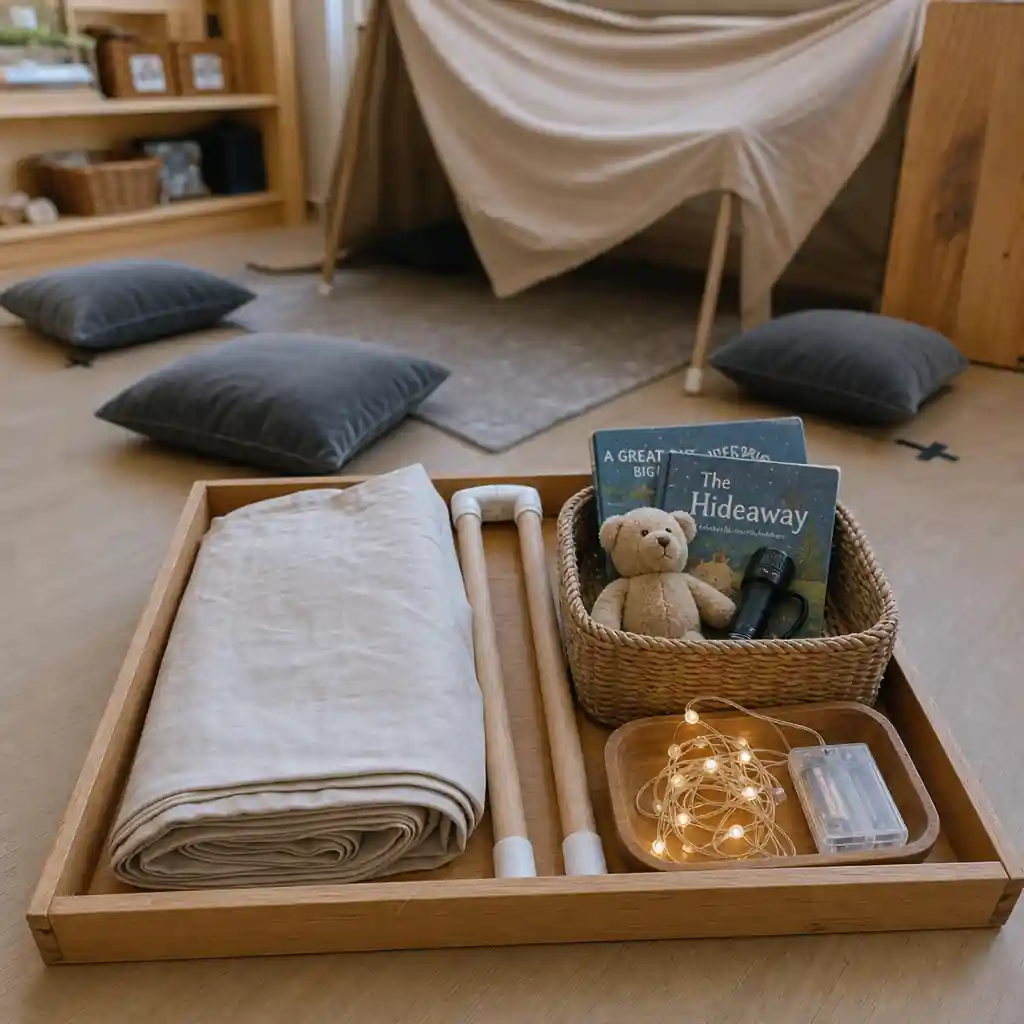
Set out a single workspace: one large sheet, four cushions placed at marked floor spots, a low pre-assembled frame or one taped stick pair, and a small basket with two books, one torch and one soft toy. Reduce extras by keeping spare clips and extra sticks locked away; place lights with the battery pack taped and accessible on a tray so children reach them. Arrange items in the order they will be used (cushions, frame, sheet, lights) so the sequence of building and balancing is clear and children can access everything themselves.
Show the whole sequence once: place cushions, fit the frame, drape the sheet and switch on the light, using slow, silent actions and one short sentence about safety. Then step back and use minimal language, avoiding prompts; only offer brief reminders about safety if needed and keep clips out of reach. Observe who repeats actions, how precisely children position cushions and sticks, how they adjust after wobble, and how they negotiate turns and space rather than intervening.
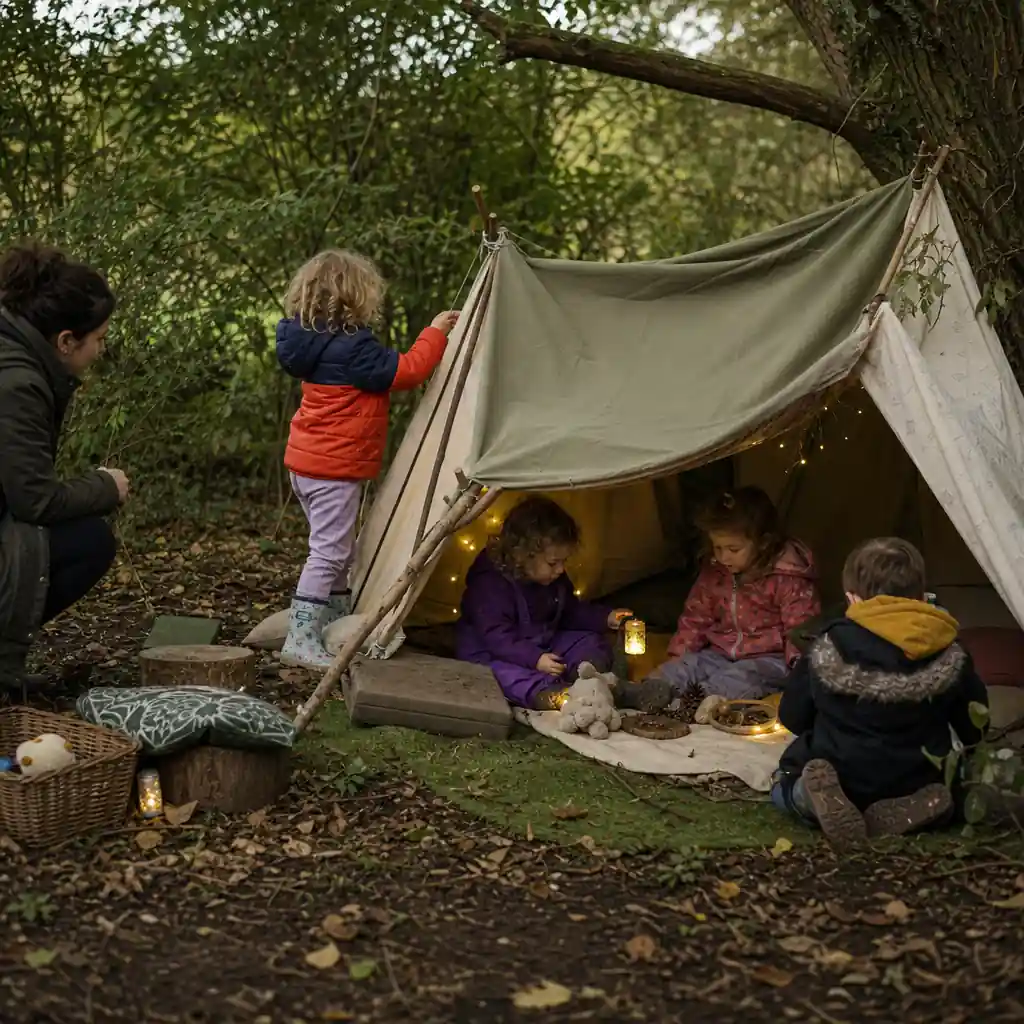
In an outdoor or nature-integrated space, the den is assembled under a low branch, between bushes or beside a sheltered wall on grass or compacted soil so surfaces are varied. Materials are arranged using large natural fabrics or canvas sheets, smooth taped sticks and low, stable logs or cushions covered in blanket as anchors, plus a ground rug or moss mat and secure battery lights. Children may add leaves, pinecones or lightweight bark as decorations and weights.
The adult observes from nearby, remaining ready to check anchor points, tighten taped ends or attach clips safely but not to direct construction. The adult uses minimal prompts and single-word questions, models careful handling of sticks once, then steps back to supervise. Children choose roles, take turns lifting and adjusting, test angles and stability, negotiate access and shape, and may move in and out to notice light, sound and balance while the adult responds with brief, responsive observations.
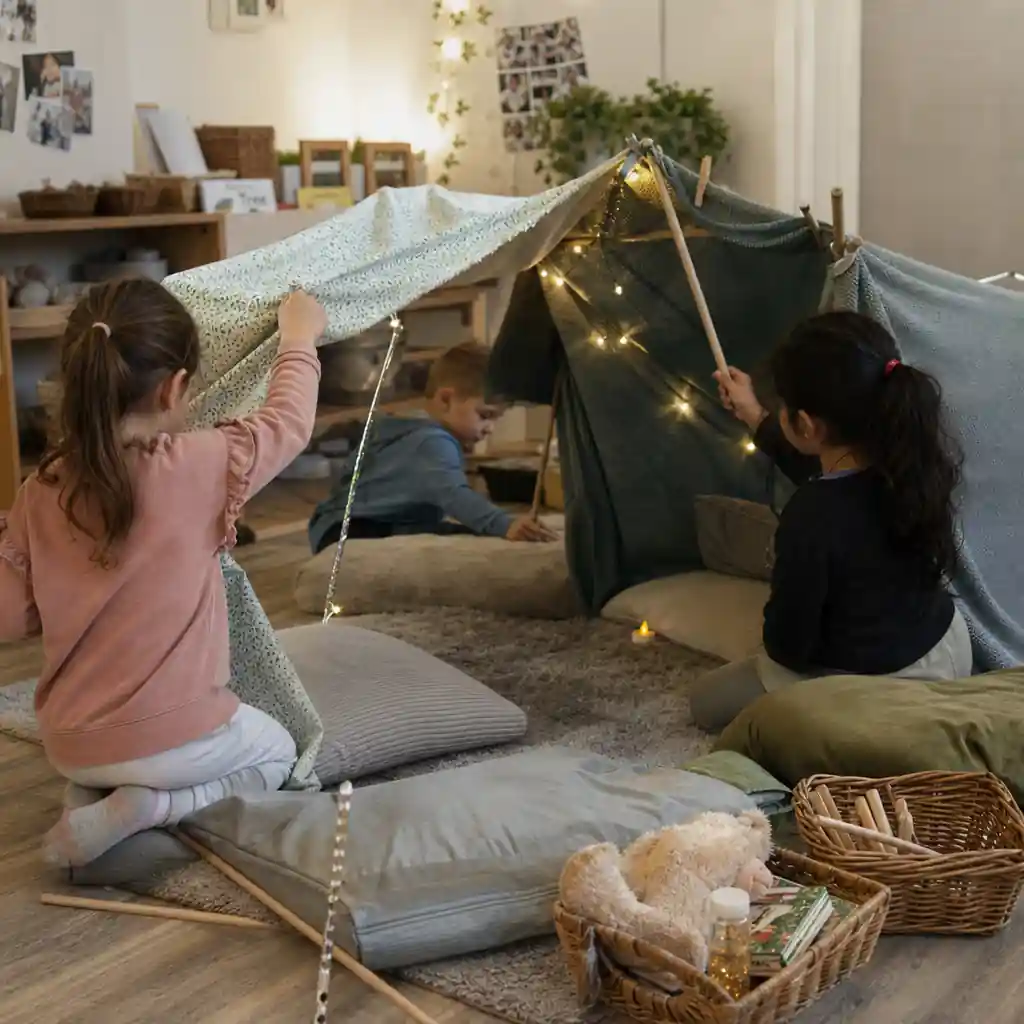
Ethos adaptation: Reconfigure the corner or central floor area as an inviting building zone with materials fully visible on low shelves or in open baskets so children select fabrics, cushions and sticks themselves. Lay rugs to define the den footprint and place cushions at varying heights as loose parts rather than fixed anchors. Replace single-use pegs or pre-built frames with a small selection of neutral supports (taped dowels, low airer) and many open props—soft toys, books, sensory bottle—so the child may invent entrances, rooms or stories without a prescribed final form.
The adult steps back as observer and co-researcher, using commentary instead of instruction: "I can see you’re testing how the fabric hangs" or "What happens if you move that cushion?" Materials remain in reach so the child may change scale, abandon or return to the build; turn-taking and negotiation emerge naturally as children rearrange space. The adult notices balance attempts, language used in planning, and repeated stabilising strategies as embedded observation cues for EYFS goals in movement, communication and understanding of materials.

Use natural, calming materials: wool or cotton cloths in muted colours, a simple wooden clothes horse as the frame, and a heavy wool blanket as the ground layer. Replace fairy lights with a single warm LED lantern placed by the adult, and keep props simple and open-ended, such as a basket of cloths, pinecones, and a small selection of picture books.
Keep adult language gentle and rhythmic, focusing on simple descriptions rather than problem-solving talk, and allow longer quiet stretches for children to settle into imaginative play. Step in mainly to maintain a peaceful tone, to model careful handling of materials, and to support inclusion when the space feels exclusive. Observe the mood of the group, the quality of play themes, and whether the den is being used for rest or high-energy play, and respond by softening the environment or widening the space.