Painting on windows using washable paint mixed with dish soap for vertical mark making (0–4 years)
Mark making
An adult sets a shallow bowl of blue paint on a small table beside the window and keeps a folded microfibre cloth within reach. A child drags a brush upward, pauses, and tilts their head as the line thins and starts to drip. The adult says, “Drip down,” and places the cloth on the sill without wiping the mark away. Another child presses a sponge onto the glass, lifts it to check the print, then dabs three quick times in a row, watching the lighter patches appear in the sunlight.
Children explore painting on a vertical surface using washable paint that can be wiped away. The window offers a different feel from paper, with light coming through and marks showing up in new ways. Children often return to the same area to add layers, change colours, or watch drips and smears. The adult supports access, comfort, and clean-up so children can focus on the experience.
Step-by-Step Guidance
1. Choose a window or glass door panel at child height with good natural light. Clear the sill and move nearby furniture to create a defined working area.
2. Protect the floor directly under the window with towels or a wipe-clean mat. Place cloths within adult reach for quick wipe-ups.
3. Mix washable paint with a few drops of washing-up liquid in small pots. Offer only a small amount of each colour to reduce waste and make clean-up easier.
4. If using painter’s tape, add a few simple strips to the outside edges of the working area or across the window to create sections. Keep shapes large and easy to see.
5. Present the tools in a small set (for example, one brush and one sponge to start). Place paint pots on a stable surface beside the window.
6. Invite the child to begin painting. Stay close enough to support reaching, tool changes, and paint pot stability, while leaving the child to decide where and how to make marks.
7. As the child paints, offer brief language that matches what is happening (colour names, action words, position words like up/high/low). Avoid directing what to draw.
8. If the child wants to change the surface, offer a damp cloth or a light spray of water (adult-controlled) so they can wipe, smear, or start again.
9. When interest fades, support a simple clean-up routine: wipe the window, remove tape slowly, and place tools into a washing-up bowl or sink area.
10. Finish by checking the floor for drips and drying the area so it is safe for the next use.
Learning Objectives
In Physical Development, children may build shoulder stability and hand control through repeated vertical strokes, dabbing, and reaching. In Expressive Arts and Design, children can explore colour, line, and layering on a see-through surface. In Communication and Language, children may use words, gestures, or sounds to share choices and describe what they notice as the paint moves and changes.
Adult Role
Stay emotionally attuned by noticing when a child wants closeness, space, or a pause, especially if the slippery surface or drips feel unpredictable. Model simple, descriptive language in the moment (for example, “long line”, “dab”, “higher”, “drip down”) and mirror the child’s words without turning it into a test. Scaffold only when needed: steady paint pots, offer a cloth, or adjust tool size; step back when the child is repeating actions or concentrating. Observe how the child uses their body on a vertical surface (reach, balance, grip changes) and how they respond to colour mixing and wipe-back. Hold responsibility for safety by managing the step stool, keeping paint away from eyes and mouths, and maintaining a non-slip floor area.
Observation Cues
Does the child choose big arm movements, small wrist movements, or a mix as they paint higher and lower on the window?
Do they switch grip (whole hand to fingertips) when using different tools?
Do they notice and respond to drips, smears, or colour mixing by changing their actions?
Do they return to a section to add layers, wipe, or redraw shapes?
What language or sounds do they use for colours, actions (wipe, dab, swirl), or effects (see-through, shiny, drip)?
Time & Space
10–25 minutes, with flexible stopping points for wiping and returning later.
A clear window or glass door panel with a safe standing area in front, plus space for paint pots on a stable nearby surface and floor protection underneath.
Materials
Safety
Age adaptations
Budding Adventurers
Add a few more tape lines to create simple “panes” and offer a small tray of three colours. Introduce a stable step stool with close adult supervision so the child can explore higher marks and longer strokes. Offer language for position and movement (top/bottom, across, zigzag) and let the child decide whether to paint inside sections, over tape, or across the whole window.
Curious Investigators
Offer a wider range of brushes (thin and thick) and invite the child to choose where tape should go, keeping the adult responsible for placing it safely. Provide a cloth and a small spray bottle for the adult to use on request so the child can explore wipe-back drawing and layered effects. Follow the child’s ideas with open prompts such as “What are you noticing about the colours on the glass?” while keeping the focus on process rather than a finished picture.
Confident Discoverers
Offer more deliberate sectioning with painter’s tape, including a few intersecting lines to create a stained-glass style grid. Provide a small palette of colours and a thin brush for detail alongside a broader brush for filling areas, letting the child choose tools for different effects. Support the child to plan and revise by noticing patterns, symmetry, and layering, and by offering wipe-back as a way to edit rather than start over.
EYFS Links
Physical Development: Vertical painting invites reaching, stretching, and controlled arm movements, which can support shoulder stability and fine motor control through repeated strokes and tool handling. Expressive Arts and Design: Children can explore colour, line, and texture on a transparent surface, noticing how layering and light change what they see. Communication and Language: The shared focus on visible marks supports back-and-forth talk, naming colours and actions, and using positional words as children describe what is happening on the glass.
Ethos adaptations
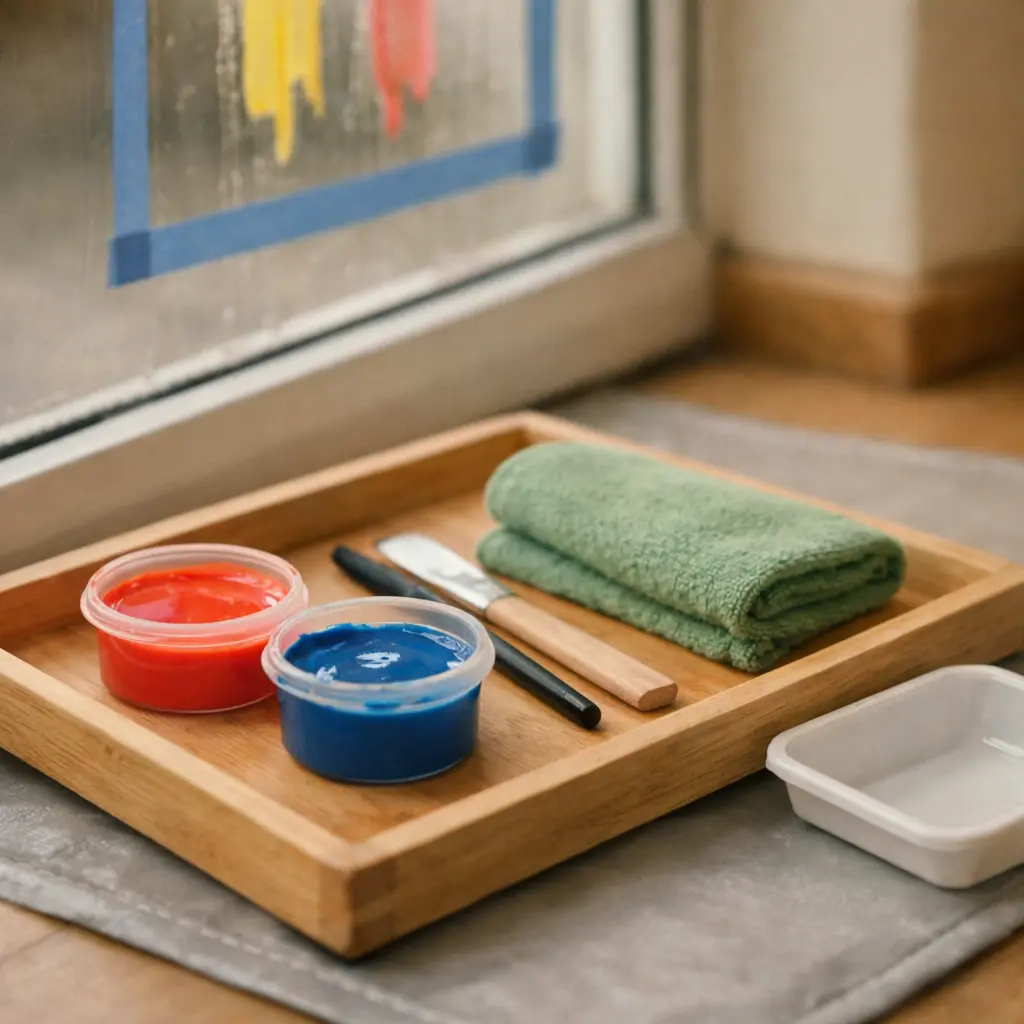
Limit the setup to a single low window panel or a section taped with low-tack painter’s tape and place one shallow tray holding two small paint pots (max two contrasting colours) and two brush types (one thin, one flat). Provide a single microfibre cloth and a small wipe-clean mat within reach so children manage their own clean-up. Remove extra sponges and tools so the clear goal—controlled vertical mark-making and layering on a defined glass area—is obvious and reachable without adult rearrangement.
Show the routine once: a slow, silent demonstration of holding the brush, making a vertical stroke, and wiping a small area, then step back and limit words to brief safety reminders only. Do not prompt during play; instead observe for repetition, steadiness of shoulder-led strokes, deliberate layering or self-correction when marks drip or misalign, and signs of focused engagement or withdrawal to decide when to offer minimal help.
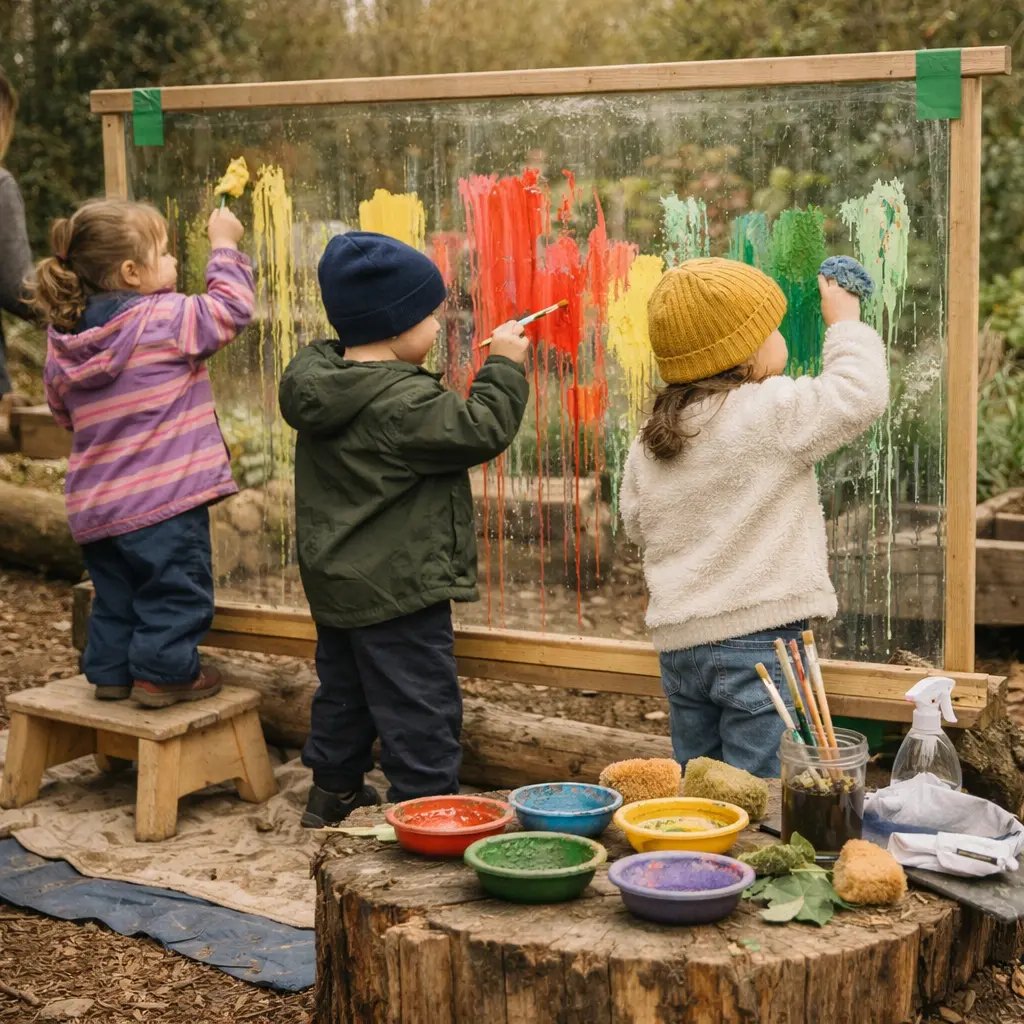
In an outdoor or nature-integrated space, set the activity against a sheltered window, greenhouse pane or a clear sheet fixed to a low frame near grass and planted beds so light and weather add variation. Materials are arranged on a tree stump or low table: washable poster paint in shallow pots, wooden-handled brushes, natural sea sponges or cloths, low-tack tape and towels; leaves or safe twigs are available for stamping or mark-making alongside brushes to keep exploration open-ended and tactile.
The adult observes from nearby, checks anchors and the step stool, tops up water and manages spray/wipe needs but avoids step-by-step instruction, offering brief, responsive prompts or single words when asked. Children choose tools, heights and locations, experiment with vertical strokes, layering and drips, return to change marks and use gestures or words to describe what they notice while the adult quietly supervises and intervenes only to maintain safety.
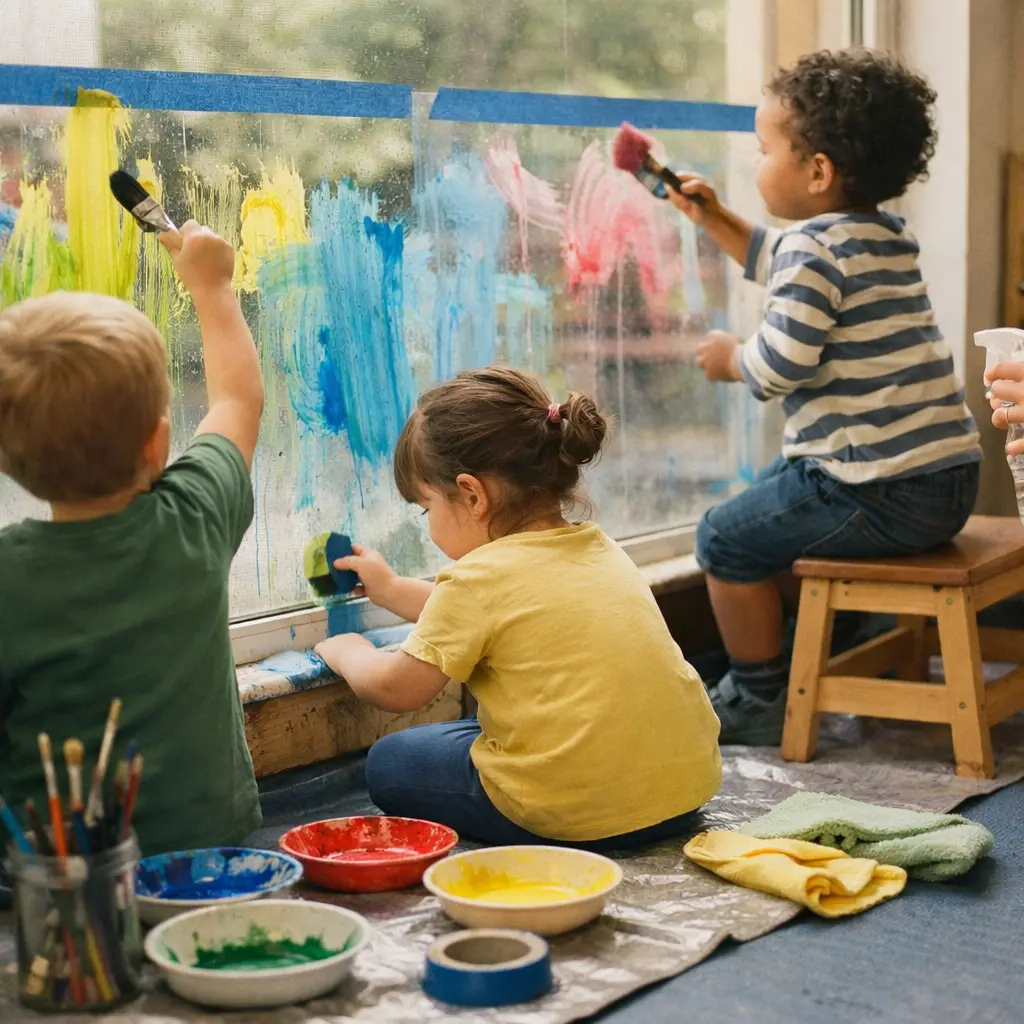
Ethos adaptation: Set the window as an open studio strip at child height with floor protection down and paint pots spaced so children can approach from different points. Offer brushes of two–three sizes, foam brushes, small sponges, painter’s tape, and accessible microfibre cloths without preset examples. Keep a stable, supervised step stool nearby so higher zones are reachable. Paint is pre-mixed with washing-up liquid; the spray bottle stays with the adult, visible and available when requested, so water and drips can become part of the exploration.
The adult watches first, positioning language as noticing: “I can see long strokes up high,” “You’re wiping away the blue to make space,” “What happens if I mist this area?” The child may layer, smear with hands or tools, tape to block or frame, wipe to reveal light, or return to a previous patch. The adult documents brief moments of grip changes, shoulder reach, repeated patterns, colour words, gesturing for turns with tools, and comments about light through colour.
Steiner (Waldorf) Adaptation
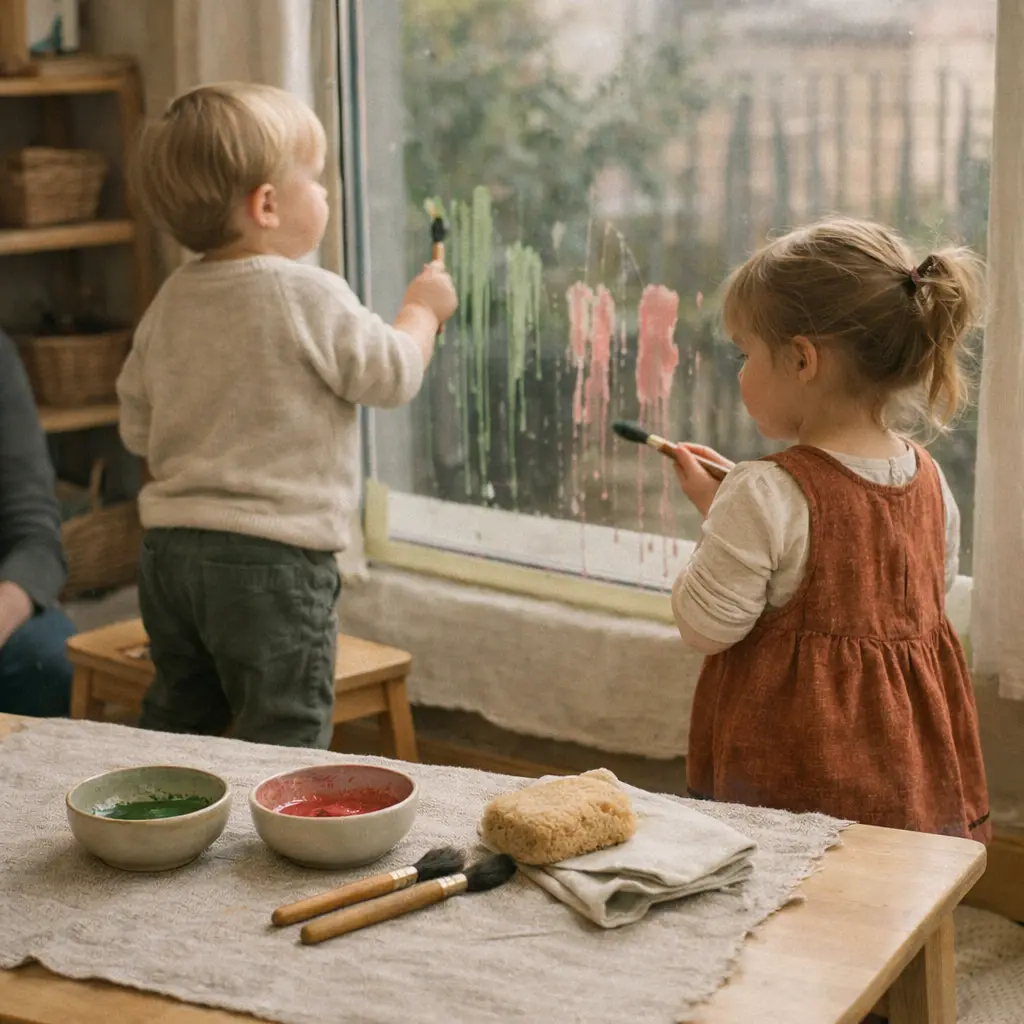
A small, defined painting area is prepared on the lower window with a neutral cloth at the base and low-tack painter’s tape marking edges to keep the workspace contained and calm. Only two muted pots of natural pigment mixed with water and a drop of plant-based soap are offered, alongside a few wooden-handled brushes with natural bristles and a wool or cotton sponge; microfibre cloths and a wipe-clean mat remain for safety. Floor and step stool are placed for stable access; bright or plastic materials are removed.
The adult demonstrates a single, calm vertical stroke on the glass and then moves to observe, using minimal language and modelling rather than instruction. The child returns to repeated strokes, dabbing and watching drips, choosing pacing and layering without a fixed outcome; the adult stays nearby to support access, refill natural paints, or intervene only for safety, noting shoulder reach, hand control and descriptive language that arises during the activity.