Navigating a DIY outdoor obstacle course using garden and household equipment (0–4 years)
Problem solving
The adult draws a chalk line on the patio edge and sets a low crate a few steps away, with a plank resting close to the ground. Two children stand behind the line, watching another child push a tyre along the grass. The adult says, “Tyre stays in this lane,” and walks alongside without holding it. A child steps onto the plank, arms out, then steps off and looks back at the hoops. The adult crouches near the chair tunnel and taps the ground underneath, waiting as the child decides whether to crawl through.
Children explore a DIY obstacle course made from familiar household and garden items, choosing how to move through each challenge. The course offers repeated chances to try, pause, change direction, and attempt a different approach. It can be revisited across days so children notice what feels easier, harder, or more interesting over time.
Step-by-Step Guidance
1. Walk the outdoor area and choose a flat route with clear edges (fence line, wall, or chalk boundary) so children can see where the course begins and ends.
2. Place a clear start point and a waiting spot a few steps back from the first obstacle to reduce crowding.
3. Set up 3–6 stations using what you have, keeping heights low: hoops for stepping/jumping; chairs for crawling under; a tyre or sturdy box for pushing; a low crate/plank line for balancing; a short open space for a run or careful walk; optional pillowcase sacks placed to one side for older children.
4. Check each item for stability: chairs on flat ground, crates not stacked, plank secured so it cannot roll, tyre route away from people’s legs.
5. Introduce the course with a brief walk-through. Name each station with simple action words (step, crawl, push, balance) and show one safe way to try it.
6. Invite children to choose where to start. Allow them to skip stations, repeat favourites, or change the order.
7. Stay near the highest-risk point (often balancing or tyre pushing). Offer a hand only when needed, then release as soon as the child regains control.
8. Use short, in-the-moment language that matches what the child is doing: “slow feet”, “hands on the ground”, “wait behind the line”, “one at a time under the chair”.
9. Adjust the course as you observe: widen hoop spacing, lower the balance line, shorten the push distance, or remove the sack race if it causes falls or collisions.
10. End with a calm finish point. Offer a drink/rest, then invite children to help return items to a safe storage spot.
Learning Objectives
Physical Development: children may practise balance, coordination, core strength, and controlled movement as they climb, crawl, jump, push, and step. Personal, Social and Emotional Development (PSED): children may build confidence through trying again, managing small frustrations, and taking turns in shared space. Communication and Language: children may use simple words and gestures to plan routes, ask for help, and describe what their bodies are doing.
Adult Role
Stay emotionally attuned by noticing when a child looks unsure, over-excited, or frustrated, and respond with calm presence and simple reassurance. Model language that helps children organise their bodies and negotiate space, using short phrases linked to action (for example, “your turn after Sam”, “feet on the plank”, “stop and look”). Scaffold only when it increases safety or helps a child re-enter play, such as steadying a chair briefly or offering a hand for the first step, then step back to allow the child to lead. Observe how children choose challenge, manage waiting, and adapt their movements, and use what you notice to make small changes to spacing, height, and flow. Hold responsibility for safety by checking stability, managing turn-taking at pinch points, and positioning yourself where you can intervene quickly.
Observation Cues
Does the child choose the same section repeatedly, or seek a new challenge after success?; Notice how the child adjusts speed and body position when balancing (arms out, slower steps, looking down then ahead).; Listen for self-talk or planning language such as “I’m going under”, “watch me”, “my turn”, “too wobbly”.; Watch for problem-solving moves: moving an item, changing direction, asking an adult to hold something steady, or choosing a different route.; Notice turn-taking and spacing: waiting, following closely, or creating distance for safety.; Observe stamina and recovery: short bursts, pauses to rest, and returning to the course.
Time & Space
15–40 minutes, depending on how often children repeat sections and whether the course is adjusted during play.
Outdoor area with a clear route (garden, yard, playground strip) and enough width for children to pass safely and for a separate waiting spot.
Materials
Safety
Age adaptations
Budding Adventurers
Add choice and small problem-solving moments: two hoop paths (close or wider spacing), a longer push route, and a balance section with a “step off and try again” point. Introduce pillowcase sacks only as an optional side station with plenty of space and adult nearby, focusing on stepping in and out safely rather than racing. The adult supports children to notice space and speed (“slow down near the plank”), and helps them negotiate turns when they want to follow a friend closely.
Curious Investigators
Offer 5–6 stations and invite children to help decide the order, such as moving hoops to make “big jumps” or “tiny steps”. Add a simple rule that children can choose, like “touch the cone at the end” or “balance to the chalk star”, while keeping the route flexible. The adult listens for children’s plans and theories (“it’s easier if I go sideways”), reflects them back, and supports safe peer collaboration such as holding a chair steady for a friend under close supervision.
Confident Discoverers
Include more complex sequencing and self-management: a start/finish line, a waiting marker, and an optional timing element for children who request it. Add a controlled challenge such as weaving around chairs before balancing, or pushing the tyre to a target zone without knocking cones. The adult steps back further, intervening mainly for spacing and risk points, and uses language that supports reflection (“what did you change that time?”) without directing a single ‘right’ method.
EYFS Links
Physical Development: the course offers varied whole-body movements (crawling, balancing, jumping, pushing) that children can repeat and refine at their own pace, supporting coordination and strength through real movement challenges. PSED: children often meet manageable difficulty, practise waiting and turn-taking, and experience pride or disappointment in a shared space, with the adult helping them regulate and try again. Communication and Language: children may use action words, negotiate turns, and describe routes and body positions, with the adult modelling clear, safety-focused language linked to what is happening.
Ethos adaptations

Select and reduce the course to three clear challenges that target balance and controlled movement (for example: a short low plank, two hoops in a line for stepping, and a low crawl-under). Place them in a single, tidy sequence on flat ground with a marked start, a defined waiting spot and a small tray holding only the items needed (cones, one timer if used). Lower heights and one child’s pathway make success and errors visible so children can see and repeat the same movement without extra distractions.
Show the whole sequence once with a slow, quiet demonstration: walk the route, step in the hoops, crawl under the chair, and stop at the waiting spot. Then step back to the side, use only brief safety phrases, and avoid coaching or questioning. Observe whether the child repeats attempts, adjusts step width or speed, keeps balance without help, and manages waiting or turn-taking; note precision and persistence rather than giving instructions.
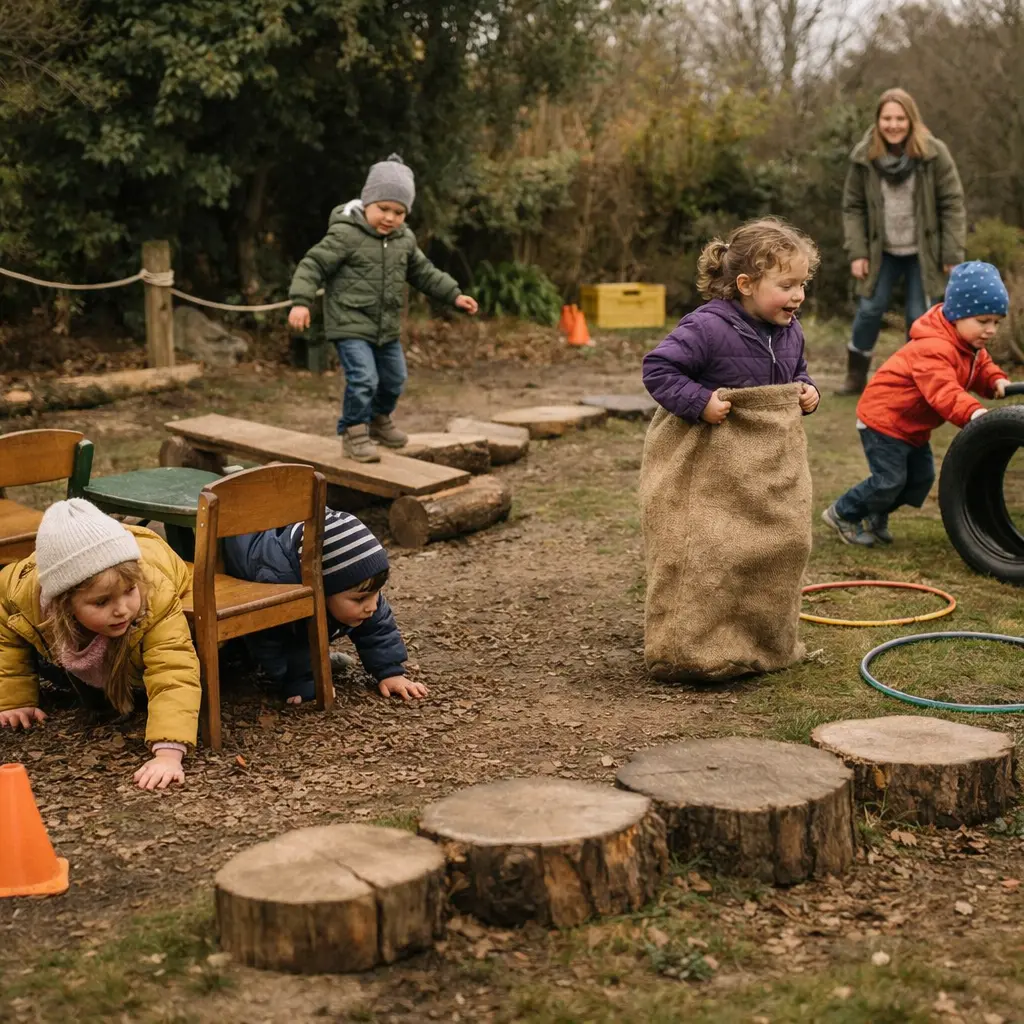
In an outdoor or nature-integrated space such as a garden patch, grassy slope or paved yard with nearby planting, the course uses natural and real materials: low logs or planks for balancing, flat stepping stones or bark pieces in place of plastic markers, tyres or a sturdy box for rolling/pushing, and hoops or chalk rings arranged among leaves and uneven surfaces. Materials are arranged openly to allow multiple lines of travel, slight slopes and soft landing zones are kept, and items remain imperfect and moveable so children can reconfigure challenges.
The adult observes from a short distance, checks stability and models safe handling of heavier items, then steps back to offer minimal, responsive prompts or single-word cues only when needed. Children choose routes, test different approaches, take turns and pause or repeat sections at their own pace; children may negotiate roles, use action words or gestures to plan and ask for help, and explore balance, climbing and pushing with the adult available to manage risk and support regulation.
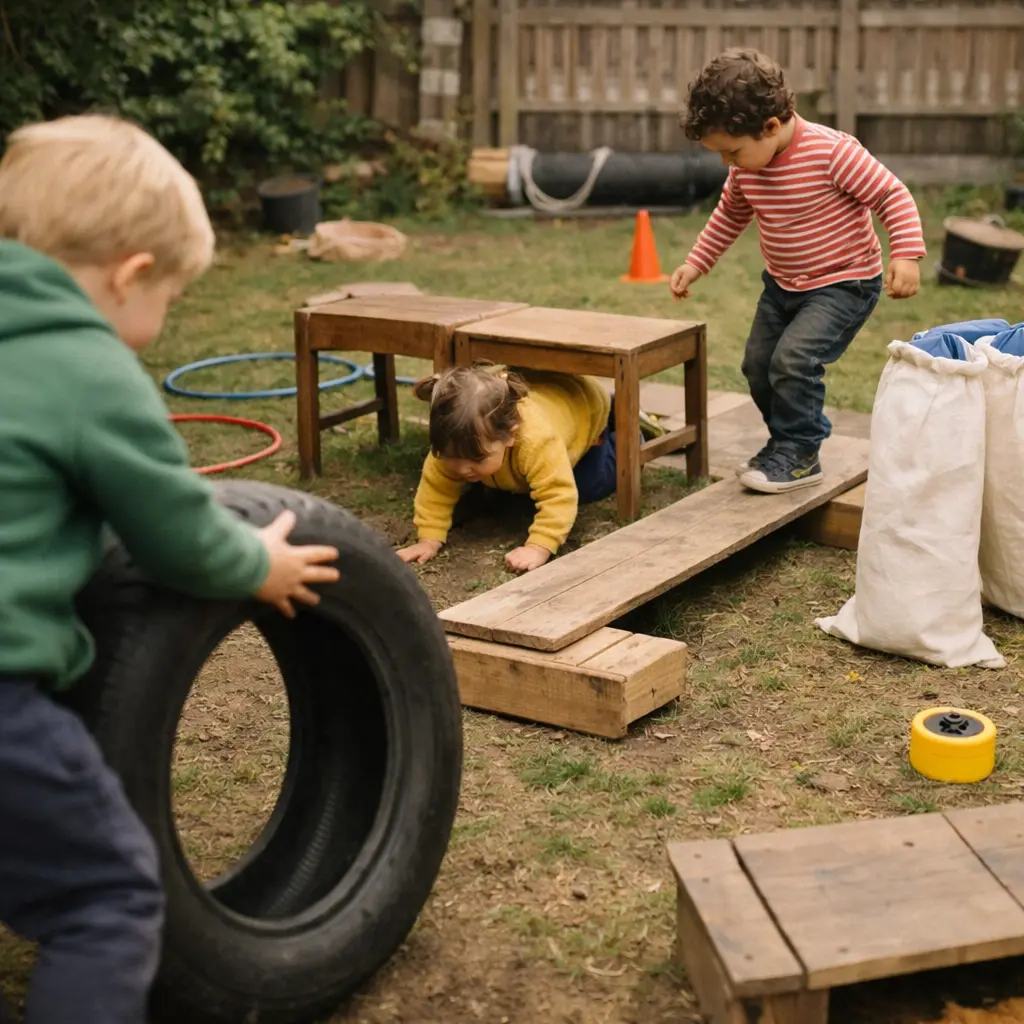
Ethos adaptation: Arrange the outdoor area as a sequence of accessible invitations rather than a fixed track — hoops, crates, tyres and pillowcases sit in visible clusters with clear gaps for choice, and start/finish markers are minimal to avoid a single route. Substitute any single-use props with loose parts (wooden planks, crates, fabric, stones) so pieces can be moved, combined, stacked or left aside. Keep balancing elements low and repeatable so the space invites return visits and changing strategies.
The adult steps back as observer and co-researcher, using commentary like "I can see you’re testing the plank" or "You’re trying a new route" and open prompts such as "What happens if you move the tyre here?" The child may change direction, pause, repeat actions or enlist peers to build new challenges; the adult notices shifts in balance, cooperation, language and persistence and records these moments naturally during play rather than directing tasks.

Create a calm, uncluttered outdoor course with a predictable flow: a clear start space, a short path, and a quiet finish with a folded cloth as a rest spot. Offer only a small number of natural, sturdy items, such as a wooden plank set very low for balancing and a single tyre for pushing, with any optional sack material kept to one side rather than built into the route. The adult chooses to keep the same layout for repeated runs, and removes extra cones, toys, and bright equipment so the space stays simple.
The adult demonstrates the movements quietly and steadily, then becomes still and available rather than talking through the course. The adult chooses a small set of consistent words used each time (“step”, “under”, “push”, “wait”), steps in only to steady equipment or slow the flow when children bunch up, and returns to the same tidy-up routine at the end. The adult watches for overexcitement, fatigue, or rough handling of the tyre, and responds by pausing the action, modelling a slower movement again, or shortening the route so children can return to steady, repeated attempts.