Transferring water between containers using trays, funnels and floating items for summer water play
Summer
Children explore moving water between containers using a small set of tools such as scoops, funnels and short pipes, with floating items adding interest and purpose. Adults notice how children compare full and empty, adjust their grip and pouring speed, and use words like more and less. The set-up supports repeated attempts and small problem-solving moments, with the adult keeping the space calm, shared and safe.
Children explore moving water between containers using a small set of open-ended tools. The experience invites repeated filling, pouring, tipping and scooping, with opportunities to notice what changes when container size and shape change. Floating items add a reason to transfer water and a chance to compare what stays on top and what moves with the flow. Adults can support children to take turns, persist with tricky pours, and use simple mathematical language linked to volume.
Step-by-Step Guidance
1. Prepare the space: place the water tray on a stable, low surface or on the floor with a non-slip mat underneath. Keep a towel within reach and limit the water depth to a shallow level.
2. Arrange materials with intention: set out a small number of containers with clearly different capacities and openings. Place funnels and scoops beside the tray, and add a few floating items into the water.
3. Introduce the invitation: bring children to the area and name what is available in simple terms (water, containers, scoop, funnel, pipe). Offer one brief demonstration of transferring water without explaining every option.
4. Support child-led exploration: allow children to choose tools and repeat actions. If a child is unsure, offer a single scaffold such as holding a container steady, moving a funnel closer, or suggesting a slower pour.
5. Weave in mathematical language: comment on what you can see using volume words (full, empty, more, less, nearly). Keep language tied to the child’s action rather than quizzing.
6. Add a gentle challenge when useful: introduce a second container for comparison, or place a floating item in a target container so children have a reason to transfer water. Keep challenges optional.
7. Manage turn-taking and space: if the area becomes crowded, create a simple boundary (two children at the tray) and offer a waiting job such as choosing the next floating item.
8. Close the activity: give a clear end point, support children to place tools back in a basket, and involve them in wiping the surface and drying hands.
Learning Objectives
Children may strengthen hand and arm control through scooping, pouring and carrying, supporting Physical Development. Children may begin to use and understand early mathematical ideas such as more, less, full, empty and nearly, within Mathematics. Children may build confidence to try different ways of transferring water and to communicate what they notice, supporting Communication and Language.
Adult Role
Stay emotionally attuned by noticing children’s comfort with splashes, waiting, and sharing tools, and by offering calm reassurance when spills happen. Model language that matches what children are doing, using short phrases such as more/less, full/empty, heavy/light, and naming tools and actions like pour, tip, scoop, float. Scaffold only when it helps a child continue independently, for example by steadying a container briefly or reducing the number of tools, and step back when a child is repeating and refining their own method. Observe in the moment for grip, two-handed control, persistence, and emerging comparisons between containers, and use these observations to decide whether to simplify, extend, or pause. Hold responsibility for safe use of water and equipment by positioning yourself to see hands and mouths, managing numbers at the tray, and removing any item that becomes unsafe or misused.
Observation Cues
Chooses different tools for the same job (scoop, funnel, container) and changes approach when it spills.
Uses or responds to words such as full, empty, more, less, heavy, light, big, small.
Shows increasing control when pouring (slower tip, closer aim, two hands).
Compares containers by looking, lining up, or filling to the top.
Notices floating items and adjusts water movement to make them travel or stay put.
Time & Space
15–40 minutes, depending on interest and how often the area is reset.
Indoor or outdoor area with a wipeable floor/surface and space for 2–4 children to stand or sit around a low tray without crowding.
Materials
Safety
Age adaptations
Budding Adventurers
Add a second scoop size and introduce a short piece of guttering pipe with smooth edges for experimenting with direction and flow. Provide three containers with clearly different capacities so children can compare by filling and emptying. Support children to try pouring from different heights and angles with control, and to notice what happens to floating items when water moves faster or slower. Use language such as nearly full, half, heavier, lighter, and invite children to show you which container holds more without turning it into a test.
Curious Investigators
Offer a small “transfer station” with a tray, 3–5 containers, two funnels, and two guttering pieces that can be positioned at different slopes using stable supports. Include a small basket of floating items so children can choose what to move and compare. Encourage children to plan where water should go and to adjust when it overflows, supporting problem-solving and cooperative play. Extend mathematical talk with capacity comparisons, using phrases like holds more/holds less, same, and not yet full, and encourage children to describe what they notice about container shape and speed of flow.
Confident Discoverers
Introduce a simple capacity comparison focus by adding two similar-looking containers with different capacities and one container with measurement marks if available. Provide enough tools for small-group collaboration (e.g., two scoops, two funnels) and invite children to agree roles such as pourer, holder, and collector, changing roles as they choose. Encourage children to make predictions about which container will be fuller and to check by filling to a line or to the brim, keeping it playful and optional. Use richer vocabulary such as volume, overflow, equal, and estimate, and support children to tidy and reset the area with increasing independence.
EYFS Links
Physical Development: Children can practise controlled movements through scooping, pouring, tipping and stabilising containers, which supports hand and arm strength and coordination.
Mathematics: Children may explore early capacity ideas by noticing full/empty, more/less, and comparing how much different containers hold through repeated filling and emptying.
Communication and Language: Adults can model clear words for actions and quantities, supporting children to understand and use vocabulary linked to what they can see and do.
Personal, Social and Emotional Development: Shared tools and limited space can support turn-taking, negotiating, and managing small frustrations when water spills or tools are in use.
Ethos adaptations
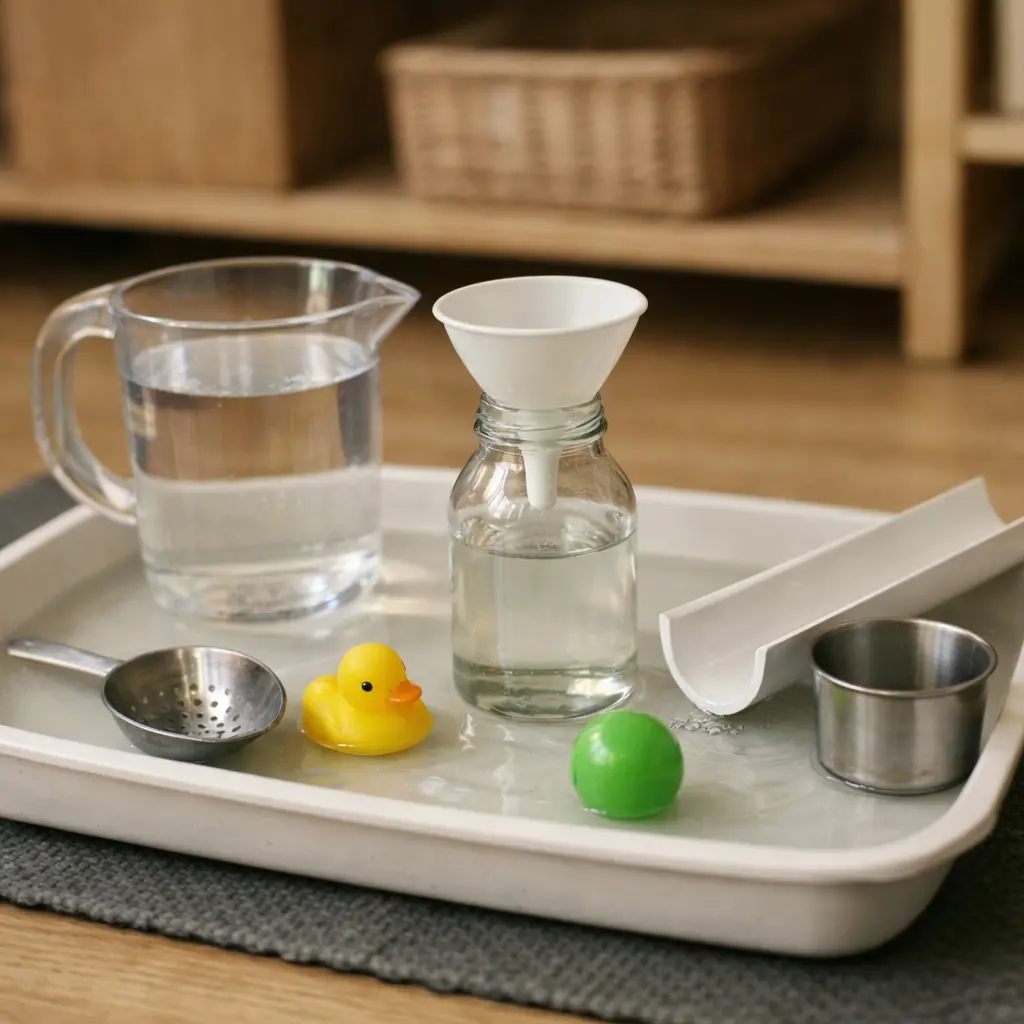
Place one shallow tray on the non-slip mat at child height with a single jug as the water source, one wide-mouthed bottle as the receiver, and one cup, arranged left to right. Offer one funnel that fits the bottle, one scoop, one short piece of guttering angled into the cup, and two floating items. Keep all other tools out of sight. Spillage into the tray and water reaching the bottle’s rim act as self-correction; the funnel’s fit and whether the float moves make outcomes visible.
Offer a brief, slow demonstration once: scoop from jug, pour through funnel into bottle to near the rim, tip via guttering into cup to move one float, then return each tool to its spot. Use a single label, full/empty, then work silently; step to the side and avoid prompts or questions. Intervene only for safety or turn-taking, using a light touch. Observe grip and wrist control, matching funnel to bottle, steady pacing, visible self-correction, and spontaneous use of more/less or full/empty.
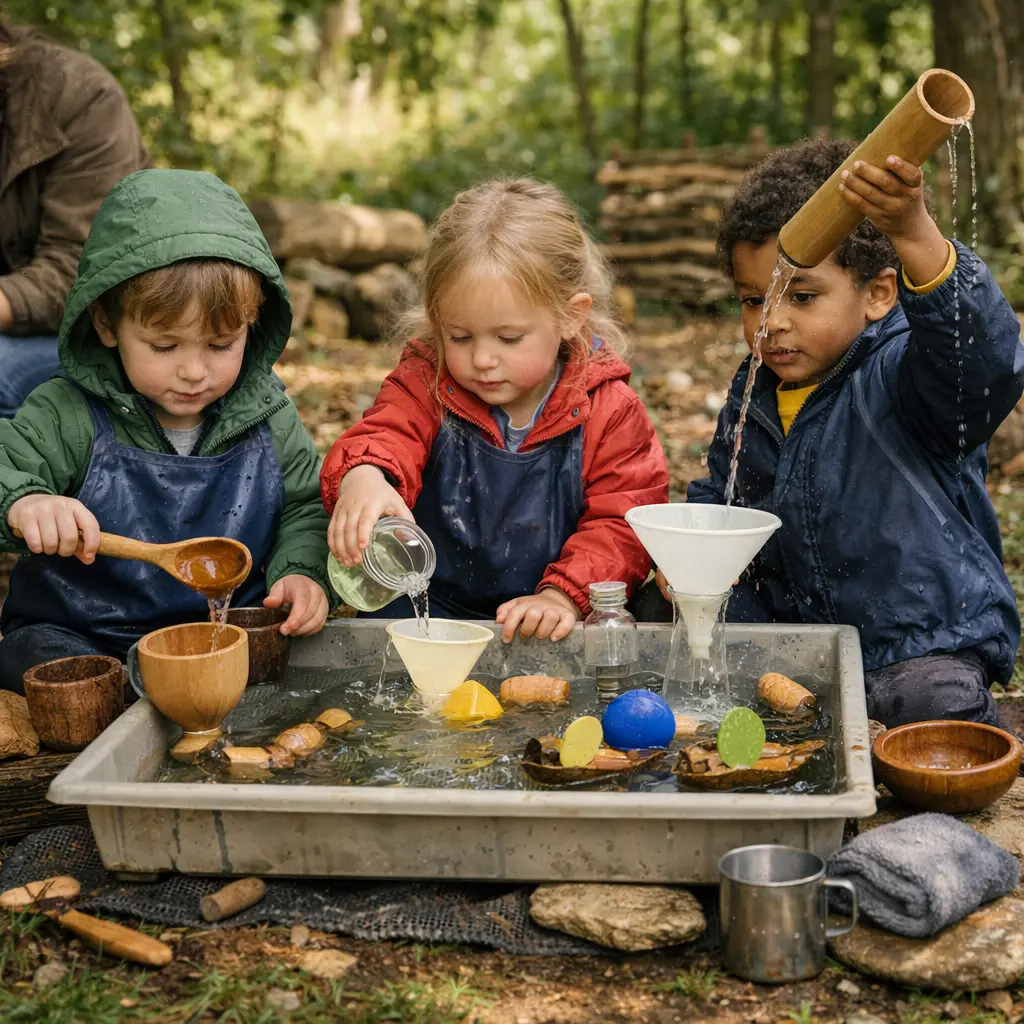
In an outdoor or nature-integrated space, move the low water tray to a sheltered patch of grass, a firm paved area, or a raised stump so surfaces are varied and slightly uneven; shallow trays sit on stones or a low bench rather than a table. Materials are arranged as real, open-ended natural alternatives: wooden ladles and bark cups, hollowed bamboo or smooth guttering lengths, corks, pinecones and bark boats for floating, and a few smooth stones to weigh down funnels. Children may collect nearby leaves or small sticks to add to their experiments.
The adult observes from close by, checking stability and modelling calm handling of wet items, then steps back to offer minimal, responsive prompts such as single words or short questions. Materials are arranged so children choose tools, roles and pacing, practising scooping, pouring and carrying with repeated tries. Children may compare more/less, full/empty aloud as they test different containers, negotiate turns and explore slightly risky choices like balancing and pouring from height while supervised.
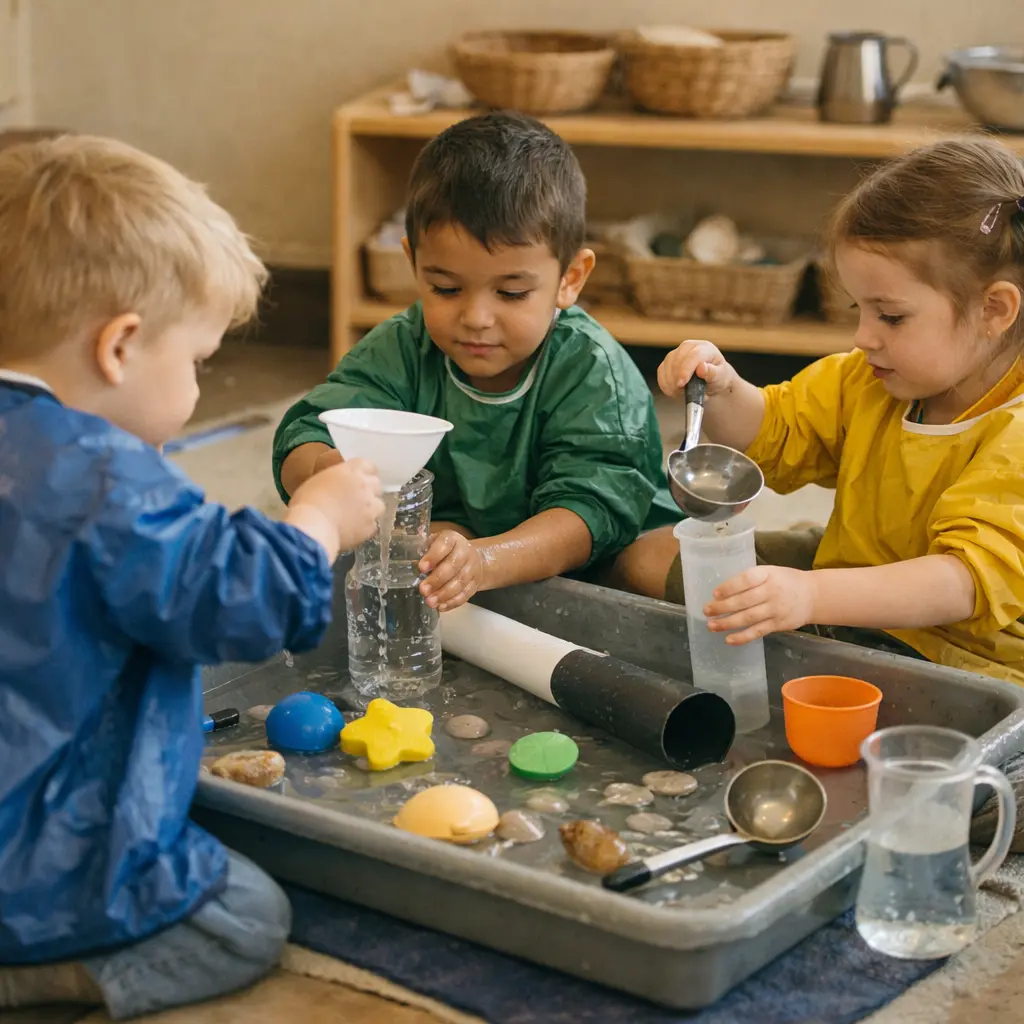
Set the tray on a low, stable surface with several work points spaced so more than one child can approach; arrange containers, funnels, tubing, scoops and floating items openly on a low shelf or tray so the child may choose tools and combine loose parts (stones, shells, fabric scraps if available) in different ways. Remove any single-use kits and keep water level low for safety; materials invite repeated filling, tipping, joining pipes or resting floats rather than a single finished task.
The adult stays back as observer and co-researcher, using commentary such as "I can see the water moving faster" or "You’re trying a smaller funnel now" and occasional prompts like "What happens if you tip it this way?" rather than instructions. The child may explore routes, create channels, test volume and negotiate turns; embedded observation cues include changes in grip and posture, strategies for stabilising containers, language about more/less, and moments of cooperative problem-solving.
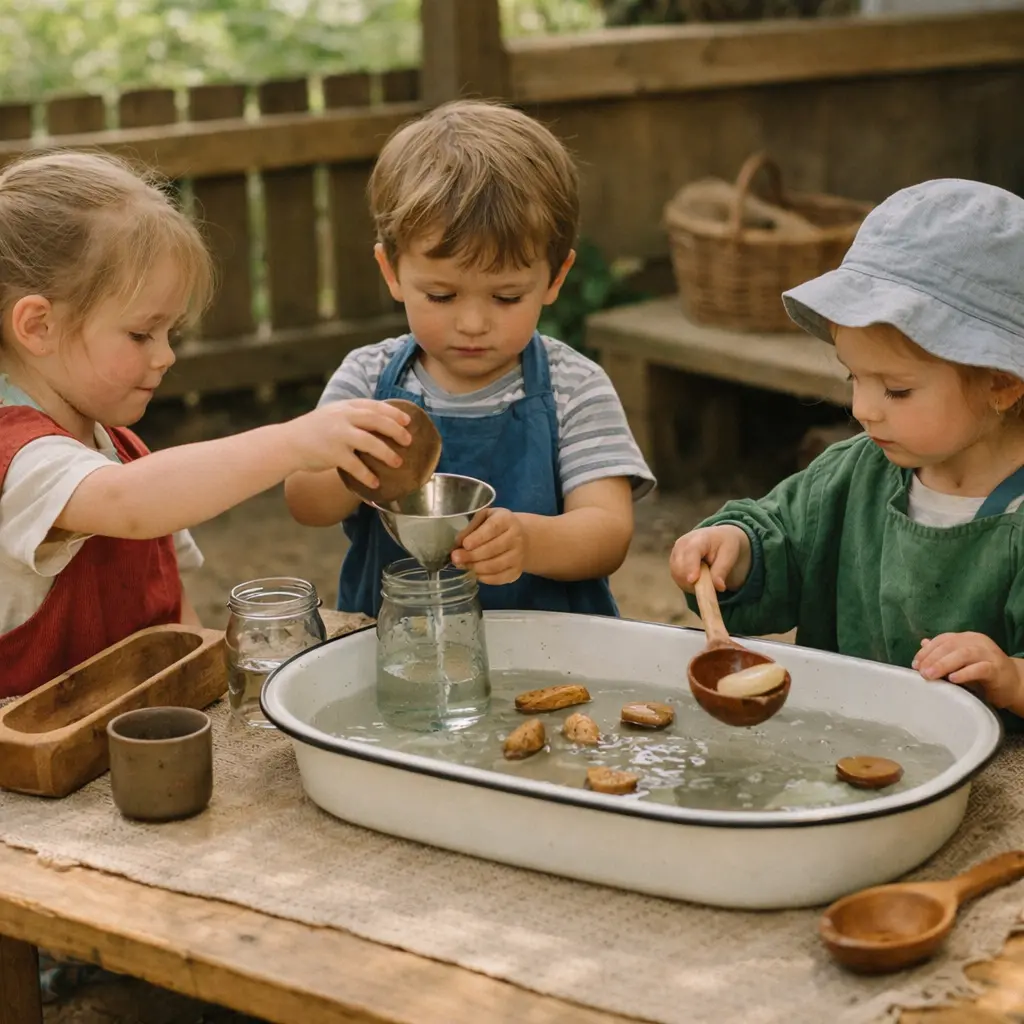
A calm corner is prepared with a low enamel basin on a stable table, set on a woven cotton towel to define the space and catch drips; shade is provided outdoors or near a window. Only a small number of items are provided: two or three glass jars or stoneware cups of differing shapes, one metal funnel, a short wooden or bamboo channel, and one small and one larger wooden ladle. Floating items are natural and simple, such as corks, walnut shells and small smooth wooden discs.
The adult demonstrates a single slow pour, showing how to steady a jar and hold the funnel, then steps back, remaining close and quiet. Language is minimal and observational, used sparingly in the moment (full, empty, almost, more, less) while supporting safe handling and shared use of tools. The child returns to scooping, tipping and carrying at their own pace, repeating sequences to compare how water moves and what floats. The session ends with an unhurried tidy: water poured onto plants, tools dried, cloth folded.